Guyana’s worsening garbage problem is not simply a matter of public behaviour or municipal inefficiency—it reflects deeper structural failures tied to policy decisions, chronic underfunding of local authorities, and weak environmental enforcement over decades.
Available data and reports point to a long-standing pattern: local government bodies, legally responsible for waste collection and sanitation, have been constrained by limited financial autonomy and inadequate subventions from central government. A United Nations–linked assessment found that municipal solid waste management in Guyana has suffered from “years of under-funding and public neglect,” resulting in garbage accumulation, clogged drains, and untreated waste entering waterways.
Local Authorities Starved of Resources
Neighbourhood Democratic Councils (NDCs) and municipalities often operate with fragile revenue bases, heavily dependent on rates and taxes that are difficult to collect. For instance, the 2026 fiscal year, the Georgetown Mayor and City Council (M&CC) has proposed a budget with projected revenue of G$4.41 billion. However, in 2025, the council recorded a significant shortfall, collecting only about G$1.8 billion to G$1.9 billion—well below its projected target.
In some communities, over 50% of local revenues are consumed by waste management alone, leaving little room for expansion, modernisation, or infrastructure upgrades.
This imbalance has several consequences:
- Limited capacity to purchase equipment such as garbage trucks and bins
- Inability to expand collection networks in growing communities
- Heavy reliance on private contractors, often at high cost
- Deferred maintenance of drainage and sanitation systems
Even Central Government statements acknowledge dysfunction at the municipal level, including demoralised staff, weak systems, and operational inefficiencies.
Critically, without sustained fiscal transfers or reforms to empower local government financing, these bodies remain structurally incapable of managing increasing waste volumes in a rapidly growing economy.
Visible Impact: Garbage, Flooding and Public Health
The consequences are evident across Guyana, particularly in coastal urban areas like Georgetown. Garbage routinely accumulates in streets and drainage systems, contributing directly to flooding. During major flood events, including the 2005 disaster, clogged canals filled with garbage prevented water from draining, worsening the crisis.
Outside the capital, towns such as Corriverton also face persistent waste disposal issues, with garbage blocking drainage and increasing flood risks.
Irregular garbage collection in some communities forces residents to resort to burning waste or illegal dumping, further compounding environmental and health risks.
Policy Contradictions and Centralised Control
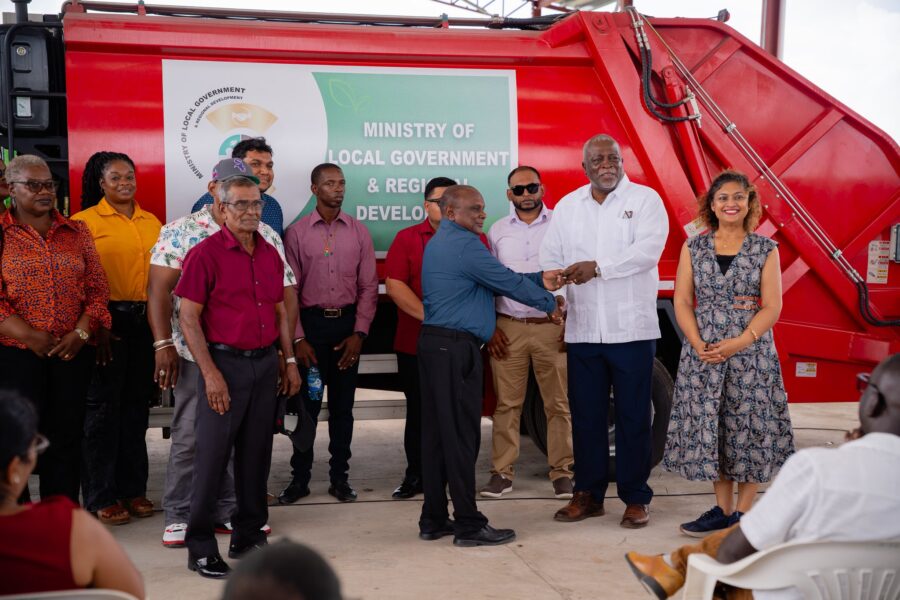
While the People’s Progressive Party (PPP) government has periodically announced initiatives—such as distributing garbage trucks or proposing solid waste legislation—these interventions have often been episodic, political/public relations stunt rather than systemic and even-handed.
Observers argue that central government has:
- Retained significant control over resources while expecting local authorities to deliver services
- Failed to provide predictable, adequate subventions
- Intervened administratively in local government rather than strengthening institutional capacity
This has created a cycle where municipalities are blamed for poor performance but lack the financial and administrative tools to improve.
Guyana is internationally recognised for its forest conservation efforts and has committed to global climate goals under the Paris Agreement. However, waste management remains a glaring domestic gap in environmental governance.
Poor solid waste systems contribute to:
- Water pollution from untreated waste discharge
- Methane emissions from unmanaged landfill and organic waste
- Marine pollution affecting coastal ecosystems
The continued dumping of untreated sewage and industrial waste into rivers—highlighted in earlier environmental studies—underscores weak enforcement of environmental protections.
These shortcomings sit uneasily alongside Guyana’s global environmental positioning, raising questions about the consistency of its climate commitments at the local level.
A Structural Problem, Not Just a Civic One
Government messaging has increasingly focused on citizen responsibility, including anti-litter campaigns and enforcement measures.
While public behaviour is a factor, experts stress that:
- Waste systems must be reliable before enforcement can be effective
- Infrastructure gaps cannot be solved through policing alone
- Sustainable solutions require investment, decentralisation, and accountability
Guyana’s garbage crisis is the product of long-term underinvestment, weak local governance frameworks, and inconsistent environmental policy implementation.
Without meaningful reform—particularly increased and predictable funding for local authorities, modern waste infrastructure, and stronger environmental enforcement—the problem is likely to worsen as the country’s population and economic activity continue to expand.