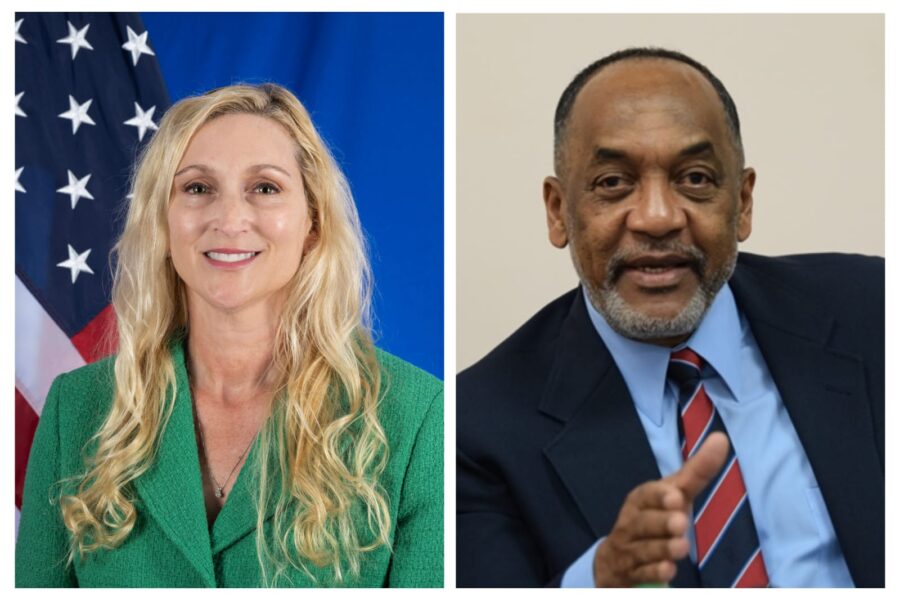
A sharp and escalating dispute has emerged over Guyana’s 2016 oil agreement, with United States Ambassador to Guyana Nicole Theriot warning against renegotiation, while former Environmental Protection Agency (EPA) Executive Director Dr. Vincent Adams has forcefully rejected her position as fundamentally flawed.
Speaking on the programme SOURCES, hosted by Svetlana Marshall, Ambassador Theriot cautioned that any move to revisit the contract with ExxonMobil would undermine investor confidence, describing it as “incredibly dangerous” and warning that it would send “a terrible signal to international investors… that you can’t trust what you’ve signed with a government that’s willing to renegotiate.” She added bluntly, “it’s a very bad idea.”
Theriot defended the arrangement, pointing to visible development outcomes and corporate investments linked to ExxonMobil’s presence. “I think it’s been incredibly beneficial to both sides… you will see signs… supported by ExxonMobil. They are doing incredible work all over this country,” she said, insisting that “there’s no doubt… Guyanese are benefiting… it’s been a win-win.”
“Absolute baloney!” Adams declared, arguing that both the contract and established legal principles allow for renegotiation. “Clause 32 of the contract says you could renegotiate if both parties agree,” he noted.
Clause 32 of the 2016 Production Sharing Agreement is known as the “stability clause”, and it significantly restricts Guyana’s ability to unilaterally change or renegotiate the contract.
- Article 32.1 states that the Government cannot “amend, modify… or require renegotiation” of the agreement without the prior written consent of the contractor (ExxonMobil and partners).
- Article 32.2 further prevents the Government from imposing new taxes, royalties, or financial burdens on the company after the agreement is signed.
- Article 32.3 requires that if any change in law negatively affects ExxonMobil’s economic benefits, the Government must take steps to restore those benefits, effectively shielding the company from adverse policy change
He further contended that the current administration has abandoned its earlier stance, recalling that “Bharrat Jagdeo and Irfaan Ali shouted from the roof top when in opposition that they will renegotiate ‘because the [APNU+AFC] government has sold out our patrimony and every Guyanese is sad whenever there is a discovery.’ One of the first things Ali said in an interview with Guyanese Critic… is that ‘yes, we will renegotiate the contract’.”
Adams also invoked international legal standards, stating, “there is a universal principle in contract law called ‘changed condition’ which more than applies to Guyana.”
Drawing from his time at the EPA, Adams pointed to concrete examples where Guyana successfully imposed changes outside the strict terms of the agreement. “We unilaterally went outside of the contract… by demanding and getting the parent company guarantee… by telling them that if not, they will not produce a barrel of oil,” he said. He added that authorities also secured “unfettered access up to and including unannounced visits” to offshore facilities, replacing earlier restrictive provisions.
Adams did not hold back in his criticism of the government, accusing it of failing to defend national interests and aligning too closely with the oil company. Referencing legal proceedings and a High Court ruling by Justice Sandil Kissoon, he said, “We all know what happened… the law suit that followed with the devastating ruling… just incredible!”
In his most pointed remarks, Adams argued that ExxonMobil is simply acting in its own interest, while the government is failing in its duty to the people. “It is not Exxon to be blamed… they are only performing their fiduciary responsibilities… while our govt is not performing their paramount responsibility to look after the best interest of its people.”
Justice Sandil Kissoon’s 2023 High Court ruling found that ExxonMobil’s Guyana operations were in breach of their environmental permit for failing to provide adequate financial guarantees for oil spill liabilities. He ordered the company to secure an unlimited parent company guarantee and full insurance coverage, while also ruling that the Environmental Protection Agency had failed in its duty to enforce compliance. The judge stressed that Exxon’s liability is uncapped, warning that the lack of safeguards posed serious risks to Guyana and its citizens.
Adams underscored his point by invoking the court’s own language, noting that Exxon’s actions have been enabled by what Justice Kissoon described as a “derelict, pliant and submissive” government.
The starkly opposing positions expose a deepening fault line in Guyana’s oil debate—between safeguarding investor confidence and aggressively pursuing what critics argue is a fairer share of the country’s vast oil wealth.