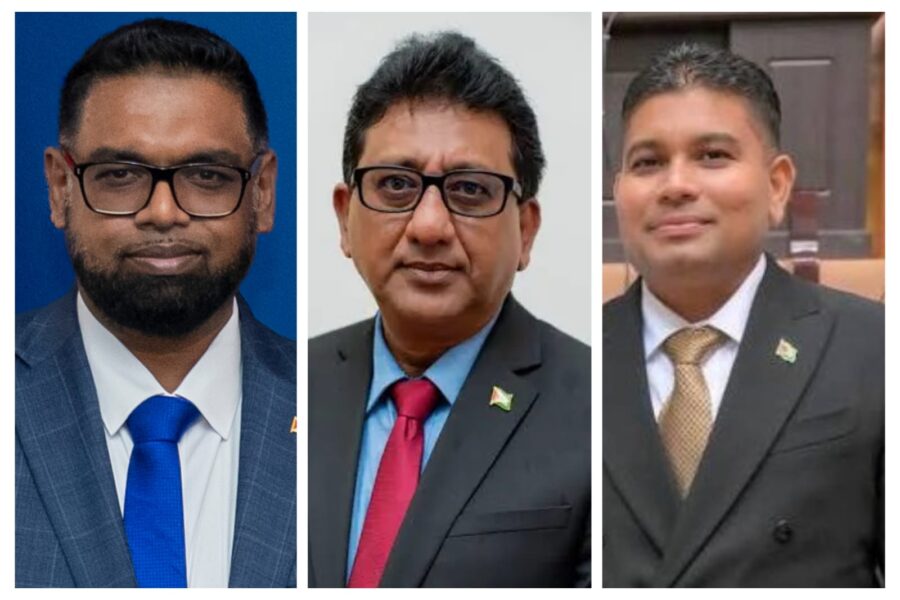
As the extradition proceedings involving the father-and-son Mohamed duo intensify, the Caribbean Court of Justice (CCJ) has intervened, granting an interim stay on Wednesday, March 25, that pauses the case in the local courts pending a full hearing of the appeal.
The United States is seeking the extradition of Azruddin Mohamed and his father Nazar “Shell” Mohamed based on a federal indictment alleging a large-scale gold smuggling, fraud, and money laundering scheme. U.S. prosecutors allege the pair exported more than 10,000 kilograms of gold using fraudulent declarations and evaded over US$50 million in taxes and royalties.
The CCJ’s ruling halts the ongoing committal proceedings before the Georgetown Magistrates’ Court and sets April 21, 2026 for the regional court to hear the matter, effectively fast-tracking the case at the highest judicial level.
Ahead of the hearing, Attorney General Anil Nandlall maintained that the State’s case against the Mohameds remained strong and that their appeal lacked merit. He indicated that the government would firmly oppose both the application for special leave and the substantive appeal, expressing confidence that “the appeal will not succeed” and had “no likelihood of success.”
Azruddin Mohamed, who is Leader of the Opposition, heads the We Invest In Nationhood (WIN) party, which holds 16 of the Opposition’s 29 seats in the 65-member National Assembly. The governing People’s Progressive Party (PPP) controls 36 seats.
Against this backdrop, social commentator GHK Lall is casting the case as a high-stakes political dilemma for the PPP, arguing that the outcome could reverberate far beyond the legal arena.
In an op-ed published in Village Voice News, Lall characterised the CCJ as the Mohameds’ final legal hurdle. “The father-son Mohamed team heads to the CCJ. It’s honoured as the apex court…Last Chance Chambers. Lose there, and it’s finished. Handcuffs time,” he wrote, suggesting that an adverse ruling would likely result in their transfer to the United States.
He framed the anticipated extradition as an extension of prior US engagement, stating it would involve “a continuation of the one that the US hosted in Barbados, and to which the PPP Govt thoughtfully gave its blessing,” while noting there would be “no unpleasant holdups at CBJ International Airport.”
Central to Lall’s commentary is a pointed question about the government’s true position. “Gut check: Do PPP leaders, both group and government, really want to see the backs of the Mohameds, have them out of their sights?” he asked.
Lall contended that the Mohameds may hold sensitive information with potential implications for senior officials. “They know some of what is in the heads of those two gentlemen…do they really want the Mohameds sharing deep, dark PPP secrets with members from some US Government posse?” he wrote.
He cited a series of past events and alleged links that, in his view, could come under renewed scrutiny, including “the manipulations surrounding the December 2018 parliamentary no confidence motion,” and “who had a hand in giving them a pass on various activities that were swept under the rug…before May 2015 and after late August 2020.”
Among other issues, Lall referenced “whose names featured in some way in the Curacao gold bust,” as well as individuals “instrumental in tax exemptions and vehicle tax (custom duties) arrangements,” adding that such matters may represent only a portion of what could surface.
While offering no evidence for these claims, Lall suggested that any disclosures could emerge in the context of cooperation with US authorities. “If the US could have done business with Panama’s Manuel Noriega, then why not others,” he wrote.
The op-ed also examined the reported relationship between the Mohameds and President Irfaan Ali, describing it as once close but now fractured. “It is widely known and accepted that the Mohameds enjoyed a special bond with Excellency Ali,” Lall stated, adding that the President may face “the biggest risk,” since “friends sharing that degree of intimacy have secrets for one another.”
Looking ahead, Lall argued that the PPP faces difficult consequences regardless of the outcome. “The PPP Govt has a problem. The Mohameds go and they are a big problem…How much will they spill?” he wrote, while cautioning that their remaining in Guyana could also complicate future political arrangements, including leadership transitions tied to constitutional term limits.
He further pointed to potential friction with international stakeholders, writing, “The stinker is that Mohamed the Younger swore on the Koran to deal with the Exxon contract,” suggesting this could present challenges for relations with US interests.
Lall concluded by raising the prospect of a negotiated resolution. “Something has to give. Some offer made that is unrefusable…Does the PPP of Ali, Jagdeo, Nandlall really want that?” he asked.
The developments at the CCJ, combined with the underlying U.S. case, the government’s stated position, and Lall’s commentary, underscore the growing intersection of legal proceedings and political scrutiny, as the extradition matter continues to unfold with significant implications for governance, parliamentary dynamics, and international relations.