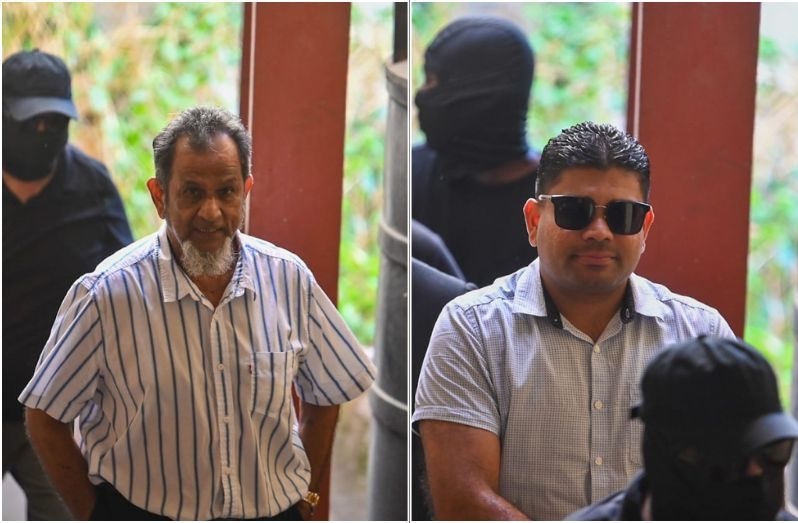
By Mark DaCosta- In a troubling development in the ongoing extradition proceedings involving U.S.-indicted businessmen Nazar Mohamed and his son Azruddin Mohamed, the Guyana Police Force was unable to produce key documentation during recent court hearings. Azruddin Mohamed, who is also the Leader of the Opposition and head of the We Invest in Nationhood (WIN) party—the country’s main opposition holding 16 seats in the National Assembly—remains before the court alongside his father. The absence of the requested records has raised serious questions about the enforcement of bail conditions and has further complicated the already contentious legal proceedings.
The proceedings on March 13 revealed that the Ruimveldt Police Station could not immediately produce the station diaries for January and February 2026, even as allegations suggest that the Mohameds may have breached their bail conditions by failing to report as required. With the business magnates out on bail set at GY$150,000 each, it was mandated that they check in at the police station weekly, specifically between 1 p.m. and 3 p.m. every Friday. However, it was alleged by the prosecution that there were multiple instances where this crucial condition was not adhered to.
During the hearing, special prosecutor Glenn Hanoman presented a compilation of alleged violations he had painstakingly tracked. Instances included both men reporting earlier than prescribed times and occasions where they arrived one or even two days late. Hanoman asserted that such discrepancies amounted to a “technical breach”, highlighting a worrying pattern. “It’s the pattern that shows that they feel as though they can report when they feel like and not strictly comply with the timelines set by the Court,” he declared, emphasising the importance of adherence to the stipulated reporting schedule as the extradition proceedings draw near to their conclusion.
Inspector Hinds of the Ruimveldt Police Station was instructed to supply the necessary documentation, yet he could only provide details concerning the reported entries for March 6, revealing that the younger Mohamed checked in at 10 a.m. followed by his father at 1:14 p.m. Alarmingly, when pressed for further details, Hinds cited a lack of available records as they were “currently locked up” by the station sergeant. This delay has left many questioning the overall integrity of the police force and its ability to uphold justice within our nation.
Magistrate Judy Latchman, in her attempts to bring clarity to this convoluted situation, insisted on reviewing the official station diaries to verify the prosecution’s claims. The importance of such documentation cannot be overstated, especially when dealing with high-profile cases that have captivated public attention. As Latchman noted, “I will definitely have to see the book. The court will have to see the books.” By expressing such diligence, she exemplified an essential commitment to ensuring that the rule of law is safeguarded.
In the midst of this procedural chaos, the case has raised wider concerns about the accountability and independence of the country’s law enforcement institutions. The inability of the Guyana Police Force to produce essential records in a timely manner casts a troubling shadow over its capacity to enforce the law fairly and without political interference. With high-profile figures at the centre of the matter, questions are also being raised about whether justice is being applied evenly or selectively.
The controversy is further deepened by the fact that U.S. authorities are seeking the Mohameds’ extradition on allegations of gold smuggling and money laundering, while some observers argue that the ruling People’s Progressive Party (PPP) cannot be viewed as an innocent bystander given the intense political rivalry between the government and the opposition forces now led by Azruddin Mohamed.
The inability to provide documentation demonstrates how critical lapses can fundamentally obstruct justice. This underbelly of procedural disarray only fuels suspicions of bias in the judicial system and leads the public to question whether the administration of justice is truly blind.
Despite the citizens of our nation looking towards their institutions to uphold the law fairly and without prejudice, the incidents surrounding this case only serve to illustrate systemic weaknesses that require immediate redress. As the court proceedings continue, one can only hope that transparency will prevail, allowing the truth to emerge from the shadows of bureaucratic failures.