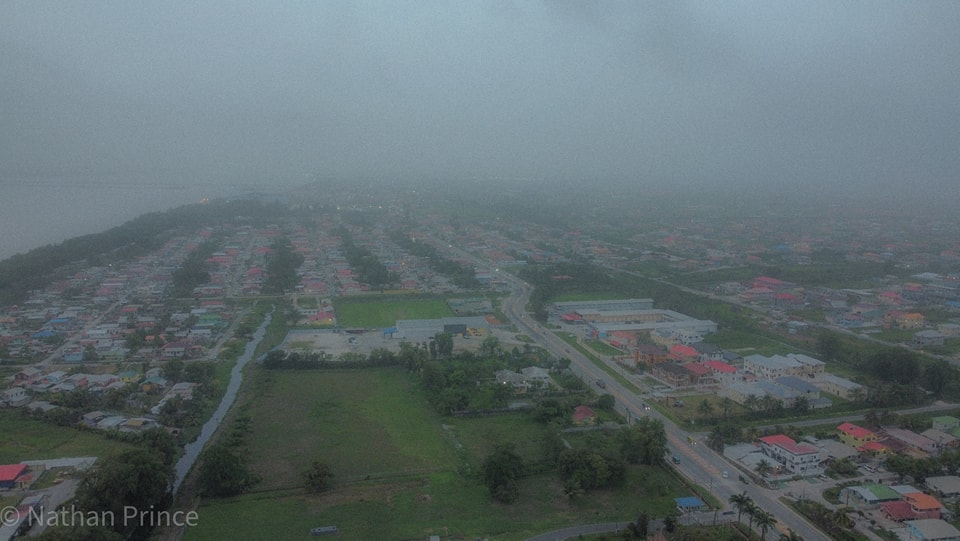
By Mark DaCosta- The Environmental Protection Agency has issued a stark warning about a Saharan dust plume sweeping across Guyana, bringing hazardous air quality and serious health risks. Vulnerable groups, including children, the elderly, and those with respiratory or cardiovascular conditions, face immediate danger.
The arrival of Saharan dust over our nation is not a distant meteorological curiosity; it is a direct assault on the health of our people. The Environmental Protection Agency has cautioned that poor air quality will persist, urging citizens to limit outdoor activity, wear protective masks, and remain indoors as much as possible. For many, these measures may seem inconvenient. For those living with asthma, Chronic Obstructive Pulmonary Disease (COPD), or cardiovascular conditions, however, the dust represents an immediate threat to life.
Air pollution of this kind is dominated by fine particulate matter, known as PM2.5, which penetrates deep into the lungs. For a healthy individual, exposure may result in a sore throat, watery eyes, or a persistent cough. But for those with compromised respiratory systems, these particles can trigger bronchoconstriction — the narrowing of airways that traps air in the lungs and prevents oxygen from reaching the bloodstream. The consequences are swift and severe: suffocation, oxygen deprivation, and in extreme cases, death. As one medical expert has warned, “justice delayed is justice denied,” and in this context, hesitation in seeking treatment can be fatal.
The EPA’s advice is clear. Citizens should stay indoors, reduce physical exertion, and wear N95 or KN95 masks when venturing outside. Yet the reality is that many Guyanese households are ill-equipped to seal themselves off from airborne toxins. Dust particles seep through cracks, doors, and windows, meaning that even those who remain indoors are not entirely safe. For individuals already struggling with COPD or asthma, the onset of symptoms should not be ignored. If breathing becomes laboured, if chest tightness develops, or if rescue inhalers fail to provide relief, the only safe course of action is immediate hospitalisation. Waiting for symptoms to “pass” is a gamble with life itself.
The EPA has promised to provide updates, but the broader question is why our nation remains so vulnerable to environmental hazards. The Saharan dust phenomenon is not new; it is seasonal, predictable, and well-documented. Yet year after year, Guyanese citizens are left scrambling for masks, clean indoor air, and medical support. This is not simply a natural disaster — it is a governance failure. The PPP government has failed to invest in robust public health infrastructure, failed to ensure widespread access to protective equipment, and failed to educate citizens adequately about the dangers of air pollution.
The government’s neglect is particularly glaring when one considers the plight of rural communities. In villages where hospitals are distant and resources scarce, the advice to “head to a hospital immediately” is easier said than done. Transport is limited, medical facilities are underfunded, and staff are overstretched. The PPP’s chronic underinvestment in healthcare has left these communities exposed, with little more than hope to protect them. Sovereignty means little when citizens cannot breathe freely in their own homes.
The dust crisis also exposes the government’s broader disregard for environmental preparedness. While the EPA issues warnings, the PPP has consistently failed to integrate environmental health into national planning. Air quality monitoring is sporadic, data is limited, and public communication is reactive rather than proactive. Citizens are told to “stay indoors” and “wear masks,” but there is no systematic distribution of protective gear, no emergency shelters with filtered air, and no long-term strategy to mitigate recurring dust events.
This pattern of neglect mirrors the PPP’s wider governance failures. Just as the sugar industry has been left to collapse, just as corruption scandals have been brushed aside, so too has environmental health been treated as an afterthought. The government’s rhetoric of progress rings hollow when citizens are forced to choose between suffocation at home and exposure outdoors.
The immediate priority for citizens is vigilance. Those with respiratory vulnerabilities must monitor their symptoms closely. If shortness of breath worsens, if chest pain develops, or if lips and fingernails turn bluish—a sign of oxygen deprivation—hospitalisation is non-negotiable. Medical facilities can provide oxygen therapy, nebulised medication, and systemic steroids that are far more effective than home remedies during an environmental emergency. In these moments, survival depends not on government promises but on swift medical intervention.
Yet the long-term solution lies in demanding accountability. Guyanese citizens must insist that environmental health be treated as a national priority, not a seasonal inconvenience. The PPP’s failure to prepare for predictable crises is not merely incompetence; it is negligence. Our nation deserves leaders who recognise that safeguarding the air we breathe is as fundamental as safeguarding our borders.
The Saharan dust plume is a reminder that nature does not wait for political convenience. It strikes indiscriminately, exposing the fragility of our systems and the vulnerability of our people. The EPA’s warning is urgent, but it is also an indictment of a government that has failed to protect its citizens. In the face of dust, disease, and danger, Guyanese must demand.