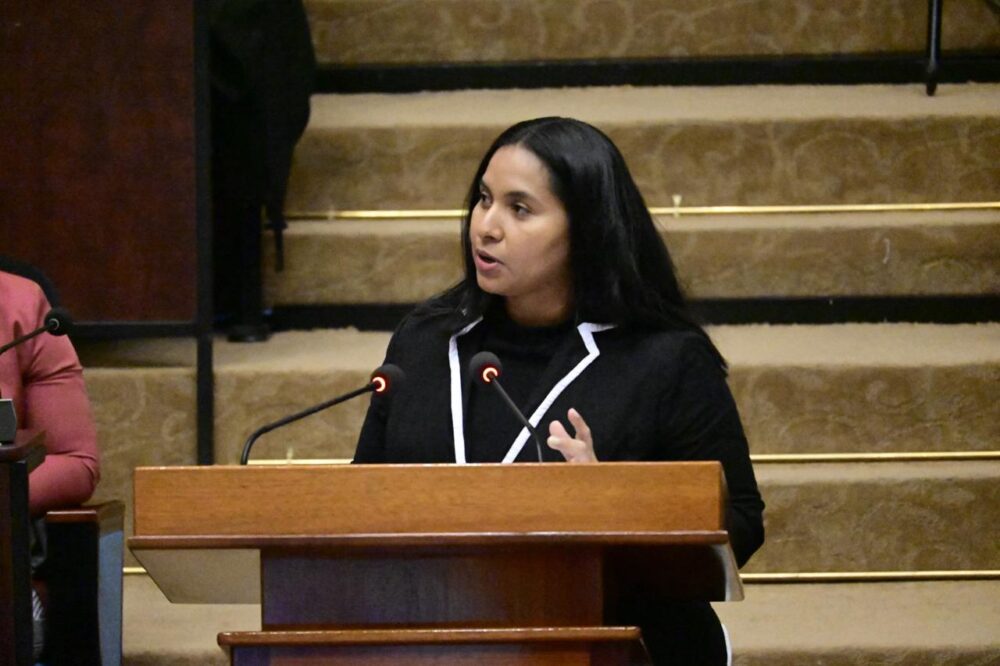
By Mark DaCosta- On Wednesday, Hon. Juretha Fernandes, Member of Parliament for A Partnership for National Unity (APNU) with responsibility for Tourism and Amerindian Affairs, used her budget presentation to expose serious flaws in the government’s financial management, warning that its decisions are failing the nation’s most vulnerable citizens, particularly Indigenous communities.
In her address, Fernandes highlighted a significant disconnect between the staggering budget allocations by the governing People’s Progressive Party (PPP) and the actual benefits reaching the grassroots. She argued that despite the government’s claims of unprecedented spending, the expected outcomes for the nation’s most disadvantaged populations, especially Indigenous people, are sorely lacking. Fernandes pointed out that the proposed Budget 2026, with a total expenditure of more than $1.5 trillion, surpasses the APNU Coalition’s entire combined tenure by over $5 trillion, yet it continues to reveal a fundamental failure to deliver meaningful improvements in essential areas such as housing, healthcare, and education.
Drawing attention to the deficit of $448.9 billion apparent in the budget proposal, Fernandes noted that this amount alone exceeds the largest budget that her party had ever implemented while in office. This glaring shortfall prompts serious concerns about fiscal responsibility and prioritisation within the PPP administration. “They come and treat here as though it’s an exhibition site in which they just fluff and bluff,” she remarked, accusing government ministers of grandstanding instead of addressing substantive issues affecting citizens.
Fernandes directed sharp criticism towards the Ministry of Amerindian Affairs, asserting that Indigenous populations — as a minority group — are particularly affected by the government’s negligence. She referenced the recent Guyana National Population and Housing Census, revealing details about the hinterland population of 112,822 and the notably high average household size of 4.24. This statistic underscores the pressures faced by these communities, compounded by cultural misunderstandings that often caricature their living conditions. Fernandes stated, “Not because you are born as an Indigenous person should subject you to a life of poverty,” emphasising that cultural identity should not be a pretext for economic stagnation.
The Parliamentary further exposed the government’s lacklustre efforts in healthcare, sharing a firsthand account of her visit to the Kaikan health centre, where unsanitary conditions were alarming. “We opened a door, bats coming out flying at you. That is the legacy of the PPP,” she exclaimed, illustrating the stark contrast between government declarations of progress and the grim realities on the ground for many citizens.
In addressing the education sector, Fernandes provided sobering statistics that vividly depict a trend of declining academic performance in remote areas compared to previous years. She noted the shocking drop in mathematics pass rates for Regions 1, 7, 8, and 9, challenging claims of improvement under the current government. “They are spending money and delivering less,” she asserted, calling attention to the fundamental issues within education management and accountability.
Fernandes also touched on the broader implications of social neglect within Indigenous communities by citing the government’s failure to implement effective village sustainable plans. Out of 247 planned initiatives, only 125 have been executed, revealing a disheartening pattern of inefficiency and broken promises. “When they come to this House and they speak so grand about all the wonderful things that they are doing, I want to say that they are from one thing tremendously wrong,” she declared, emphasising the need for accountability and tangible results.
The economic discourse continued as Fernandes illustrated how the government struggles with population growth, noting significant discrepancies in migration patterns contrasted with soaring birth rates among undocumented immigrants. Such inconsistencies lead to questioning the credibility of government statistics and claims of economic prosperity. She raised concerns about over 30,000 undocumented Venezuelans in our country, an alarming statistic that further complicates the economic and social landscape.
Throughout her speech, Fernandes maintained a theme of persistent incompetence characterising the current administration, proclaiming, “No amount of money that is thrown at incompetence can cure that disease.” Her call for honesty and representation resonates with those disillusioned by the government’s performance thus far. “We must be honest when we come to this House and we make our representation,” she concluded — an appeal for integrity amid escalating frustrations.
With the budget debate unfolding, the stark gap between government spending and actual service delivery dominates the concerns of Fernandes’ constituency. Through her impassioned advocacy,
the APNU continues to demand accountability from the People’s Progressive Party/Civic (PPP) government, insisting that the needs of Indigenous and vulnerable populations take priority amid massive budget allocations. Applause may echo in the chambers of power, but real change must reach the homes and lives of citizens who deserve tangible improvements—not just grand statements and theatrical displays.