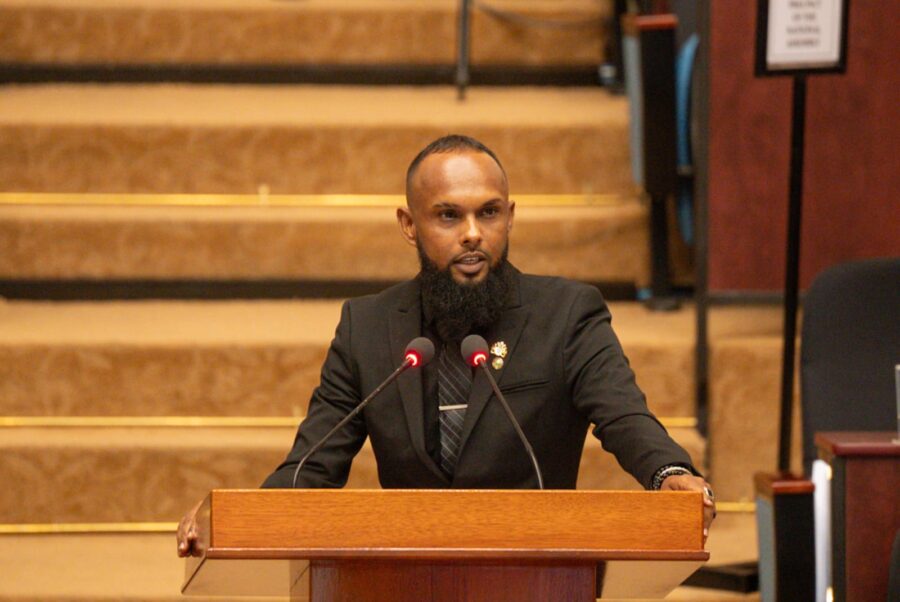
A Partnership for National Unity (APNU) Member of Parliament Riaz Rupnarain on Tuesday questioned the priorities of the Government’s $1.558 trillion 2026 Budget, contending that record levels of spending have not translated into meaningful relief for working people or vulnerable groups.
Making his maiden contribution to the National Assembly on day two of the budget debates, Rupnarain noted that he is only the second elected parliamentarian from Jacklow, Pomeroon River since 1977. He said his presence in the House carried a responsibility to represent all Guyanese. “I have been elected by a few but to represent all, from Pomeroon to Parliament,” he said.
Rupnarain acknowledged that the 2026 Budget is the largest in Guyana’s history but described it as a statement of priorities that remains heavily focused on infrastructure, with limited attention to poverty reduction, cost-of-living pressures and the needs of working-class and vulnerable citizens. “The budget has the numbers, but it lacks the priorities,” he told the House.
He challenged the government’s assertion that the budget benefits all groups, noting that government speakers repeatedly highlighted a narrow range of pension and social assistance measures. Rupnarain pointed to the increase in the income tax threshold, which he said removes just over 5,000 persons from the tax register while leaving more than 90 percent of the national labour force still subject to income tax.
According to Rupnarain, the resulting benefit—approximately $2,500—does not meaningfully offset living costs, particularly in hinterland and riverain communities. Citing an Inter-American Development Bank (IDB) report, he said food prices rose by 8.2 percent last year and argued that the government continues to recycle policies rather than pursue substantive reform.
Addressing concerns over poverty data, Rupnarain said responsibility for up-to-date indicators rests with national authorities. “If the most current comprehensive poverty indicators available are not current, it is not the fault of the IDB. It is the fault of the national data management committee,” he said, adding that “a trillion-dollar economy cannot operate on blind spot.”
While welcoming assistance to children, the elderly and persons with disabilities, Rupnarain said uniform social and education grants fail to account for unequal circumstances. He highlighted the burden faced by families in the Lower Pomeroon River, where students travelling to Charity Secondary School can spend approximately $2,000 per day, amounting to nearly $390,000 per academic year.
He said some families are forced to decide which children attend school on certain days, describing such outcomes as inconsistent with poverty reduction goals. “Policy that ignores differences is just for visibility, not for transformation,” he said.
On labour issues, Rupnarain said the $10,000 increase for 10-day workers represents limited progress but does not address long-standing structural concerns, including the absence of pension security and consistent National Insurance Scheme contributions. “A stipend does not address the long-term problem,” he said.
Turning to foreign affairs, Rupnarain said issues of sovereignty and territorial integrity must be approached as national, not partisan, matters. He welcomed a 10 percent increase under Programme 121 in the Ministry of Foreign Affairs’ allocation but said the budget lacks a clearly articulated foreign policy framework, six years into the government’s tenure.
He questioned how education and awareness efforts related to the Guyana–Venezuela territorial controversy are being implemented, particularly in border communities such as the Pomeroon River, Bartica and Lethem. “Awareness cannot be an abstract line item,” Rupnarain said, adding that border residents “deserve explanation, reassurance, and inclusion, not silence.”
Rupnarain also called for closer collaboration between the Ministries of Foreign Affairs and Education to ensure the territorial controversy is incorporated into CSEC and CAPE history syllabi, noting reports that teachers are unprepared to assess the topic. He said limited public education efforts are insufficient to address concerns in affected communities.
In closing, Rupnarain warned that political fear and unequal access to state resources persist in some communities and said Parliament is too often informed of major decisions after they are made rather than consulted beforehand.
“A trillion-dollar-plus budget is not an achievement if most of the people still remain poor,” Rupnarain said.