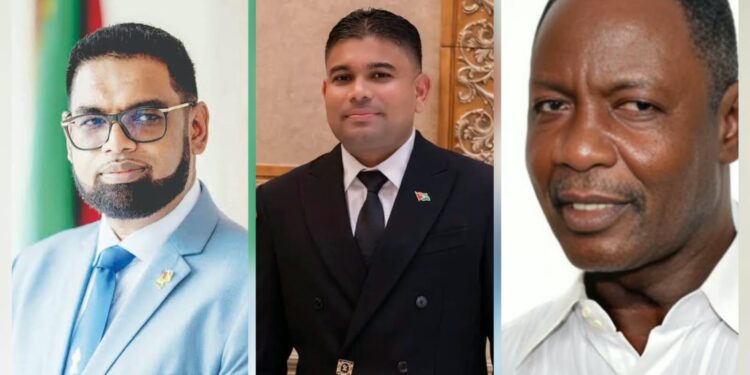
By Mark DaCosta-In a pointed letter to the nation, former Georgetown Mayor Pt. Ubraj Narine has fired back at relations consultant, Kit Nascimento’s call for Azruddin Mohamed to step aside as Opposition Leader, accusing him of selective outrage, partisan bias, and enabling foreign interference. Narine systematically dismantles Nascimento’s arguments, framing the intervention as an attempt to undermine democracy and the will of the Guyanese people.
Highlighting what he describes as double standards, Narine pointedly asks, “Where was this moral fervour when President Irfaan Ali himself faced 19 fraud charges in the past?” and “Where was Mr. Nascimento’s alarm when the current Head of State was sanctioned by the Canadian government?” He argues that Nascimento’s sudden concern over “sanctioned individuals” is politically expedient, designed to protect the PPP regime while targeting Mohamed and the We Invest in Nationhood (WIN) party, rather than rooted in principle.
Narine begins by questioning Nascimento’s newfound moral fervour. He asks bluntly: “Where was this moral fervour when President Irfaan Ali himself faced 19 fraud charges in the past?” This rhetorical question cuts to the heart of the matter. If Nascimento truly cared about reputational risk, why was he silent when the Ali himself was under serious allegations? Narine continues: “Where was Mr. Nascimento’s alarm when the current Head of State was sanctioned by the Canadian government?” His point is unmistakable—Nascimento’s outrage is not principled, it is selective, and it serves the interests of the PPP.
Throughout his letter, Narine portrays Nascimento as a partisan defender of the governing People’s Progressive Party (PPP). He notes that Nascimento has “long been a controversial and partisan voice, particularly when it comes to defending the PPP government and its officials.” This observation situates Nascimento’s intervention within a broader pattern of shielding PPP figures while attacking their opponents. Narine argues that Nascimento’s sudden discovery of the dangers of “sanctioned individuals” is politically expedient, designed to undermine Mohamed and the WIN party while ignoring the corruption allegations against PPP ministers.
Narine asks pointedly: “Why has Mr. Nascimento not spoken with equal urgency about PPP ministers who have visibly enriched themselves while in office?” This question exposes the double standards at play. While Nascimento is quick to amplify allegations against Mohamed, he remains conspicuously silent about the enrichment of PPP officials. Narine concludes that “selective morality is not morality at all.” This phrase encapsulates his critique: morality cannot be applied selectively to opponents while ignored for allies.
The letter also situates itself firmly within the democratic context of the 2025 General and Regional Elections. Narine reminds readers that “the Guyanese people spoke clearly at the 2025 General and Regional Elections. WIN emerged as the main opposition through the democratic will of the electorate.” This statement underscores the legitimacy of Mohamed’s position as Opposition Leader. Narine insists that neither Nascimento nor anyone else has the authority to silence or sideline voters simply because their choice is inconvenient to the ruling party. He warns that democracy does not mean accepting elections only when the results are comfortable.
Narine is particularly critical of Nascimento’s defence of the Speaker’s actions. He argues that Nascimento’s support for delaying Mohamed’s appointment amounts to “an endorsement of political gatekeeping rather than constitutional democracy.” He insists that the Leader of the Opposition is not appointed by foreign governments, columnists, or consultants, but by the will of the people and the constitutional process. This critique directly challenges the PPP regime’s attempts to manipulate parliamentary procedures to its advantage, aided by voices like Nascimento.
The intolerance for the present approach to governance is clear in Narine’s letter. He portrays the PPP government as corrupt, self-serving, and willing to sacrifice democracy for power. His disdain for the United States is equally evident. He sees Washington’s involvement in Guyana’s affairs as manipulative, cloaked in the language of partnership but driven by its own interests. He notes that Nascimento’s arguments rely heavily on the position of the US Embassy and the statements of the US Ambassador, Nicole Theriot, who described Mohamed’s potential participation in Parliament as “concerning” and “problematic.” Narine rejects this foreign interference, insisting that Guyana’s democracy must be defined by its people, not by Washington.
Narine’s letter is also a call for consistency in advocacy. He argues that “Guyana does not need lectures rooted in double standards. What the country needs is consistent advocacy for accountability across the board, not partisan interventions designed to shield one political camp while attacking another.” This statement is a direct challenge to Nascimento and, by extension, to the PPP regime. It demands that accountability be applied universally, not selectively, and that democracy be respected regardless of partisan convenience.
The conclusion of Narine’s letter is both defiant and patriotic. He declares: “The people have spoken. Their voices cannot, and must not, be muted.” This final statement encapsulates the essence of his rebuttal. It is a reminder that democracy belongs to the people, not to foreign governments, partisan consultants, or ruling elites. It is a call to defend sovereignty against both domestic betrayal and foreign manipulation.