


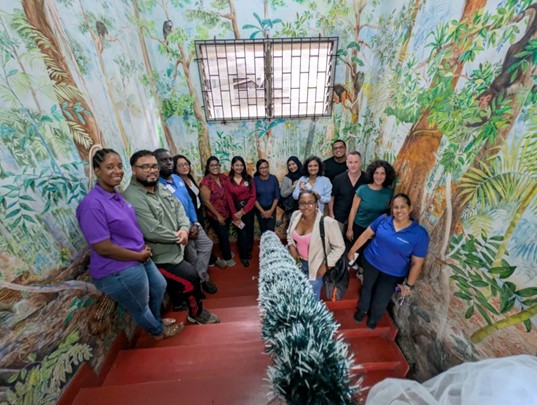
A major international scientific collaboration bringing together the University of Guyana and leading research institutions across South America is reshaping how biodiversity is monitored and conserved in one of the world’s most critical ecosystems—the Amazon rainforest. Through a shared commitment to innovation, capacity building, and long-term environmental stewardship, the partnership, which includes, the University of Guyana’s Centre for the Study of Biological Diversity, the French Centre National de la Recherche Scientifique (CNRS), the Institut de Recherche pour le Développement (IRD), and a network of research stations and observatories across Guyana, French Guiana and Brazil, is harnessing cutting-edge environmental genomics to better understand, protect, and sustainably manage Amazonian biodiversity amid accelerating global change.
At the heart of this collaboration is a shared recognition that genetic diversity is the foundation of all biodiversity. Genetic variation enables species and ecosystems to adapt to environmental pressures, resist disease, and remain resilient over time. As the project collaborators emphasised, “genetic diversity underpins the long-term survival and adaptability of individuals, populations, and ecosystems, and without understanding how this diversity changes over time, conservation efforts remain incomplete.”
This partnership also forms part of a wider international research network known as Bio-Track Amazonia, which spans five Amazonian countries: Brazil, Peru, Guyana, Colombia and French Guiana, and brings together experts in genomics, ecology and bioinformatics.
The collaborators explained that the initiative was established to respond to the urgent need for scalable, reliable biodiversity monitoring in the Amazon, a hyperdiverse region experiencing unprecedented anthropogenic pressures. “The Amazon rainforest requires innovative monitoring tools that can operate across vast and remote landscapes while delivering accurate, timely data to inform conservation policy,” the research team noted.
Central to the project’s work is the use of environmental genomics, a rapidly expanding field that analyses genetic material obtained directly from environmental samples such as soil, water and air. This material, known as environmental DNA or eDNA, allows scientists to detect species and assess ecosystem health without the need for invasive sampling. According to the project partners, “environmental genomics has revolutionised biodiversity monitoring by enabling non-invasive, highly sensitive species detection, even in challenging or remote environments.”
Recent advances in third-generation, high-throughput sequencing technologies have further transformed this field. These tools make it possible to generate highly accurate genetic data in real time, allowing researchers to monitor ecosystems as changes occur. The team highlighted that such technologies are especially valuable in regions like Amazonia, where traditional monitoring methods can be logistically difficult and costly to sustain.
Through Bio-Track Amazonia, the team is pursuing three core objectives. First, they aim to develop and refine cutting-edge sampling methods for both terrestrial and aquatic ecosystems, including airborne DNA collection, spiderweb-trapped eDNA, and blood-meal analyses, all optimised for Amazonian conditions. Second, the collaboration is focused on building next-generation genomic reference databases by integrating natural history collections with novel sequencing approaches, such as targeted capture and nanopore adaptive sampling. This work is intended to overcome long-standing taxonomic gaps, particularly for non-model tropical species. Third, the project seeks to empirically validate the power of eDNA detection across space and time by comparing genomic data with traditional biodiversity monitoring methods, including camera traps and forest inventories, at partner observatories such as Nouragues Station, the HYBAM network, Sophia Point Rainforest Station and the Rosario Experimental Station.
By harmonising protocols and sharing expertise across borders, the team believe the project will lay the foundation for a future Pan-Amazonian eDNA Observatory. As the team stated, this would enable “real-time, cost-effective biodiversity assessments capable of guiding conservation decision-making across the Amazon basin in the context of global environmental change.”
A critical focus of the initiative is shifting from short-term, site-based studies to long-term biodiversity monitoring. While many eDNA studies have concentrated on comparing pristine and disturbed sites at a single point in time, Dr Gyanpriya Maharaj, Director of the University of Guyana’s Centre for the Study of Biological Diversity, stressed that this approach is insufficient for understanding long-term ecological trends. “Tracking biodiversity over time allows us to understand how populations and ecosystems are changing and the real impacts of conservation actions—insights that single-time-point studies simply cannot provide,” she explained.
However, transitioning to long-term monitoring presents its own challenges. Environmental conditions such as temperature, water flow and microbial activity can influence how eDNA degrades and moves through ecosystems, affecting detection rates. Ensuring methodological standardisation across the Amazon’s vast and ecologically diverse landscapes is another major hurdle. Addressing these challenges, the collaborators noted, is essential for building a robust and reliable monitoring framework.
One of the flagship initiatives within this broader collaboration is the CNRS-funded project: The Guiana Shield in the Face of Global Change – Advancing Environmental Genomics for Biodiversity Monitoring in Amazonia. This project directly involves the University of Guyana and leverages recent advances in nanopore sequencing, a technology that enables real-time DNA sequencing in local laboratories or even directly in the field, without the need for large-scale infrastructure.
The project team underscored the transformative potential of this approach for countries in the global South. “By enabling sequencing to be conducted locally, we reduce dependence on overseas facilities, accelerate data generation, and strengthen regional scientific capacity,” Dr Maharaj stated. “This is a significant step towards more equitable and responsive biodiversity research in Amazonia,” she added.
A key component of the project is its strong emphasis on training and capacity building. In recent months, the team has launched eDNA training programmes involving local rangers, conservation practitioners, scientists and students across Guyana, French Guiana and Brazil. These sessions focus on practical skills, including how to collect environmental DNA samples, how to store them properly, and how the resulting data can be applied to biodiversity monitoring and conservation planning. “Empowering local stakeholders with these skills ensures that biodiversity monitoring is not only scientifically robust but also locally driven and sustainable,” Dr. Jerome Murienne a key member of the project team affirmed.
As the year-long project progresses, additional training will be provided in data processing and bioinformatics. This next phase will enable participants to analyse genomic data independently, contributing to education, the development of standardised monitoring procedures, and the formulation of evidence-based biodiversity policies.
Although environmental DNA research is not new to the region, the collaborators emphasised that this initiative builds on previous projects and represents the first long-term eDNA monitoring programme of its kind across the Guiana Shield. From a scientific standpoint, it is expected to generate critical new knowledge about Amazonian biodiversity, ecosystem dynamics, and the impacts of climate change and resource exploitation.
Beyond its scientific contributions, the project carries significant societal and socio-economic implications. Dr. Louise Brousseau, another key member of the project team highlighted that the project will support Amazonian countries in developing comprehensive genomic catalogues of their unique biodiversity while complementing traditional monitoring methods such as camera trapping. “Access to cutting-edge technologies enables countries to establish long-term monitoring systems that safeguard ecosystems while supporting sustainable development,” Dr. Brousseau noted.
Looking ahead, the partners envision the evolution of the project into a fully integrated Amazonian biodiversity observatory that incorporates community-based conservation approaches. This future direction is expected to enhance local participation, improve resource management, and deliver tangible socio-economic benefits to communities dependent on fisheries, forestry and water resources. As the collaborators concluded, “this initiative marks a decisive shift towards an ‘in and for Amazonia’ approach, where local expertise, innovation and ownership drive the conservation of one of the planet’s most vital ecosystems.”





![The experimental vaccine can be stored at two to eight degrees Celsius and can be distributed more easily in India, which has the world's second-highest number of infections at 9.6 million [File: Euan Rocha/Reuters]](https://sp-ao.shortpixel.ai/client/to_webp,q_glossy,ret_img,w_120,h_80/https://villagevoicenews.com/wp-content/uploads/2020/12/India-vaccine.jpg)
