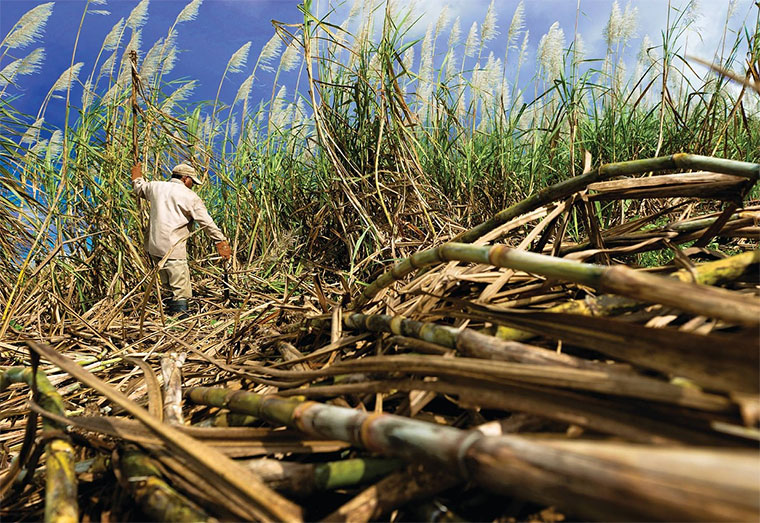
By Mark DaCosta-According to the Opposition, the People’s Progressive Party (PPP) government led by President Irfaan Ali and Minister of Agriculture Zulficar Mustapha, must accept responsibility for the continuing decline of the Guyana Sugar Corporation (GuySuCo) and the failure to meet the 2025 sugar production target. Despite billions of dollars in subsidies, the industry remains plagued by inefficiency, poor management, and lack of accountability. The PPP’s refusal to acknowledge its role in this crisis, while offering hollow promises and excuses, has left sugar workers and the wider economy in a state of uncertainty.
The Guyana Sugar Corporation’s failure to meet its 2025 production target was not an unforeseen setback, but the predictable outcome of years of mismanagement and political neglect. When the People’s Progressive Party (PPP) returned to office in 2020 after succeeding the A Partnership for National Unity and Alliance for Change (APNU+AFC) administration, GuySuCo’s output stood at just 88,868 metric tonnes of sugar across its operating estates—an early warning sign of deeper structural and governance failures that were left unaddressed.

GuySuCo’s 2025 revised goal of 70,000 metric tonnes was quietly lowered after repeated failures, yet even that reduction proved unattainable, with output ending at approximately 59,200 metric tonnes. While this represented a modest increase from the record lows of 2024, it was still far below the levels required to sustain the industry. The PPP government, despite pouring over $13 billion into GuySuCo in the 2025 budget, has failed to deliver meaningful reform or credible solutions.
Opposition voices had long warned of this outcome. Vinceroy Jordan, a Member of Parliament, for the A Partnership for National Unity (APNU), stated plainly: “The time for excuses is over. Accountability is long overdue.” His words echo the frustration of many Guyanese who see the sugar sector being treated as a bottomless pit for public funds, with little to show in return. Jordan had repeatedly cautioned that GuySuCo was bound to fail under the PPP’s approach, but those warnings were dismissed. Instead, the Minister of Agriculture chose to rely on propaganda and inflated projections, ignoring the reality on the ground.
The problems facing the sugar industry are multifaceted but not insurmountable. Climatic volatility has played a role, with excessive rainfall and outdated drainage systems leaving cane to rot in the fields. Yet climate alone cannot explain the collapse. Labour shortages have become chronic, as workers abandon the estates for better-paying jobs in construction and services driven by the oil boom. Turnout rates at estates such as Blairmont and Albion have fallen to as low as 50 per cent, leaving fields under-harvested and factories underutilised.
At the heart of the crisis lies poor management and weak leadership. The cost of production remains unsustainably high, estimated at over US$1.00 per pound, while world market prices are significantly lower. This imbalance makes GuySuCo uncompetitive and reliant on endless state subsidies. Mechanisation, touted as the government’s solution, has been slow and inadequate. Estate rehabilitation has been patchy, workers remain demoralised, and accountability is virtually absent. As Jordan observed, “Year after year, billions of taxpayers’ dollars are poured into GUYSUCO with little to show but missed targets, declining productivity, poor field management, labour shortages, factory inefficiencies, and weak leadership.”
The PPP’s response has been to announce grand projects, such as a US$20 million white sugar refinery at Wales, while ignoring the immediate needs of workers and estates. These initiatives may sound impressive, but they do little to address the structural weaknesses crippling the industry. For the average sugar worker, wages remain stagnant and job security uncertain. Families who once depended on sugar for their livelihoods now face a future clouded by instability.
Alternative visions have been proposed. The We Invest in Nationhood (WIN) party’s “AgriVision” plan, for instance, suggests diversifying estate lands into crops such as corn and hemp, creating new opportunities for farmers and reducing reliance on sugar. Such ideas reflect the need for bold reform and innovation. Yet the PPP has shown little willingness to embrace change, preferring instead to cling to a failing model.
The government’s refusal to accept responsibility is perhaps the most damaging aspect of this saga. Minister Mustapha continues to behave as though GuySuCo’s collapse is someone else’s fault, offering excuses rather than solutions. As Jordan pointed out, “The failure to meet the 2025 sugar production target vindicates what we in the Opposition have been saying all along: without serious reform, competent management, and honest leadership, GUYSUCO will continue to fail.”
This failure is not merely about missed targets; it is about the erosion of trust between government and people. Sugar workers, their families, and the wider economy deserve better than recycled promises. The PPP’s approach has been to throw money at the problem without addressing its root causes. That strategy has not worked, and it will not work.
Our nation’s sugar industry was once the backbone of the economy, a source of pride and prosperity. Today, it stands as a symbol of mismanagement and political arrogance. The PPP’s inability to rescue GuySuCo reflects a broader pattern of governance that prioritises optics over substance. The billions spent could have been invested in diversification, modernisation, or worker support, but instead they have been squandered on sustaining a failing enterprise.
The lesson is clear: without accountability, reform, and competent leadership, GuySuCo will continue its downward spiral. The PPP must stop deflecting blame and confront the reality of its failures. The people of Guyana deserve honesty, not propaganda; solutions, not excuses. The sugar industry’s collapse is not an act of fate but the direct result of poor policy choices. Until the government accepts responsibility, the crisis will deepen, and the burden will fall on taxpayers and workers alike.
In the words of Jordan, “Accountability is long overdue.” The PPP must heed that call, for the sake of our nation and its future.