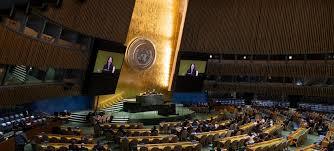
The high-level meeting marked the conclusion of the World Summit on the Information Society (WSIS+20), a process launched in the early 2000s to guide global cooperation on digital development, access and inclusion, at a time when the internet was only starting to become an essential part of everyday life.
Two decades later, delegates said the challenge is no longer simply getting people online but ensuring that digital technologies – including AI – are governed in ways that protect human rights, build trust and close widening digital gaps.
Why the summit matters
WSIS was created in 2003 to help countries work together on the opportunities and risks posed by information and communication technologies, or ICT.
It brought governments together with businesses, civil society and technical experts – a multistakeholder approach that remains central to digital governance today.
At this year’s review, participants reflected on how deeply digital tools now shape the economy, education, healthcare and daily life, while warning that millions remain excluded.
Digital divides widening
In remarks to the General Assembly on Tuesday, its President, Annalena Baerbock, said access to the internet has become essential – from telemedicine in remote villages to online education and digital financial services – yet progress is sluggish.
While global Internet access stands at around two-thirds of the world’s population, she noted that in developing countries it is far lower, and women and girls continue to be disproportionately left behind.
“Two decades later, our shared vision of a people-centred, inclusive and development-oriented information society remains unfinished,” she said.
She warned that access alone is not enough, stressing the need for responsible governance of emerging technologies such as AI, particularly as innovation often moves faster than regulation.
New priorities
The meeting concluded with the adoption of an outcome document reaffirming countries’ commitment to a people-centred digital future grounded in human rights and the principles of the UN Charter.
The text calls for faster action to close digital divides, greater investment in digital infrastructure and skills, and more predictable policy environments to support digital development. It also highlights the importance of trustworthy governance of data and AI, building on commitments already made under the Global Digital Compact.
Member States encouraged stronger international partnerships on AI capacity-building, particularly for developing countries, including training programmes, access to resources and support for smaller businesses.
The document also notes plans to establish an Independent International Scientific Panel on AI and to launch a Global Dialogue on AI Governance in 2026.
People at the centre
Throughout the process, speakers emphasised that governments cannot shape the digital future alone. The outcome reinforces the approach that brings governments, industry, civil society and the tech world together.
International Telecommunication Union (ITU) Secretary-General Doreen Bogdan-Martin said WSIS was born from a belief that digital innovation must reflect human needs, while UN Development Programme (UNDP) Associate Administrator Haoliang Xu described the review as both a moment to recognize progress and to chart a path forward.
That people-centred message also came through beyond the negotiating rooms.
Creative and inclusive: Joseph Gordon-Levitt
Speaking to UN News on the sidelines of the meeting, actor and filmmaker Joseph Gordon-Levitt reflected on the human side of digital transformation, focusing on creativity, inclusion and the shared responsibility to shape healthier digital spaces as technology becomes ever more embedded in daily life.
“What’s inspiring to me about the UN and the community I’ve met here is that, despite it being an uphill battle – a bit of a David and Goliath dynamic – people are trying to work not just for a dollar, but for helping, for making the world better, often to support the most vulnerable in the global south,” he said.
United Nations