Thursday, October 22, 2026
Village Voice News
ADVERTISEMENT
  • Home
  • News
  • Sports
  • Editorial
  • Letters
  • Global
  • Columns
    • Eye On Guyana
    • Hindsight
    • Lincoln Lewis Speaks
    • Future Notes
    • Blackout
    • From The Desk of Roysdale Forde SC
    • Diplomatic Speak
    • Mark’s Take
    • In the village
    • Mind Your Business
    • Bad & Bold
    • The Voice of Labour
    • The Herbal Section
    • Politics 101 with Dr. David Hinds
    • Talking Dollars & Making Sense
    • Book Review 
  • Education & Technology
  • E-Paper
  • Contact Us
No Result
View All Result
Village Voice News
No Result
View All Result
Home Global

US military buildup in Caribbean sees bombers, Marines and warships converge near Venezuela

New counter-narcotics task force will coordinate air, maritime and special operations missions

Admin by Admin
October 21, 2025
in Global
A U.S. Air Force B-52H Stratofortress bomber assigned to the 2nd Bomb Wing, integrates with a U.S. Marine Corps F-35B Lightning II aircraft assigned to the Marine Fighter Attack Squadron 225, in the U.S. Southern Command area.  (U.S. Air Force)

A U.S. Air Force B-52H Stratofortress bomber assigned to the 2nd Bomb Wing, integrates with a U.S. Marine Corps F-35B Lightning II aircraft assigned to the Marine Fighter Attack Squadron 225, in the U.S. Southern Command area. (U.S. Air Force)

0
SHARES
0
VIEWS
Share on FacebookShare on Twitter

(Fox News)- The United States has significantly increased its military presence across the Caribbean under U.S. Southern Command, deploying bombers, warships, and Marines as part of an expanded campaign targeting drug-trafficking and so-called “narco-terrorist” networks operating near Venezuela.

In addition to seven strikes on boats believed to be carrying narcotics, the Trump administration has built up thousands of troops in the region.

READ ALSO

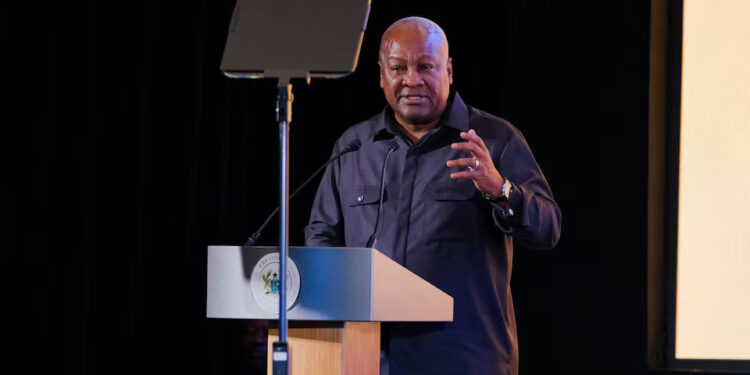
Ghana president: anybody committed to fighting terrorism is welcome in West Africa

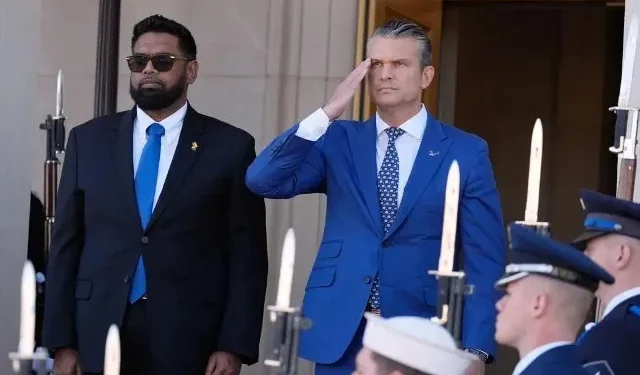
Guyana, US Sign Defence Pact to Expand Military Cooperation

War Secretary Pete Hegseth this month announced the creation of a new counter-narcotics Joint Task Force operating near Southern Command, saying it was established “to crush the cartels, stop the poison, and keep America safe.” The task force will coordinate air, maritime, and special-operations missions across the region — marking the largest U.S. military effort in the Caribbean in decades.

U.S. Air Force B-52H Stratofortress bombers and Marine Corps F-35B Lightning II fighters recently conducted a bomber attack demonstration over the region — a show of force captured in Defense Department imagery. For four hours on Wednesday, B-52s from Barksdale Air Force Base in Louisiana patrolled near Venezuela’s coast in a display of military might aimed at Venezuelan dictator Nicolás Maduro.

At least seven U.S. Naval warships and one nuclear submarine are believed to be patrolling the region.

The USS Iwo Jima Amphibious Ready Group is also operating in the Caribbean Sea. Ship spotters photographed the flagship USS Iwo Jima (LHD-7) off the coast of Ponce, Puerto Rico, on Friday. The group includes USS Fort Lauderdale (LPD-28), USS San Antonio (LPD-17) and the 22nd Marine Expeditionary Unit, based at Camp Lejeune and Marine Corps Air Station New River, N.C. The 22nd MEU comprises Marine Medium Tiltrotor Squadron 263 (Reinforced), Combat Logistics Battalion 26 and Battalion Landing Team 3/6.

Three U.S. Navy guided-missile destroyers — USS Jason Dunham (DDG-109), USS Gravely (DDG-107), and USS Stockdale (DDG-106) — are currently deployed in the Caribbean, joined by the guided-missile cruiser USS Lake Erie (CG-70) and the littoral combat ship USS Wichita (LCS-13), which has been operating near Cuba.

Open-source reporting indicates that a U.S. nuclear-powered attack submarine has been deployed near Venezuela, although the exact number of nuclear vessels and their precise locations have not been confirmed by the Pentagon.

In Puerto Rico, the U.S. has deployed ten F-35 fighter jets and at least three MQ-9 Reaper drones, transforming the island into a key logistics and surveillance hub for operations in the region. Reuters imagery from Aguadilla, Puerto Rico, shows the drones staged for use.

Recent photos also show that Naval Station Roosevelt Roads, a major U.S. facility closed in 2004, has been reactivated. Satellite images and on-site photos reveal aircraft and personnel operating from the base, including at least one AC-130J Ghostrider gunship equipped with Hellfire missiles parked at José Aponte de la Torre Airport, which serves the installation.

Special-operations aviation has increased as well. In early October, MH-6 “Little Bird” light-attack helicopters — typically used by U.S. Army Special Operations Forces — and MH-60M Black Hawks were spotted training off the coast of Trinidad and Tobago, according to images first published by The Washington Post.

The Pentagon has not detailed how long the buildup will last, but a New York Times report estimates about 10,000 U.S. troops are currently operating in the theater — the largest American presence in the region in decades.

U.S. defense officials have linked the deployments to ongoing counter-narcotics and counter-terrorism missions tied to recent strikes on vessels accused of trafficking drugs from Venezuela. The moves come as tensions escalate following Colombia’s claim that one of the U.S. strikes killed a fisherman, not a trafficker — an accusation the White House has denied.

Analysts say the combination of heavy bombers, stealth fighters, Marines, and Navy surface combatants underscores a shift from law-enforcement interdiction to a broader show of force aimed at deterring state-linked trafficking networks.

“This is a posture we haven’t seen in the Caribbean since the early 2000s,” said one defense analyst familiar with U.S. operations in the region. “It’s clearly meant to send a message — not just to traffickers, but to governments accused of enabling them.”

Experts generally agree the U.S. buildup does not suggest preparations for all-out war.

Mark Cancian, a senior defense adviser at the Center for Strategic and International Studies, told Fox News Digital that such a campaign would require between 50,000 and 100,000 U.S. troops — far more than the roughly 10,000 currently in theater.

“What I think they’ve put in place is the capability to launch strikes at either the cartels or the Maduro regime,” Cancian said. “If I had to bet, it’s probably against the cartels — but I wouldn’t rule out something against the regime.”

That limited but flexible posture reflects what some experts describe as a modern form of coercive diplomacy.

“It sort of looks like we’re in the throes of a 21st-century version of gunboat diplomacy,” said Brandan Buck, a foreign policy analyst at the Cato Institute. “The Trump administration is doing what it can to force some sort of transition [of] power — out of Maduro’s hands and into someone else’s — without a classic invasion.”

Ryan Berg, director of the Americas Program at the Center for Strategic and International Studies, said the current deployment gives Washington strike options without committing to a major ground war.

“The force posture currently in the southern Caribbean is consonant with the potential for precision strikes using Tomahawk missiles or other weapons, but without risking the lives of U.S. service personnel,” Berg said.
ShareTweetSendShareSend

Related Posts

Ghana's President John Dramani Mahama gives a speech in Accra, Ghana, June 18, 2026. REUTERS/Francis Kokoroko Purchase
Global

Ghana president: anybody committed to fighting terrorism is welcome in West Africa

by Admin
October 22, 2026

LONDON,  (Reuters) - Ghana's President John Dramani Mahama said ​on Wednesday he was not concerned about Russian ‌security assistance in...

Read moreDetails
President and Commander-in-Chief Dr. Mohamed Irfaan Ali and U.S. Secretary of War Pete Hegseth
Global

Guyana, US Sign Defence Pact to Expand Military Cooperation

by Admin
October 22, 2026

President Irfaan Ali and United States (US) Secretary of War Pete Hegseth on Wednesday signed a Joint Declaration for an...

Read moreDetails
Global

New data group to boost digital economy, AI

by Admin
October 21, 2026

China Daily - China National Data Group Co, a new centrally administered State-owned enterprise, was officially inaugurated on Tuesday in...

Read moreDetails
Next Post
Deputy Mayor Kirk Fraser

Local Govt Heads Left Out of Stipend Increases Since 2020 – Deputy Mayor Kirk Fraser


EDITOR'S PICK

His Excellency President Dr Irfaan Ali described the St George’s School of Sciences as a pioneering step in reshaping Guyana’s educational landscape and as a “new model of education” tailored for the modern era.

The school, officially commissioned today in Georgetown, stands as the country’s first secondary institution solely dedicated to scientific education—an initiative, the President said, that promises to profoundly impact the academic and professional futures of Guyana’s youth.

“This is no ordinary school. It is a school of excellence, created for those with the hunger to learn and the commitment to achieve. Admission to this institution is not automatic—it is earned. Students must demonstrate strong competence in English, mathematics, and science, with marks that reflect discipline and potential.”

The school is equipped with smart classrooms featuring interactive boards, multimedia technology, and digital tools; state-of-the-art laboratories for science and information technology; and device-based learning whereby students will each receive a laptop, among other world-class facilities.

A new model of education

President Ali underscored that the school’s holistic curriculum marks a deliberate departure from the “narrow confines of rote learning”. Extended learning opportunities will be offered through tutorials, while students will also be required to participate in music, sport, foreign languages, technical and vocational education and training (TVET), and community service.

“We want to produce scientists with soul, technicians with talent, and leaders with compassion,” he stated.

“And let me emphasise—standards will be enforced. Students will be monitored for punctuality, attendance, and completion of assignments. Parents will be promptly notified of infractions. This school is not just about nurturing intelligence—it is about cultivating responsibility.”

The President highlighted the growing importance of STEM (Science, Technology, Engineering, and Mathematics) education in today’s rapidly evolving and technology-driven global economy.

“From climate change to artificial intelligence, from health to renewable energy, the challenges and opportunities of the 21st century demand problem-solvers who can think critically, analyse data, and innovate with purpose. In developing countries like Guyana, it is especially important, as it empowers young people to participate meaningfully in national development, close the digital divide, and compete on the global stage.”

He also emphasised that Guyana’s national transformation will require a new generation of scientific minds across sectors such as oil and gas, climate resilience, biotechnology, artificial intelligence, and healthcare.

“We need local talent to fill those roles. We need to train our children not just to get jobs—but to lead industries.”

President Ali further noted that his Government is currently building a national digital ecosystem that will connect classrooms, hospitals, government services, agriculture, commerce, and industry through the power of information and communication technology (ICT).

“As we roll out this system, we need to prepare our citizens for a digital future. We cannot do so unless science and technology assume greater importance within our education system. We need students to be equipped with the analytical skills, technical competencies, and creative mindset to thrive in a digitally connected and data-driven world. Without a strong grounding in science, we risk becoming consumers rather than creators in the digital age.”

He added that science education is a gateway to equality, teaching critical thinking, logic, and evidence-based decision-making.

“It empowers young people, especially those from marginalised communities, to challenge assumptions, solve real-world problems, and create innovative solutions.”

The Head of State added that while specialised learning is an idea long overdue in Guyana and represents a bold shift in the country’s academic approach, traditional schools, with their rigour and cultural legacy, will continue to serve as the bedrock of the nation’s education system.

He said that these traditional institutions must be complemented with specialised schools that focus on the arts and creative industries; agricultural science; engineering and robotics, and maritime studies and aviation technologies, among other areas.

“To all of Guyana, I wish to say that what was once a school reduced to ashes is now a symbol of resilience and reinvention.  Let the St George’s School of Sciences stand tall and vindicate the confidence which we have placed in its role as a torchbearer of the type of education system we are rolling out across Guyana.”

The school is equipped with 10 classrooms, five laboratories (three for science, one for IT and one for home economics), and other state-of-the-art amenities. It also has the capacity to house about 250 students.

Minister of Education, the Honourable Priya Manickchand, and other Government officials were also at the event.

St George’s School of Sciences represents new model of education—President Ali

July 2, 2025

Mr. President, Does Your Conscience Trouble You?

July 6, 2026

Balwant Singh’s Hospital Refutes Claims

April 7, 2023

HerVenture App Empowers 12,000 Women-Owned Businesses in Guyana with Personalized Roadmap for Growth

February 3, 2023

© 2024 Village Voice

No Result
View All Result
  • Home
  • News
  • Sports
  • Editorial
  • Letters
  • Global
  • Columns
    • Eye On Guyana
    • Hindsight
    • Lincoln Lewis Speaks
    • Future Notes
    • Blackout
    • From The Desk of Roysdale Forde SC
    • Diplomatic Speak
    • Mark’s Take
    • In the village
    • Mind Your Business
    • Bad & Bold
    • The Voice of Labour
    • The Herbal Section
    • Politics 101 with Dr. David Hinds
    • Talking Dollars & Making Sense
    • Book Review 
  • Education & Technology
  • E-Paper
  • Contact Us

© 2024 Village Voice