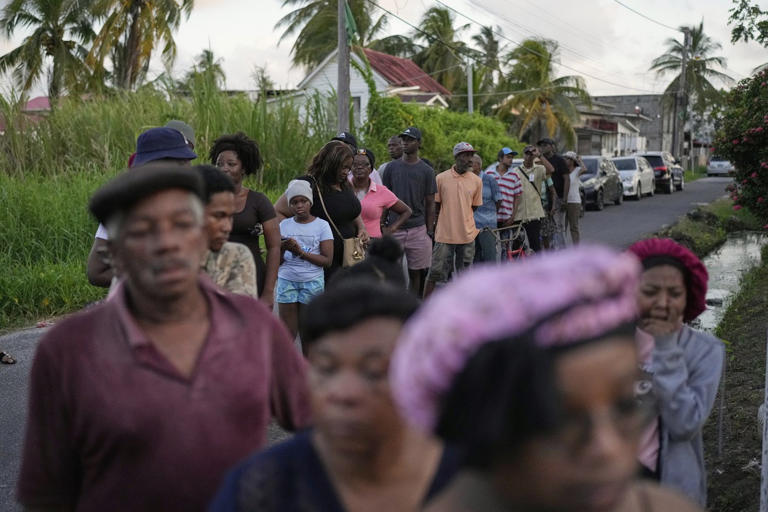
While the 2025 General and Regional Elections in Guyana were conducted without the violent flashpoints of previous cycles, mounting evidence suggests that the process fell far short of being genuinely free and fair. This growing consensus—rooted in long-standing concerns about a bloated and unconstitutional voters’ list—has cast a shadow over the legitimacy of the outcome and the credibility of the institutions tasked with protecting democracy.
International observer missions, including the European Union, Organisation of American States (OAS), Commonwealth, CARICOM, and the Carter Center, praised the peaceful conduct of the polls. But significantly, none declared the elections to be fully “free and fair.” Instead, they noted widespread abuse of state resources by the ruling People’s Progressive Party (PPP), which exploited incumbency using state media, vehicles, buildings, and personnel for partisan gain. Despite these advantages, the PPP failed to secure a two-thirds parliamentary majority, hampered by low voter turnout even in its core constituencies.
A Voters’ List Nearly as Large as the Population
The issue at the heart of Guyana’s electoral dysfunction remains the voters’ list, which observers and analysts have described as “bloated” and “unconstitutional.” With the Official List of Electors (OLE) for Guyana’s September 1, 2025, General and Regional Elections containing 757,690 registered voters, while the national population is estimated at approximately 780,000, the voters’ list has long been a source of national anxiety. For more than a decade, Guyanese citizens have called for its cleanup—a call echoed across party lines at different moments in political time.
When the PPP lost power in 2015, then-Opposition Leader Bharrat Jagdeo himself demanded a new and accurate voters’ list, aligning with national concern. Yet after returning to government in 2020, the PPP reversed its position. Not only did the party refuse to initiate constitutional reforms that would enable a fresh registration process, it also blocked efforts to introduce biometric voter identification—a key tool to prevent multiple voting and impersonation.
The A Partnership for National Unity + Alliance for Change (APNU+AFC) coalition, which governed from 2015 to 2020, had begun a house-to-house registration process aimed at sanitizing the list. But this effort was derailed by a court ruling just ahead of the 2020 elections.
This failure to fix the list has had grave consequences. According to Village Voice News in-country statistician, “If the process was flawed from the outset and the systems were never put in place to rectify it, the outcome could never be credible. It’s that basic.”
Constitutional Violations
The problem extends beyond administrative oversight. At the center of the controversy is GECOM’s continued use of a consolidated voters’ list that includes both Guyanese and Commonwealth citizens, despite the Constitution’s explicit provisions to the contrary.
Articles 59 and 159 of Guyana’s Constitution make clear that only citizens of Guyana are entitled to vote in General Elections, while Commonwealth citizens resident for over a year may vote only in Regional and Local Elections. Yet GECOM maintains one list for both.
This constitutional breach has allowed non-resident Commonwealth citizens to potentially vote in General Elections, compromising the validity of the outcome and shredding the very idea of national sovereignty in electoral decision-making.
Without a complete overhaul of the electoral architecture, Guyana will remain mired in cycles of mistrust, legal manipulation, and state-sponsored campaign abuse. Despite the absence of violence in 2025, the foundational issues surrounding voter eligibility, state resource misuse, and systemic bias persist—undermining any claim that these elections met democratic standards. As one analyst bluntly stated, “You can’t build democracy on a rotten foundation and expect the house to stand.”