As Guyana approaches another election, the Irfaan Ali government and its People’s Progressive Party (PPP) are once again asking the people for their trust, their votes, and ultimately another term in office. But after more three decades of control, the question must be asked bluntly: what has the PPP truly delivered, other than a nation entrenched in corruption, deepened poverty, and worsening inequality?
Corruption has become the bloodstream of Guyana’s governance under the PPP, by none other than the acclaimed Transparency International. From allegations tied to contracts, state resources, and mismanagement of oil revenues, to the lack of accountability across public institutions, the government has done little to curb the rot. Instead, the Ali administration has presided over a system where friends of the powerful flourish while ordinary Guyanese are left behind.
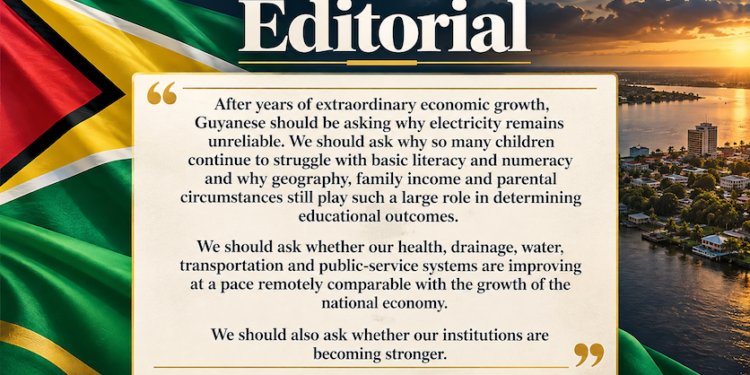
The consequences are devastating. Despite years of booming growth and the promise of oil wealth, more than half the population continues to live in poverty, surviving on less than US$5.50 a day. Communities are starved of basic services, young people see migration as their only path to opportunity, and entire families are trapped in cycles of deprivation. In the face of these realities, the government’s grand rhetoric about development rings hollow.
What is most troubling is that corruption is not simply a financial crime. It is an assault on human development itself. Every dollar siphoned off by mismanagement or political favouritism is a dollar taken away from schools, hospitals, housing, and infrastructure that could transform lives. Every corrupt deal widens the gap between Guyana’s potential and the bleak daily struggle of its people.
Yet, with this shameful record, the PPP now dares to ask Guyanese to reward them with another term. They make this appeal after decades of failed governance that has stunted the nation’s progress and eroded public trust. Their policies, far from fostering development, have created conditions that perpetuate dependency and inequality, policies that can only be described as anti-human development.
The people of Guyana can no longer tolerate recycled promises and government that treats power as an entitlement. They deserve leadership that confronts corruption head-on, invests transparently in national wealth, and ensures that prosperity is not confined to the political elite.
On September 1, when Guyanese cast their votes, the outcome must mark the beginning of a new chapter. Whoever is elected should commit not only to eliminating corruption but also to building a society where development is measured by the quality of life of every citizen. Guyana needs governance that improves the Human Development Index for all, regardless of race, class, creed, or political association. The time has come for leaders to put the nation before party and the people before power.