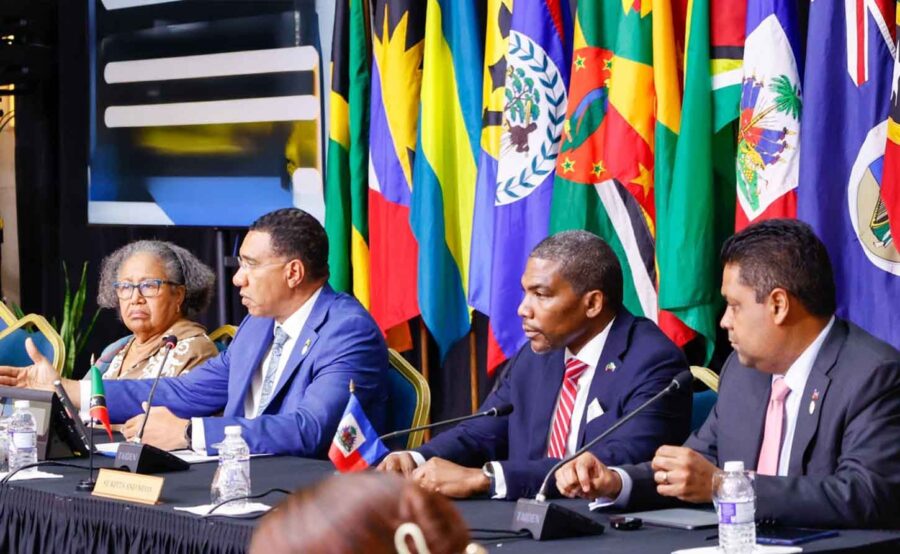
(WiredJA)- While CARICOM stands by watching, the U.S. uses their own member state as a laboratory for extraterritorial overreach that will soon target them all
The federal indictment of Jimmy “Barbecue” Chérizier should have triggered emergency CARICOM sessions and unified condemnation. Instead, it has been met with the deafening silence that has become the region’s shameful trademark when Haiti suffers.
CARICOM leaders, apparently viewing Haiti as their “poor cousin,” fail to grasp a chilling reality: Washington is using their own member state as a testing ground for extraterritorial tactics that will inevitably be deployed against them.
The $5 million bounty on Chérizier’s head represents more than pursuit of a gang leader—it’s the assertion that the United States can criminalize diaspora support to any Caribbean nation, indict foreign nationals living in their own countries, and impose American domestic law extraterritorially with total impunity.
CARICOM’s silence is not just morally bankrupt—it’s strategically suicidal. History screams the warning: the same stick that licks the black snake will lick the yellow one.
CARICOM’s Own Member State: The Perfect Laboratory
Haiti—a full CARICOM member since 2002—has become Washington’s perfect laboratory for testing the limits of extraterritorial overreach. While her Caribbean “brothers and sisters” look the other way, the United States experiments with tactics that make a mockery of sovereignty and international law.
Chérizier’s indictment reveals the circular logic of American extraterritorial sanctions: Washington sanctions you, then prosecutes you for violating sanctions you never agreed to be bound by.
The former Haitian police officer stands accused of conspiracy to violate U.S. sanctions—while living in Haiti, allegedly committing crimes in Haiti, against Haitian citizens.
But here’s what should terrify every CARICOM capital: they’re not just targeting Chérizier. Bazile Richardson, arrested in Texas, faces charges for allegedly sending money to Chérizier from members of the Haitian diaspora in the United States.
This criminalises the very lifeline that every Caribbean nation depends on—remittances from their scattered children abroad.
Where is CARICOM’s outrage? Where are the emergency sessions? Where is the unified condemnation of this assault on a member state’s sovereignty? The silence speaks volumes about how the region views Haiti—and about how unprepared they are for when these same tactics target them.
From Testing Ground to Regional Targeting
Washington didn’t start with Haiti by accident. As the Caribbean’s most vulnerable member state—politically unstable, economically devastated, and already isolated by decades of international intervention—Haiti provides the perfect testing ground for tactics that can later be deployed against stronger CARICOM states.
For 62 years, the U.S. embargo against Cuba has operated extraterritorially, pressuring third parties into compliance and threatening to cut financial aid to countries that trade non-food items with Cuba.
Venezuelan sanctions have caused an estimated $22.5 billion in lost income since 2017, contributing to at least 40,000 excess deaths through collapsed public services and restricted access to medicine and food. Secondary sanctions have targeted companies worldwide, seizing billions in Venezuelan funds.
But those were non-CARICOM states. Now Washington is perfecting these tactics on a full CARICOM member, while the region’s leaders offer nothing but shameful silence. They’re beta-testing on Haiti before rolling out the program region-wide.
Recent events prove the expansion is already underway. In Guyana, U.S. Ambassador Nicole Theriot has brazenly interfered in the electoral process by warning that relations could be strained if sanctioned businessman Azruddin Mohamed—a constitutionally eligible candidate—becomes president.
Theriot openly stated that having an OFAC-sanctioned individual in government is “concerning” and “problematic,” threatening that U.S. companies might “de-risk or even cut ties” with Guyana.
This represents a direct assault on every Guyanese citizen’s constitutional right to democratic self-determination. The issue isn’t Mohamed’s guilt or innocence—he faces legal proceedings in Guyana’s courts where justice will be determined.
The issue is that a foreign ambassador is attempting to dictate which constitutionally qualified candidates Guyanese voters can choose.
Mohamed was sanctioned in June 2024 over allegations of tax evasion in Guyana and gold smuggling, but under Guyana’s Constitution, he remains eligible to seek the presidency.
That decision belongs to Guyanese voters, not Washington bureaucrats. As Mohamed correctly stated: “This is a sovereign nation. This is the will of the people, they want me to run for office.”
Yet Theriot is effectively telling 800,000 Guyanese voters that their constitutional rights are subordinate to American financial interests.
Banks have closed accounts of WIN candidates simply for exercising their democratic rights, while the U.S. threatens economic punishment if citizens make the “wrong” electoral choice. This is colonial-era interference dressed up as diplomatic dialogue.
Former Trinidad and Tobago Prime Minister Keith Rowley’s detention at an Antigua airport—flagged on an Interpol watch list for alleged “criminal activity”—shows how easily international mechanisms can be weaponized against any Caribbean leader who steps out of line. To date no one knows how he wrongly ended up on that list!
Wake Up: CARICOM is Already in the Crosshairs
The targeting has already begun, but CARICOM leaders are too busy treating Haiti like a “lesser god” to notice the pattern.
Consider the vulnerabilities that make every Caribbean state a potential target: heavy dependence on remittances, international banking relationships that transit through U.S. financial systems, and energy partnerships that might conflict with American interests.
Trinidad and Tobago processes Venezuelan oil transactions. Barbados maintains banking relationships with Iranian institutions. Jamaica hosts Cuban medical programs. Guyana explores energy partnerships with sanctioned entities. Any of these connections could become tomorrow’s “sanctions violations.”
But instead of recognising their collective vulnerability and standing with Haiti, CARICOM members practice the same shameful hierarchy that has always plagued the region.
Haiti—despite being a founding member of their struggle against colonialism—is treated as an embarrassment, a burden, unworthy of the solidarity they demand for themselves.
This isn’t just morally repugnant—it’s strategically insane. By allowing Washington to experiment on Haiti without unified resistance, CARICOM is essentially providing a training ground for tactics that will soon target them all.
CARICOM has consistently condemned the extraterritorial application of U.S. domestic law, calling such measures contrary to the UN Charter and international law. But condemnation without action is mere diplomatic theater.
As one editorial noted, “we are greatly heartened by the unity among Caricom leaders in the bloc’s current dealings with the US government”—but unity must translate into concrete resistance.
End the Shameful Silence
CARICOM has consistently condemned extraterritorial application of U.S. domestic law—but only when it affects Cuba and Venezuela. When it targets their own member state Haiti, the silence is deafening. This selective solidarity exposes the ugly classism that has always plagued Caribbean unity.
The Chérizier indictment represents a qualitative escalation in American extraterritorial aggression, but it’s being tested on the member state CARICOM apparently considers expendable.
By weaponizing terrorism designations against local actors in domestic conflicts, Washington transforms complex socio-political crises into simple good-versus-evil narratives that justify unlimited intervention.
As CARICOM representatives have noted when defending other nations, “the only sanctions permitted under international law are those adopted by the Security Council under terms of the UN Charter.” Yet when these same illegal sanctions target Haiti—their own member—the organization’s principled stance evaporates.
The choice for CARICOM is stark: defend Haiti now as a full and equal member, or watch helplessly as Washington perfects on Haitian soil the same techniques that will soon devastate Trinidad, Jamaica, Barbados, and beyond.
The United States has turned a CARICOM member state into a laboratory for imperial control, and the region’s shameful silence makes them complicit in their own future subjugation.
Haiti may be CARICOM’s poorest member, but she deserves the same fierce defense any other member would receive. The failure to provide it reveals not just moral bankruptcy, but strategic blindness that will cost the entire region dearly.
The creeping net is already closing—and CARICOM’s own indifference is helping to weave it.