By Mark DaCosta-Azruddin Mohamed, presidential candidate for the We Invest In Nationhood (WIN) Party, spent the closing day of his Region Seven tour in the remote Indigenous settlement of Itaballi, telling villagers his campaign will come to them rather than bringing people into town — a direct rebuke of what his supporters say are tactics used by larger parties to inflate crowd sizes.
The businessman-turned-candidate framed his stop in Itaballi as part of a deliberate outreach to communities he says have been neglected, promising more equitable distribution of resources, improved healthcare and education, and fair allocation of proceeds from carbon-credit programmes — all pitched as benefits WIN would deliver for Indigenous communities.
Mohamed arrived in Itaballi, a riverside community in Region Seven (Cuyuni-Mazaruni), to an audience of local residents on the campaign’s final regional day. Itaballi, reachable primarily by boat from the Mazaruni River and home to an estimated several hundred people, typifies the small, scattered settlements across the vast Rupununi-Mazaruni interior where basic services are limited and travel to regional centres can be costly and time-consuming. For many inhabitants, visits from national politicians are infrequent; Mohamed used that point to underline his message of direct engagement.
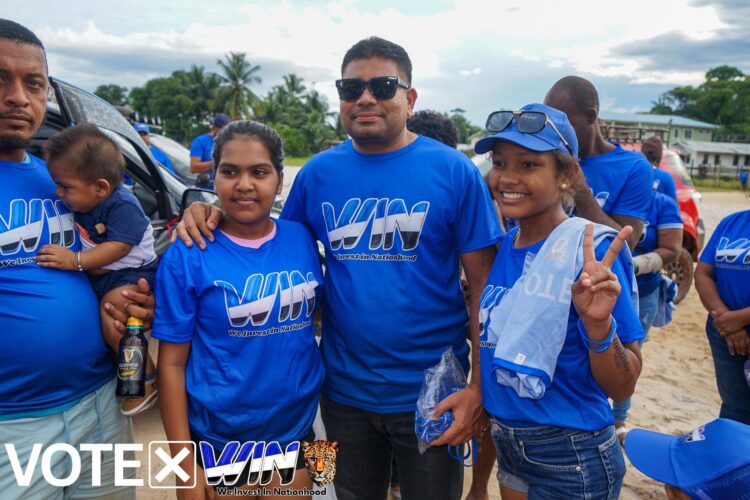
“We don’t transport supporters to our meetings, we meet them where they are,” Mohamed told the gathering, stressing that WIN prefers to bring its message to voters rather than bus people in to create an impression of larger support. He reiterated his campaign’s commitment to follow up with residents irrespective of election outcomes, saying he would return to communities even if he is not elected. The candidate characterised WIN’s presence in Indigenous villages — he pointed out his party’s recent visits across hinterland settlements — as evidence of genuine support for Indigenous Guyanese.
Mohamed’s visit comes against a backdrop of persistent accusations levelled at the governing People’s Progressive Party/Civic (PPP/C) during this campaign season. It is widely believed in some quarters that the PPP has been bussing large numbers of supporters into regional rallies to bolster visible turnout, and there have been allegations circulating that attendees are being paid to appear at certain political events. Those claims have been strongly denied by PPP representatives in other forums, who say attendance figures reflect grassroots support; nonetheless, the perception of orchestrated attendance has become part of the political discourse and a key point of critique for smaller parties seeking to distinguish themselves.
At the Itaballi meeting Mohamed set out a list of promises aimed at winning the trust of indigenous voters. He said WIN would pursue a more even distribution of public resources across regions, boost healthcare delivery in remote areas, ensure transparent and equitable disbursement of funds generated through carbon-credit sales involving indigenous lands, and enhance the standard of schooling for children. These pledges echo long-standing calls from hinterland communities for better roads, stronger health posts, and culturally appropriate education that acknowledges indigenous languages and traditions.
Residents who spoke with campaigners during the stop described a mixture of gratitude and scepticism. Some welcomed the personal approach of a candidate who had sought them out, saying travel to regional campaign hubs is often prohibitive and that national politicians rarely engage at village level. Others expressed reservations, noting that promises have been made by successive administrations without sustained follow-through. Those sentiments underline the challenge for any party trying to convert a one-time visit into lasting political allegiance.
As the campaign clock winds down, Mohamed’s stop in Itaballi was designed to symbolise accessibility and accountability. Whether that impression will be enough to sway undecided voters or counter allegations of organised attendance at rival events remains to be seen. For residents of the remote settlement, the immediate gain was an encounter with a presidential hopeful on their own soil — a rare occurrence that, in this election season, carries political as well as personal resonance.






![Samsung vice chairman Jay Y Lee has been sent back to prison on bribery charges after a years-long graft trial [SeongJoon Cho/Bloomberg]](https://villagevoicenews.com/wp-content/uploads/2021/01/Samsung-vice-chairman-Jay-Y-Lee.png)