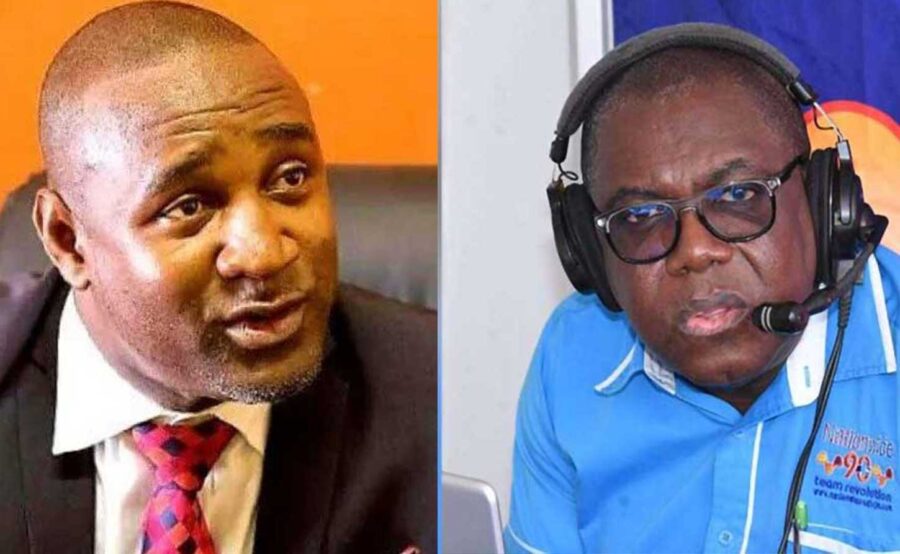
(WiredJA)- The airwaves crackled with menace on Monday morning when veteran broadcaster Cliff Hughes transformed his Nationwide News Network platform into something more akin to a street corner threat than professional journalism.
His suggestion that someone should “box” People’s National Party General Secretary Dr. Dayton Campbell and tell him to “shut yuh mouth” didn’t just cross ethical lines—it obliterated them, exposing a rot in Jamaica’s media landscape that threatens the very foundations of democratic discourse.
Hughes’ violent outburst wasn’t delivered in a moment of passion or off-camera frustration. This was calculated aggression, broadcast live to thousands of Jamaicans, targeting a political figure whose only “crime” was defending an entire class of workers from government-sanctioned character assassination.
The implications stretch far beyond one broadcaster’s loss of professional composure—they reveal how Jamaica’s media has become complicit in weaponizing rhetoric against the working class.
The Toxic Chain Reaction
The controversy began with Transport Minister Desmond McKenzie’s inflammatory remarks branding taxi operators as “evil” and suggesting they endanger children. Such sweeping condemnation of an entire sector—one that forms the backbone of Jamaica’s public transportation system—represented more than poor political judgment. It was a deliberate strategy of scapegoating, designed to deflect from the Jamaica Labour Party government’s failure to provide adequate rural transportation solutions.
Dr. Campbell’s response was measured and appropriate: he called on taxi operators to withdraw political support from a party that insulted their dignity. This wasn’t inflammatory rhetoric—it was democracy in action, a political leader defending constituents from government attack. Yet Hughes treated this defense of working-class dignity as grounds for suggested physical assault.
The broadcaster’s subsequent “apology” revealed the hollow nature of his contrition. He apologized to his listeners—not to Campbell, the target of his violent suggestion. He framed his comments as merely “inappropriate for radio,” as if recommending physical violence might be acceptable in some other forum. This wasn’t an apology; it was damage control masquerading as accountability.
Media Ethics in Free Fall
Hughes’ behavior exposes a dangerous evolution in Jamaica’s media landscape, where supposedly neutral platforms have become extensions of political warfare. The veteran journalist cannot simultaneously position himself as an arbiter of political conduct while using his microphone to promote the very hostility he claims to oppose. This fundamental contradiction destroys media credibility and transforms journalism into partisan advocacy.
The People’s National Party’s response has been surgical in its precision, identifying exactly why Hughes’ non-apology falls short of professional standards. Their statement notes the broadcaster “cannot play both roles”—presenting himself as a political referee while promoting violence against those he disagrees with. This observation cuts to the heart of media ethics: journalists cannot maintain credibility while abandoning objectivity for partisan attack.
The PNP Youth Organisation’s condemnation goes further, identifying Hughes’ outburst as part of a “disturbing pattern within the JLP and its affiliates—where bullying, intimidation, and violence are condoned or brushed aside.” This pattern recognition is crucial because it contextualizes Hughes’ comments within a broader ecosystem of normalized political violence that threatens Jamaica’s democratic culture.
Working-Class Dignity Under Siege
Lost in the media ethics debate is the human cost of this rhetorical violence. Jamaica’s taxi and bus operators represent thousands of hardworking citizens who navigate dangerous roads, unreliable vehicles, and economic uncertainty to provide essential services. Many transport children to school, elderly citizens to medical appointments, and workers to jobs that keep the economy functioning.
Minister McKenzie’s characterization of these workers as “evil, rapists, and abductors” wasn’t just politically tone-deaf—it was a calculated assault on working-class dignity designed to turn public opinion against an entire profession. Such rhetoric creates real-world consequences, potentially subjecting taxi operators to increased harassment, reduced patronage, and social stigmatization.
The PNP’s defense of taxi operators through their proposed RIDE Program demonstrates the stark policy contrast at stake. While the governing party vilifies transportation workers, the opposition proposes partnership and respect through programs that would provide affordable student transportation while supporting operator livelihoods.
The Weaponisation of Words
Hughes’ violent rhetoric represents a disturbing escalation in the weaponization of political discourse. When media figures suggest physical violence against political opponents, they normalize aggression as an acceptable response to disagreement.
The Broadcasting Commission and media professional organizations now face a critical test of their relevance and authority. Their response to Hughes’ conduct will signal whether Jamaica’s media regulatory framework has teeth or exists merely as window dressing for international observers.
The taxi operators caught in this rhetorical crossfire deserve better than being used as political footballs by ministers seeking scapegoats and broadcasters promoting violence. Their dignity and livelihoods shouldn’t become collateral damage in political warfare conducted through supposedly neutral media platforms.
As Jamaica’s media grapples with its identity crisis, one thing remains clear: microphones are powerful weapons when wielded irresponsibly. The question now is whether the country’s democratic institutions have the courage to ensure they’re used to build rather than destroy the foundations of civilized discourse.
The airwaves are watching, and so is democracy itself.