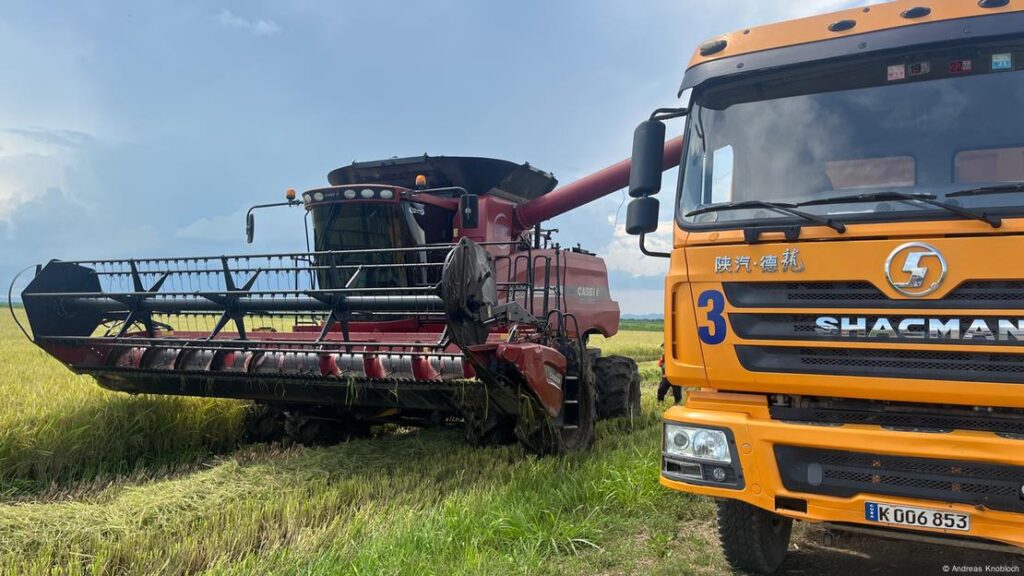
DW – With a deep rumble, the massive threshing wheel of the rice harvester pushes through the tightly packed green stalks. The plants vanish into the belly of the machine, where rice grains are separated from their husks and the straw is tossed back onto the field. A few workers watch the process from the field’s edge.
After a few rounds, the combine harvester moves to the side and transfers the harvested rice through a long pipe into the bed of a waiting truck — then it heads back out again.
It’s harvest time on the fields of Los Palacios, a sleepy small town in the southeastern part of Cuba’s Pinar del Rio province.
The silos and an aging rice mill shimmer in the glaring sun on the horizon, and what looks like a picturesque postcard scene could prove crucial for Cuba’s food security.
The fields near Los Palacios belong to the Cubanacan farm, run by the state-owned enterprise Empresa Agroindustrial de Granos Los Palacios. In the wake of Fidel Castro’s successful Communist revolution in 1959, all foreign landowners were expropriated.
But last year, the Cuban government took an unprecedented step by granting a foreign company the right to cultivate farmland on the Communist islands.
The first foreign company to be granted a lease on a stretch of farmland was Vietnamese Agri VMA, a privately held agriculture company that is growing rice near Los Palacios.
Cuban rice output declines amid deeper crisis
Still owned by the Cuban state, the farmland lease to the Vietnamese investor is tied to a prolonged crisis in the Cuban agricultural sector caused by an overall decline in the country’s economy.
Fertilizers, pesticides, fuel, and spare parts are in short supply and much of the equipment is outdated or broken. In addition, a rigid system of mandatory state quotas offers little incentive for enhancing production.
What’s also come into play recently are environmental factors, such as soil salinization, drought, and hurricanes, which have reduced crops driving Cuban agriculture even closer to the brink of collapse.
Ariel Garcia Perez, general director of Empresa Agroindustrial de Granos, concedes that his company is currently lacking the kind of resources needed for cultivating rice.
“I mean fertilizers, herbicides, fungicides, insecticides, and also seeds — all essential for rice production,” he told the DW reporter out on one of the company’s rice fields that were being harvested.
Perez said that due to the shortages only about 6,000 hectares (14,826 acres) of rice fields are currently being cultivated, out of about 23,000 hectares that the company could cultivate in total.
Rice is one of Cuba’s staple foods. Last year, the country produced about 80,000 tons of rice — just over 11% of its domestic demand. Six years ago, production was more than three times higher, according to official data published by the Cuban state newspaper Granma recently. To meet domestic consumption, Cuba has had to increase imports.
Optimizeed seeds and better know how
Under efforts to spur the domestic rice output, the Cuban government has asked Vietnam for help because the two countries have maintained friendly relations for decades, intensifying especially agricultuiral cooperation in recent years.
For Perez, the Los Palacios project marks a entirely new level of partnership though.
Privetely owned Agri VMA is managing the lease largely independent from state interference, with operations being based on a business contract. The company has brought to Cuba its own resources, technical experts, and seeds from hybrid rice varieties developed in Vietnam.
Battered by ongoing US sanctions and, more recently, the collapse of tourism during the COVID-19 pandemic, Cuba is lacking the foreign currency reserves needed for such investments.
The Vietnamese company has directly hired 40 Cuban workers for the undertaking — another first in a country where employment is typically mediated by state-run agencies.
The rest of the farm workers needed are being provided by his company, says Perez. “We, as a Cuban company, provide services to the Vietnamese company. They pay us for working the land, harvesting the rice, drying it, and milling it.”
Vietnamese agricultural scientist Tran Trong Pai is one of six Vietnamese specialists involved in the project. “The Cuban workers here are doing a good job. But there’s a shortage of fertilizers, so we brought everything with us,” he told DW.
Promising first harvest
The Cuban-Vietnamese partnership venture began last fall with a test phase covering 16 hectares planted with Vietnamese seeds.
Meanwhile, Agri VMA has been granted so-called usufruct rights over 1,000 hectares of rice. Usufruct rights, refer to the legal right to use and enjoy the benefits of a property, even though the legal ownership of that property belongs to someone else.
With more than 900 hectares under cultivation in 2025, the results so far are “encouraging,” said Perez, attributing the success primarily to Vietnamese seeds and fertilizer.
The first 44 hectares of the Los Palacios fields yielded 296 tons of paddy rice, which is 6.75 tons per hectare, and nearly four times the 1.7 tons per hectare harvested elsewhere in Cuba in 2024.
Tran Trong Pai said the yield is not far from the eight tons per hectare typically achieved on large-scale farms in Vietnam. “We want to get even more yield here in Cuba, but this is our first time planting here. We’re still learning about the soil and how much fertilizer we need to use.”
More than a pilot project?
The harvested rice belongs to Agri VMA and the Cuban state purchases it. Garcia Perez argues the primary goal was to “replace imports.”
“We don’t need to bring rice from Vietnam to Cuba. The rice stays here, and Cuba buys it from Vietnam. That’s cheaper,” he said.
According to Granma, Cuba spent more than $300 million (€259.8 million) last year on rice imports, which was a huge burden for the chronically cash-strapped state budget.
For Garcia Perez, the project is purely about agriculture, with Vietnam having the “resources and potential we must take advantage of,” to create a “win-win situation.”
The farmland in Los Palacios has been leased to the Vietnamese company for a three-year term, and comprises initially 1,000 hectares that are planned to be expanded to 5,000 hectares.
But Garcia Perez is already thinking much bigger, dreaming of the partnership with Vietnam being “extended to other Cuban provinces.”
This article was first published in German.