Distinguished Heads of State and Government, Honourable Ministers and Parliamentarians, Representatives of International Organizations and Development Partners, Members of the Private Sector and Civil Society, Leaders of Indigenous and Local Communities, Scientists, Academics, Youth Representatives, and Friends of Nature from around the world, including our vibrant private sector and I want to thank Hess Corporation for their tremendous support in bringing this conference together.
I also want to recognize that in the room, in addition to all the organizations we would have heard are here, we do have McKenzie and Company, the United Nations representative, the Caribbean Biodiversity Fund, the Amazon Conservation Team, Yale Centre for Biodiversity and Global Change, and ISRO, the Indian Space and Research Organisation.
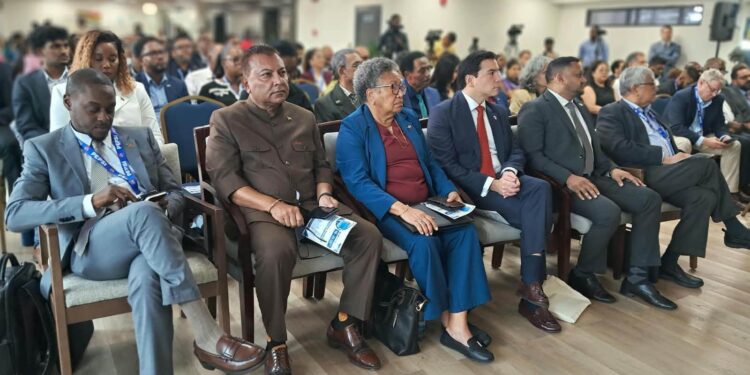
It is both an honor and a historic privilege to welcome you to Georgetown for the inaugural Global Biodiversity Alliance Summit.
Welcome to Guyana — a true treasure trove of biodiversity. Welcome to Guyana — where nature thrives and astonishes.
Here in our beloved country, nature doesn’t whisper. It sings, it soars and it roars.
Guyana is home to more than 1,200 species of birds — a staggering number that rivals, or even surpasses, much larger nations. From the resplendent cock-of-the-rock to the majestic harpy eagle, the skies and forests of Guyana are alive with color and sound.
We are the proud custodians of approximately 225 species of mammals, including iconic apex predators like the golden jaguar and rare species such as the giant river otter — a gentle guardian of our rivers and wetlands.
Our nearly 8,000 species of plants, many of which are found nowhere else on Earth, flourish atop the ancient and ecologically rich Guiana Shield — making Guyana a sanctuary of botanical wonder.
But perhaps what truly distinguishes Guyana is not just the abundance of life, but the integrity of its ecosystems. Over 85% of our land remains forested, undisturbed, and brimming with life. Ours is not a biodiversity only found in books or museums — it is a living, breathing force.
Here, in this land of mighty rivers and unbroken canopy, biodiversity is not an abstraction. It is the rustle of the forest, the call of the red howler monkey, the glint of sunlight on butterfly’s wings. It is the pulse of our land, felt deeply by those who live here and those fortunate enough to visit.
We meet at a moment of unprecedented urgency—yet also immense opportunity. Today, we are not simply launching an initiative—we are igniting a global movement to protect the living fabric of our planet, and I am proud that this movement begins here, in Guyana with the support and partnership of all of you in this room. We cannot overcome these challenges individually. We must build strong, resilient, sustainable partnerships so that we can overcome all the headwinds and storms that will come our way.
Across the globe, biodiversity is under siege. Every year, we lose an estimated 10 million hectares of forest. One million species face extinction. Wetlands are vanishing three times faster than forests and we are approaching irreversible tipping points in key ecosystems—from coral reefs to savannahs to rainforests.
These changes are not remote or abstract, they are real, immediate, and devastating.
They affect the water we drink, the food we eat, the air we breathe. They affect our jobs, our health, our economies, our cultures, our peace. They affect our very survival.
Some scientists warn that the world is facing its 6th mass extinction. And yet, the destruction continues—not due to ignorance, but due to invisibility. Because too often, the true value of biodiversity is ignored in national accounts, absent from financial statements, and invisible in boardrooms and budget plans.
The invisibility ends here.
Ladies and gentlemen, Guyana is proud to serve as the convener of this Summit and the foundational leader of the Global Biodiversity Alliance and we are proud not only because of what we have done, but because of what we represent.
Guyana is a high-forest, low-deforestation (HFLD) country. Over 85% of our land is covered in lush, carbon-rich rainforest. We sit at the heart of the Guiana Shield, one of the last intact tropical forest ecosystems on Earth.
But we are more than stewards—we are pioneers.
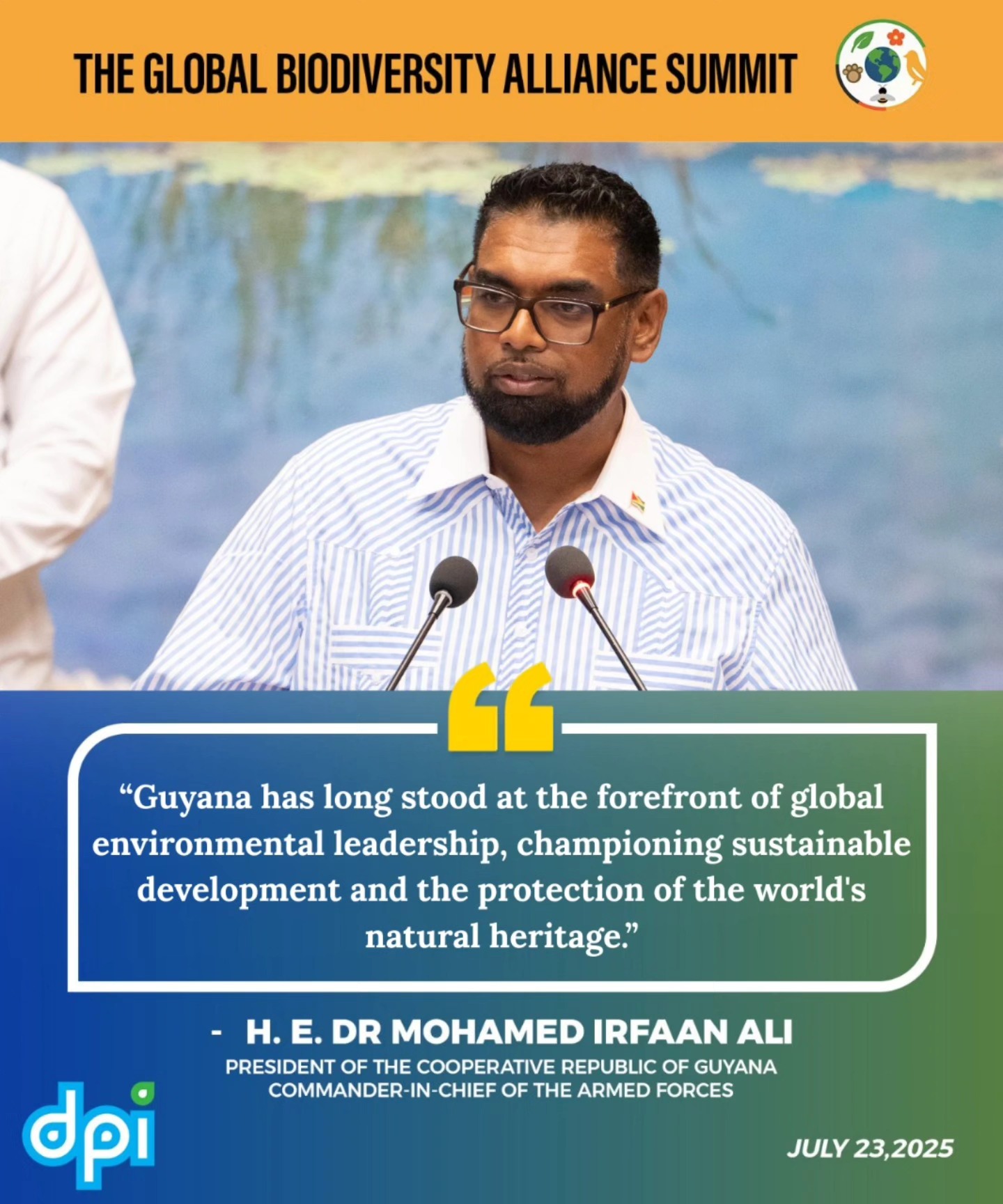
Guyana has long stood at the forefront of global environmental leadership, championing sustainable development and the protection of the world’s natural heritage. As early as the 1990s, Guyana made an unprecedented commitment by setting aside nearly one million acres of pristine rainforest for the Iwokrama International Centre, a model for sustainable forest management.
This bold move was followed by the establishment of a national protected areas system, safeguarding some 18,000 square kilometers of key ecosystems across the country. Guyana further cemented its leadership by forging a landmark forest partnership with Norway. This partnership is one of the first such climate finance agreements in the world, which has since become a global model. As a proud member of the Queen’s Commonwealth Canopy, Guyana has aligned its forests with a wider vision of shared stewardship across Commonwealth nations.
Today, the country continues to lead with the implementation of the revised and expanded Low Carbon Development Strategy 2030 (LCDS 2030), which builds on past successes to advance climate resilience, forest conservation, and a diversified low-carbon economy for all Guyanese.
Through our Low Carbon Development Strategy, we have demonstrated how economic growth and environmental stewardship can coexist. We are the first country in the world to be paid at national scale for forest carbon under the ART-TREES framework. We are innovating in areas like forest carbon and biodiversity credit, sustainable forestry, community tourism, and low carbon finance.
And now, with the Global Biodiversity Alliance, we are taking our leadership to a new level.
The Global Biodiversity Alliance is a call to arms—a rallying cry to governments, institutions, investors, communities, and citizens. It is built on three powerful convictions:
- That biodiversity is the infrastructure of life;
- That measuring biodiversity is the foundation of meaningful action; and
- That investing in biodiversity is not a luxury—it is a necessity.
We need a Global Biodiversity Alliance because nature doesn’t follow borders — and neither should our efforts to protect it. Nature is global, and so must our action be. By bringing countries, communities, scientists, and leaders together, we can share knowledge, pool resources, and tackle big problems like habitat loss and climate change faster and smarter. Together, we can protect our planet’s incredible variety of life for today and tomorrow.
The Alliance has five pillars:
- First, to advance the global goal of conserving at least 30% of land and oceans by 2030;
- Second, to embed biodiversity in national and corporate planning through measurable indicators;
- Third, to unlock innovative finance, including biodiversity credits, green bonds, and debt-for-nature swaps;
- Fourth, to empower Indigenous Peoples and Local Communities—the guardians of nature; and
- Fifth, to institutionalize monitoring and transparency through the Global Biodiversity Product and the Gross Biodiversity Power Index.
Let us be clear: this is not just an environmental imperative. This is an economic revolution. We now have evidence—rigorous, credible evidence—of what biodiversity is worth. And I thank our partners at McKinsey & Company and Conservation International for leading this groundbreaking valuation work, and I think we should applaud them.
McKinsey and Company and Conservation International did extraordinary work to get us here. Their analysis tells us that:
- Guyana’s ecosystems provide over $15.2 billion per year in ecosystem services.
- An overwhelming 96% of that value comes from non-market services—those invisible benefits we all rely on but never pay for.
- Genetic resources alone—from plant compounds with medicinal potential to unique species traits—are worth $8.4 billion annually.
- Existence and bequest values—what our people are willing to pay to preserve nature—amount to $3.6 billion per year.
Think about that. The forests of Guyana—not being cleared, not being sold, not being converted—are providing more economic value by standing than they would if destroyed. This is the very essence of a nature-positive economy.
And this value is not unique to Guyana. It is echoed in every forest, reef, wetland, savannah, and mountain on Earth. I pause to recognize also Concordia who are with us at this conference.
Yet, despite this intrinsic value, biodiversity remains grossly underfunded. Today, we invest just $200 billion per year in nature. But to meet the Global Biodiversity Framework targets, we need at least $700 billion annually.
That means we must more than triple global finance for nature. And we must ensure that this finance flows to where it is most needed—especially in the Global South.
The Global Biodiversity Alliance will prioritize this. We are committed to:
- Scaling blended finance to de-risk investment in nature-based enterprises.
- Piloting biodiversity credits that reward stewardship.
- Expanding debt-for-nature swaps, modeled on our own experience.
- Supporting community-driven finance models that place Indigenous leadership at the centre.
We invite development banks, asset managers, impact investors, and sovereign wealth funds to join us. Because financing nature is not charity—it is insurance. It is resilience. It is return on investment.
To this end, yesterday, we had fruitful discussions with the Chair of the business end of COP, private sector arm of COP 30, and we will be in that round table advancing these very ideas.
It is therefore with great pride that I announce today a landmark Memorandum of Understanding between the Government of the Co-operative Republic of Guyana and the Yale Center for Biodiversity and Global Change.
The MoU marks the beginning of a strategic, long-term collaboration focused on biodiversity science, data, and technology.
Under this agreement, Yale—through Map of Life, their global biodiversity intelligence platform —will work with Guyana to:
- Support our leadership in the Global Biodiversity Alliance;
- Help us design a world-class International Centre of Excellence for Biodiversity Research right here in Guyana;
- Build a national biodiversity information system, with maps, dashboards, and data layers;
- And guide the application of cutting-edge biodiversity science to decision-making—including for our 30×30 commitment.
Yale brings not only its world-class expertise, but also a network of partners including the E.O. Wilson Biodiversity Foundation, Map of Life, and the broader GEO community.
This is a monumental step forward—not just for Guyana, but for South-South and North-South collaboration in biodiversity science.
We are building the global biodiversity knowledge infrastructure—from the ground up, and from Guyana out.
No biodiversity strategy can succeed without the full involvement of those who live closest to nature—our Indigenous Peoples and Local Communities. In Guyana, we know this well.
In the Rupununi, the discovery of the critically endangered Red Siskin led to the formation of the South Rupununi Conservation Society—a grassroots organization led by Indigenous youth. They have not only helped restore the species—but have built pride, income, and identity through ecotourism, education, and conservation.
This is not just a story of birds—it is a story of hope.
Nature is not only about carbon or commerce—it is about connection. It is about what it means to be human. We must protect not just biodiversity, but bio-cultural diversity.
For too long, we have spoken in generalities about biodiversity. Not anymore.
With the Global Biodiversity Product, we will track tangible ecosystem outputs: from carbon sequestration to pollination to water filtration. With the Gross Biodiversity Power Index, we will rank national progress with integrity and comparability.
This is our answer to GDP. This is how we move from intention to evidence, from commitment to consequence.
We call on all Alliance members to adopt these tools—so that we can speak a common language, and hold each other accountable.
My friends, the stakes could not be higher. The moment could not be more urgent but, the opportunity has never been greater.
We are not here to admire the problem. We are here to build solutions. We are not here to repeat promises. We are here to create accountability. We are not here to lament what has been lost. We are here to protect what remains.
Let this be remembered as the Summit that changed the trajectory of our planet.
Let us rise—together—as a Global Biodiversity Alliance.
Let us show the world that we can build an economy that honors nature, a development model that values life, and a future that is abundant not in extraction, but in restoration.
Let history record that when the world stood at the brink of ecological collapse, it was the voice of small states, forest peoples, and moral conviction that sparked a global awakening.
Let that voice rise from this room here in Guyana today. Let it rise from this Alliance. Let it rise from you.
Thank you, and may we go forward in unity, courage, and action.
I end at the perfect time to welcome a champion of climate change, climate financing, and developing country, Prime Minister Motley, and I think we should give her a huge round of applause for her continuous, sustainable work. And we also have, I think, Prime Minister Ralph Gonzales. So, what an appropriate time to have another champion in the room.
We’ll be sitting, of course, with the Vice President of Ecuador, another champion Prime Minister. The Vice President of Ecuador has just launched a new legislation to protect national parks. So, we have policy makers, members of academia, scientists, who are all willing to put in the work to get it done.
And I welcome Prime Minister Ralph Gonzales and his very beautiful wife, who add immense value to his life, and I noticed they have a very striking combination of colours today. I would say the Prime Minister is playing the more diplomatic couple today, but let’s welcome everyone, and as I said, today is another important day in the life of our planet and in our work on environment.
Thank you very much and God bless all of you.