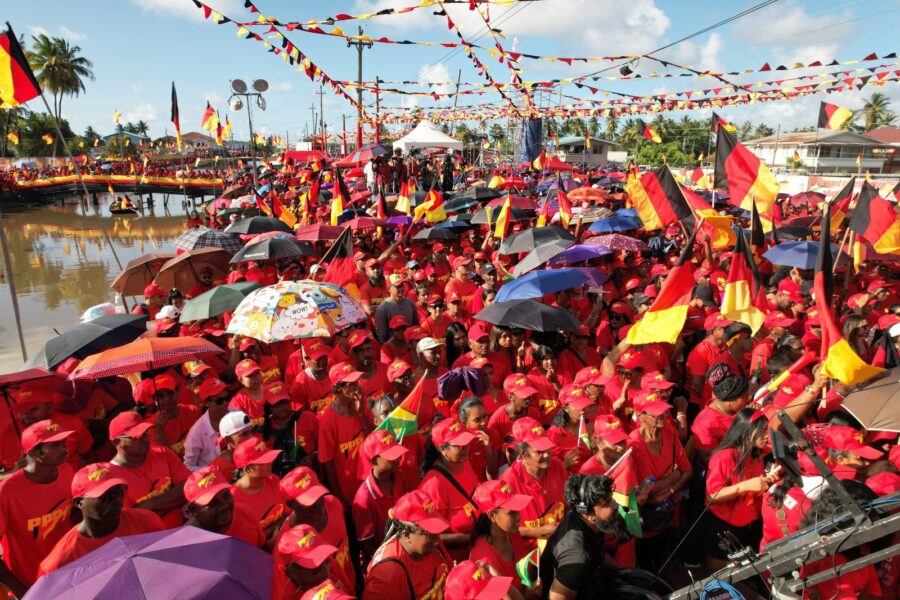
By Mark DaCosta- In what appears to be a significant bid for voter support, the People’s Progressive Party (PPP) is seeking to secure a minimum of 55,000 votes from Region Six in the lead-up to the upcoming elections. This ambitious appeal comes laden with a torrent of assertions about regional development and economic transformation, particularly in Albion, Berbice — a focal point for the party’s strategy in its quest for continued power. The recent rally, attended by an enthusiastic crowd, featured speeches from President Irfaan Ali, Vice President Bharrat Jagdeo, and other party luminaries, all keen to impress upon the public the urgency of their cause.
The rally, held on July 20 at Albion Estate Road, drew a substantial crowd that witnessed the PPC leaders’ spirited rhetoric. Ali called on residents not just to cast votes in favour of the beleaguered sugar industry but to imagine a broader prosperity for Guyana, stating, “You are not only voting because we’re going to keep sugar alive and keep those sugar jobs alive; you are voting because we will give our sugar workers more.” Such a statement raises eyebrows, given that the sugar industry has struggled under the PPP’s long tenure. The party has governed for 28 of the last 33 years, so one must question the timing of these promises and why similar efforts were not made previously.
Ali laid out a vision where Region Six becomes a key player in Guyana’s burgeoning oil and gas sector, unveiling plans for a significant oil and gas hub that features a deep-water port. This port, he proclaimed, would facilitate trade with Brazil and support local economic growth. “This region will be home to our second oil and gas hub,” he declared, detailing ambitions for gas processing facilities and infrastructure to create thousands of jobs. However, residents who have observed the slow pace of infrastructural development in their region might wonder if this newfound urgency is more about garnering votes than about committed investment.
In addition to the energy initiatives, Ali promised a plethora of advancements that would purportedly uplift the local economy and create lasting employment opportunities. Among these initiatives are plans for improved agriculture through infrastructural assistance — enhancements to drainage and irrigation systems, storage, and drying facilities for paddy. He committed to establishing “a dedicated fertiliser plant to ensure affordable and accessible supplies for local farmers.” Yet, sceptics among the populace question why such plans were not enacted in earlier years when they had the power to make substantial changes.
Vice President Jagdeo, echoing Ali’s promises, touted the PPP’s track record while insisting that the party would continue to subsidise essential costs like electricity and transport for its citizens. He boasted about the previous election’s outcome in Region Six, where the party garnered over 40,000 votes. “I’m looking for at least 55,000 votes in these elections,” he said, displaying confidence.
Among the lofty claims presented at the rally was the development of Berbice as a centre for cutting-edge technical training. Ali detailed plans for Guyana to possess the most advanced technical school in the Caribbean and Latin America by 2030, asserting, “By 2030, your region will be the technical training capital of the entire Caribbean.” He shared that the government intends to establish a state-of-the-art recreational facility and a high-performance centre for athletes in the area, recognising the need for better facilities to nurture local talent.
Further promises included an ambitious agenda for infrastructure improvements, such as promises for new roads and the construction of a toll-free, four-lane high-span bridge across the Berbice River. Renowned for burdening citizens with financial pressures, the PPP has pledged to reduce vehicle taxes and improve waste collection systems. Likewise, Ali assured residents of increased cash grants, healthcare vouchers, and further subsidies to ease the tax burden on families.
Dr Mark Lyte, a key speaker and former president of the Guyana Teachers’ Union, reiterated the party’s commitment to education, claiming, “The education sector has never seen the kind of growth we have experienced in the last five years.” While he praises the apparent advancements in education, many residents might well question whether these advancements are all-encompassing or if they come with caveats that have yet to be addressed adequately.
Chandon-Edmond, a recent crossover to the PPP, infused sentiments of loyalty and belonging in her speech, stating, “We are witnessing development that is touching every single door, every single household, and every family.” Yet her assertions face scrutiny when recalling that the PPP’s enduring tenure has often resulted in disillusionment among the electorate.
The repetitive pattern of grand promises without tangible past achievements raises doubts. Criticism of the PPP’s governance style has prompted some citizens to regard these overblown claims as mere marketing tactics to conjure enthusiasm before the polls rather than a genuine effort to bring about substantial improvements to their lives.
As the party ramps up its appeal, Ali and Jagdeo stressed the dire consequences of a minority PPP government, urging constituents not to risk their future by diverting their support to rival parties. Ali warned, “You saw the dangers of that in 2011,” implying that previous attempts at political diversity had severely disrupted societal progress. Yet these claims invoke prompts of scepticism, especially with the current levels of corruption and inefficiencies that have often marred the party’s record.
While it’s clear that the PPP aims to galvanise support through grand gestures and promises, the crucial question remains — will they translate into meaningful action or are they simply an election strategy to maintain the party’s grip on power?