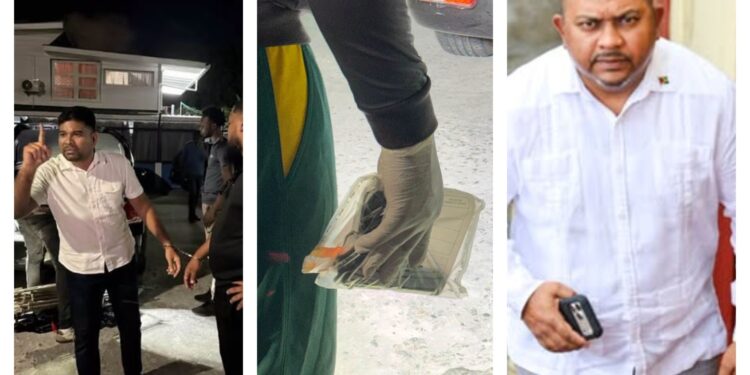
By Mark DaCosta- Nazar “Shell” Mohamed and his son have recently taken a new legal stand against the sanctions imposed by the U.S. Treasury Department, asserting their innocence in evading significant taxes related to their gold exports. This development could have far-reaching implications for their businesses and political aspirations.
In a dramatic turn of events, Nazar Mohamed has refuted allegations that he and his son, Azruddin, owe over US$50 million in unpaid taxes on gold trades exceeding 10,000 kilograms. Speaking from the Georgetown Magistrates’ Court, he insisted that his legal team is actively seeking the removal of the sanctions that have dogged them for nearly a year.
“No, I haven’t, no,” he declared when asked if he had evaded taxes, adding with conviction that multiple lawyers are diligently working on the matter. His concern centres on what he perceives as selective scrutiny, questioning how only the Mohamed family has been targeted amidst widespread gold exportation in the country.
Azruddin’s response to queries about his tax compliance was notably cautious; he simply stated, “No, I don’t know about that,” when pressed on whether taxes had been dodged – a sign of the delicate position both men find themselves in amidst the ongoing investigation.
The United States allege that the Mohameds, alongside their businesses, including Hadi’s World and Mohamed’s Enterprise, have systematically under-declared their gold exports to circumvent Guyanese taxes, subsequently depriving the government of crucial revenue. The sanctions, enacted by the Office of Foreign Assets Control (OFAC), not only blacklist the Mohameds but also restrict any financial dealings by U.S. citizens with them. It has been claimed that between 2019 and 2023, these businesses omitted substantial gold quantities from their declarations, thereby avoiding approximately US$50 million in taxes owed to the state.
Sanctions of this calibre bring severe repercussions for the sanctioned individuals and their enterprises. They impose obstacles for financial institutions wary of engaging in transactions that might fall afoul of U.S. regulations. The ramifications extend beyond mere fines, potentially crippling the operational prospects of the affected businesses.
In the midst of this scandal, Azruddin Mohamed has unveiled his aspirations to ascend to the presidency in the upcoming General and Regional Elections set for September 1, 2025. His announcement on Independence Day has been seen as a declaration of intent that challenges the status quo of our nation’s politics. With a focus on philanthropy and community engagement, Azruddin is galvanising support from those who are disillusioned with the ruling party, the People’s Progressive Party (PPP).
His call for a political overhaul resonates with citizens yearning for a leadership approach that celebrates inclusivity and equality. His platform aims to address the pressing issues of education, healthcare, and equitable economic development, positioning him as a relatable figure for a populace increasingly frustrated with entrenched political figures.
As Azruddin builds momentum, critiques of the current administration have intensified, particularly following President Irfaan Ali’s decision to call for early elections, which some perceive as an attempt to undermine Mohamed’s growing popularity. Social media and public discussions are whisking his name into the forefront, with many viewing him as a potential contender capable of disrupting the traditional power dynamics fostered by the PPP and even the People’s National Congress (PNC).
In light of this political climate, Azruddin’s fresh approach, rooted in the principles of unity and collective progress, has garnered significant attention and support. His vision suggests an evolving political landscape where the voices of citizens are acknowledged and valued. Amidst allegations of tax evasion swirling around his family name, Azruddin stands firm in his political campaign, advocating for a new era that prioritises the welfare of our homeland’s people over mere partisan politics.