Political analyst and former People’s Progressive Party (PPP) government minister Dr. Henry Jeffrey is warning that Guyana may be witnessing the rise of manufactured political movements (Astroturfing), calling into question the legitimacy of the apparent rift between the PPP and the once politically aligned Mohamed family.
Within the past two months the Mohameds and PPP leadership have been at loggerheads. After remaining silent to a June 2024 United States Dept of Treasury sanctions of the Mohamed, allegation on US$50 million in tax evasion, a few months ago Party General Secretary Bharrat Jagdeo began attacking the Mohameds and seeking distances between the two sides.
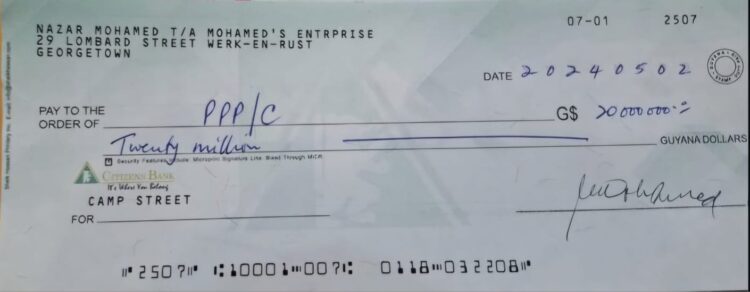
Political watchers suspected, and later confirmed by Azruddin Mohamed, that the attacks are driven by Azruddin’s growing popularity as he visited communities across the country. In his visits to the Essequibo Coast and Berbice, areas considered PPP strongholds, party supporters and government paid 10-day workers were mobilised to protest him.
Matters also took a different turn with the Guyana Revenue Authority alleging the Mohamed owned the state $900 million in taxes for the importation of luxury vehicles four years ago. The Mohamed denied owing the GRA. Last Friday, the Court barred the government from seizing the vehicle until the matter is heard.
Azruudin Mohamed has accused the PPP government, particularly Jagdeo, of harassing him, considering his growing popularity. Azruddin has alleged Jagdeo and Attorney General Anil Nandlall had promised to have GRA withdrawn the taxes if he would sign a statement that he would not run for president in the upcoming general and regional elections.
However, in a recent commentary, Dr. Jeffrey argues that the ongoing drama, marked by sudden protests, flashy social media campaigns, and claims of political realignment, is less about real grassroots dissent and more about engineered political theatre.
This is not an organic uprising, Jeffrey contends. It is a carefully orchestrated campaign meant to manipulate public perception, fracture the opposition, and deflect attention from deeper issues.
Such fake grassroots campaigns are not new. Dr. Jeffrey traces their lineage back through political history, noting examples from U.S. politics, corporate lobbying, and even Russian propaganda networks that manufacture public opinion through paid posts, staged rallies, and planted media content.
Once closely tied to the party’s top brass, the Mohameds are now seen backing anti-PPP protests and online campaigns, seemingly turning against the party they once supported. But according to Jeffrey, “the case of the Mohameds in Guyana has all the hallmarks of astroturfing.”
Viewing, with skepticism the Mohameds fallout with the PPP, Jeffrey notes dramatic shift, is underpinned by timing, funding, and media blitz, all of which points to a script, not a spontaneous political realignment.
He suggests the PPP may be publicly distancing itself from the Mohameds to appease international actors like the United States, while quietly using the fallout to destabilise opposition support. The goal, he argues, may not be to win over voters but to confuse them, fragment them, or demobilize them entirely.
In the race-voting polarised and ethnically driven electoral environment, such tactics can be effective. “If the PPP can’t get certain communities to vote for them, they may be trying to get them not to vote at all,” Jeffrey warns.
He points to familiar warning signs such as viral protest videos, identical letters to newspaper editors, sudden claims of support for Azruddin Mohamed which he contends are all hallmarks of a coordinated, well-funded messaging campaign, not a people-powered movement.
“When massive shifts in public opinion are claimed without data, and when the same talking points are repeated across platforms with no independent verification—it’s not a grassroots movement. It’s manufactured consent,” he said.
Dr. Jeffrey cautions that such deceptive political tactics pose a serious threat to democracy, especially in a digital age where perception often outweighs reality. He is contending that such campaigns are designed to mislead citizens into acting against their own interests.
He urges the Guyanese public to remain alert and critical, given that “astroturfing is difficult to detect, so it is best to always to adopt the worst-case scenario when assessing dubious political claims, largely generated by social media.”
“The manipulation of facts, narratives, and emotions has become a political weapon. And if we don’t call it out for what it is—manufactured manipulation—we risk letting democracy be driven by illusion rather than reality.”