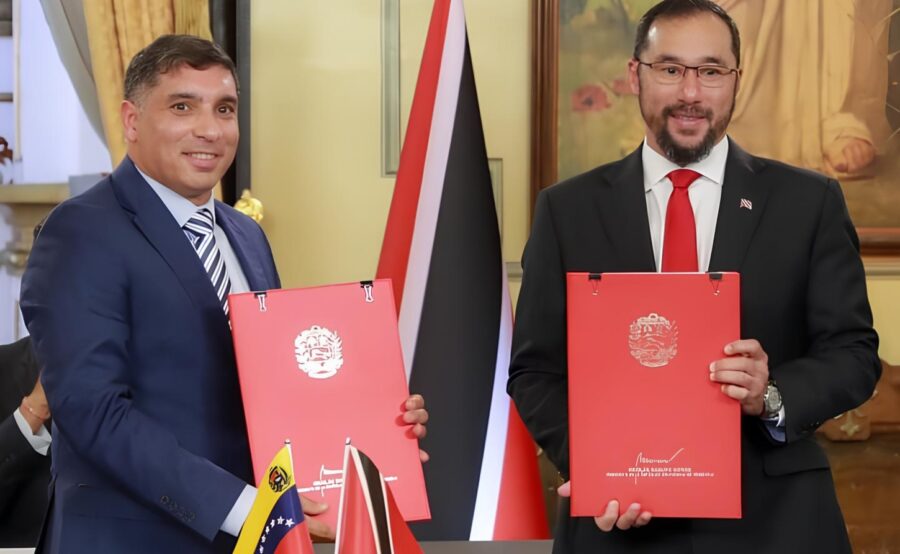
PORT OF SPAIN, Trinidad, – In a stunning blow to Trinidad and Tobago’s energy ambitions, the Trump administration has pulled the plug on crucial licenses that would have allowed the Caribbean nation to tap into shared gas fields with Venezuela, leaving government officials scrambling for diplomatic solutions and the nation’s energy future hanging in the balance.
Prime Minister Stuart Young delivered the sobering news at a hastily arranged press briefing at Whitehall, Port of Spain on Monday, revealing that Washington has revoked permissions previously granted by the US Department of the Treasury’s Office of Foreign Assets Control (OFAC) for both the Dragon Gas and Manakin-Cocuina cross-border gas fields.
“We’re currently in touch with attorneys in Washington DC,” Young stated with measured restraint, signaling the gravity of the situation while keeping his cards close to his chest on potential legal countermoves.
Young told the media that during the meeting with Rubio, he went into “granular detail” on the importance to Trinidad and Tobago and the region of the Dragon gas deal with Venezuela and what it entailed.
“Exactly how this transaction would be structured; the work that we have already done, along with Shell, to make it a reality; and the effects that it will have, in particular, on the rest of the region. I was able to set out how it would also affect the rest of the Caricom region because of the important role that we play in supporting some of our Caricom brothers and sister nations…. That was accepted.
“Secretary of State Rubio did indicate that he was pleased to receive this information…and he said that US foreign policy is in no way meant to affect or harm Trinidad and Tobago, in particular, with what we are doing for energy security. And there was a recognition that Trinidad and Tobago’s role in energy security is not limited to our domestic situation.
“He explained to me the US policy that they’re applying. I understood the US policy, and we agreed that there is a lot of room in there for Trinidad and Tobago to achieve what is needed domestically—the Dragon gas deal—as well as the role that we play throughout the region that they will give us support on and the achievement of the policy.
The timing couldn’t be more devastating for the twin-island nation. The Dragon Gas license, originally granted on October 17, 2023, was set to remain valid until October 31 this year, while the Manakin-Cocuina authorization—issued just last December—has been cut short before meaningful development could begin.
At stake is access to at least one trillion cubic feet of proven gas reserves from the Manakin-Cocuina field alone—the second largest of the fields straddling the Trinidad/Venezuela maritime border. For a small island state desperate for economic lifelines and energy security, the revocation represents more than just a diplomatic setback; it’s a direct hit to national development plans.
Young, however, projected an air of diplomatic resolve rather than surprise. “It didn’t come as a shock given recent developments the US Government has been overseeing,” he noted, hinting at wider geopolitical currents affecting relations between Washington and Port of Spain.
The Prime Minister assured citizens that his government would “continue to pursue all avenues” regarding the country’s energy sector arrangements. He’s already requested meetings with key US officials, including Secretary of State Marco Rubio, expressing confidence that Trinidad and Tobago would “be given an opportunity to continue to make our case.”
With characteristic optimism in the face of adversity, Young reminded the public that this wasn’t the first obstacle Trinidad and Tobago had faced in its energy development journey, suggesting that contingency plans were already in motion.
The original OFAC license had permitted Shell, the National Gas Company of Trinidad and Tobago (NGC), and their contractors to explore, produce and export natural gas from Venezuela’s Dragon Gas Field despite ongoing US sanctions against the Maduro regime. The Manakin-Cocuina field represented a similar opportunity for cross-border energy cooperation.
Trinidad and Tobago’s need for US permission to develop these fields stems directly from Washington’s comprehensive sanctions regime targeting Venezuela’s political leadership and economic sectors. The OFAC licenses had created a narrow legal pathway for Trinidad to engage with Venezuelan resources without violating American sanctions—a pathway now abruptly closed.
These cross-border energy projects inevitably involve collaboration with PDVSA, Venezuela’s heavily-sanctioned state oil company, making them diplomatic minefields that require delicate navigation between regional economic interests and US foreign policy objectives.
The legal foundation for American sanctions against Venezuela rests primarily on US domestic legislation, including the National Emergencies Act and the International Emergency Economic Powers Act (IEEPA), which grant the President extraordinary powers to regulate international commerce when declaring a national emergency in response to foreign threats.
Various executive orders targeting Venezuela have cited concerns ranging from human rights abuses to democratic backsliding and corruption, establishing the framework for restrictions on trade and financial transactions with the South American nation.
While firmly grounded in US law, the international legality of these sanctions remains contentious. Without explicit authorization from the United Nations Security Council under Chapter VII of the UN Charter, unilateral American sanctions face criticism as potentially violating principles of non-intervention in sovereign affairs.
Critics further argue that such economic measures often harm ordinary citizens more than targeted leadership, raising ethical questions about their implementation and effectiveness in achieving stated policy goals.
For Trinidad and Tobago, caught between its geographic reality and geopolitical forces beyond its control, the path forward requires deft diplomatic maneuvering in an increasingly complex international landscape where energy security, regional cooperation, and great power politics converge at its maritime borders.
There is a critical role here for the Caribbean Community (CARICOM) to play in discussions with the United States, as Trinidad and Tobago is an integral part of this regional body. CARICOM can lend a sober, collective voice to the negotiations, especially given that the entire region stands to benefit from any production that would emanate from a positive decision.
As a unified bloc representing shared Caribbean interests, CARICOM’s involvement could potentially shift the diplomatic calculus and provide Trinidad with the regional backing needed to navigate these troubled waters. WiredJA