Sunday, November 15, 2026
Village Voice News
ADVERTISEMENT
  • Home
  • News
  • Sports
  • Editorial
  • Letters
  • Global
  • Columns
    • Eye On Guyana
    • Hindsight
    • Lincoln Lewis Speaks
    • Future Notes
    • Blackout
    • From The Desk of Roysdale Forde SC
    • Diplomatic Speak
    • Mark’s Take
    • In the village
    • Mind Your Business
    • Bad & Bold
    • The Voice of Labour
    • The Herbal Section
    • Politics 101 with Dr. David Hinds
    • Talking Dollars & Making Sense
    • Book Review 
  • Education & Technology
  • E-Paper
  • Contact Us
No Result
View All Result
Village Voice News
No Result
View All Result
Home Global

George Lamming, a giant of modern Caribbean writing, dies

Staff Writer by Staff Writer
June 19, 2022
in Global
0
SHARES
0
VIEWS
Share on FacebookShare on Twitter

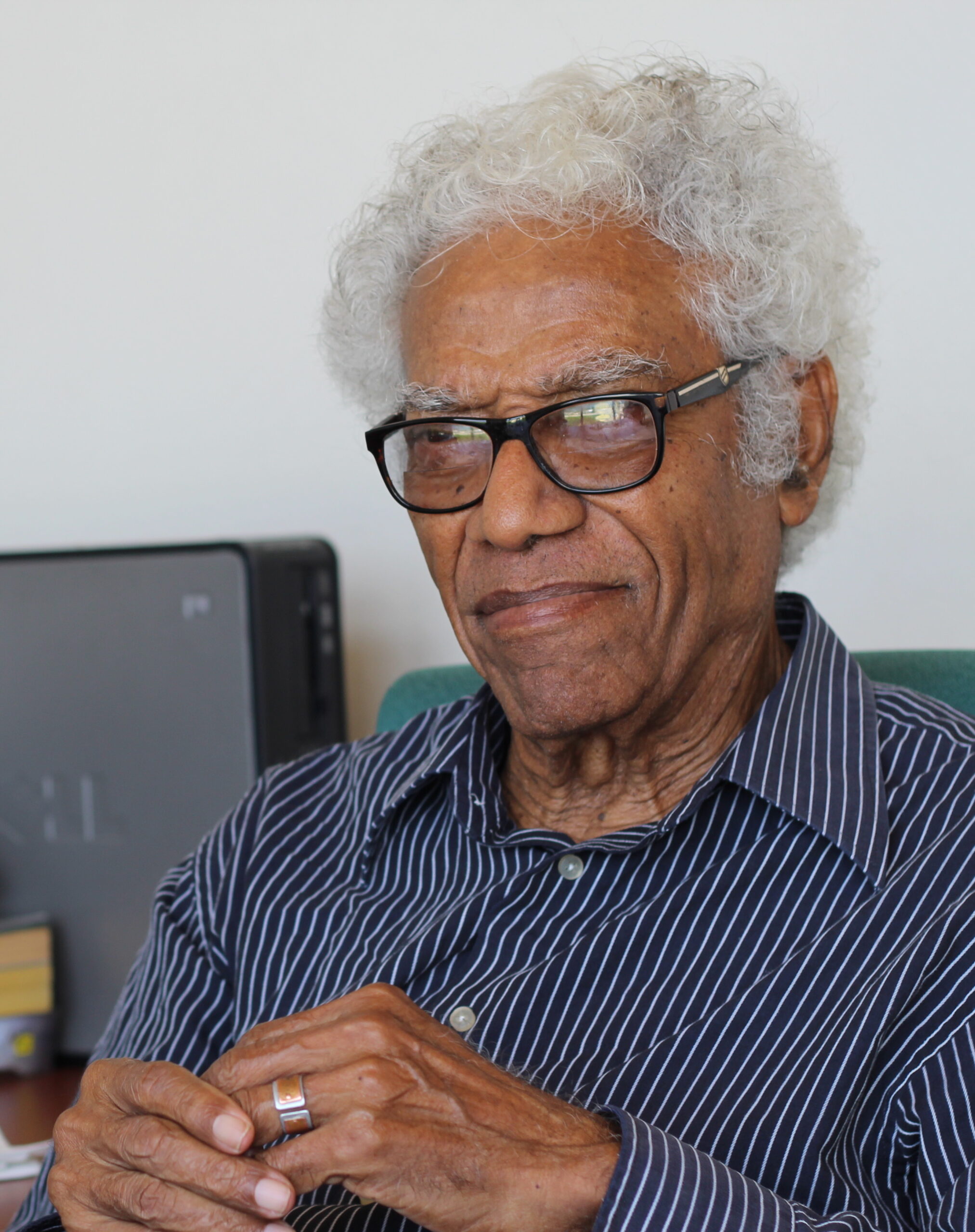
George Lamming, a giant of post-colonial literature whose novels, essays and speeches influenced readers and peers in his native Barbados and around the world, has died at age 94.

His death this month was confirmed by Barbados Prime Minister Mia Mottley, who said, “Wherever George Lamming went, he epitomized that voice and spirit that screamed Barbados and the Caribbean.” No cause of death was given.

READ ALSO

US visa restrictions force some African contestants out of Miss Universe competition

Thousands of flights canceled as airlines work to dig out from nationwide ground stop

Along with such contemporaries as Nobel laureate V.S. Naipaul, Kamau Brathwaite and John Hearne, Lamming was among a generation of post-World War II writers from the West Indies who came of age as British rule in their region was being challenged and spent at least part of their 20s in England. But unlike Naipaul, who settled in London and at times wrote disdainfully of his origins, Lamming returned home and became a moral, political and intellectual force for a newly independent country seeking to tell its own story.

“There is a kind of English which is used, say, in official situations, in the civil service context, in the context of parliament, in the context of school, and so on,” he once wrote. “But there was always, in any given territory, another kind of English, the English of popular speech, the language which the mass of population use.”

Lamming had a broad, connective vision he would say was inspired in part by the Trinidadian historian-activist C.L.R. James. His calling was to address the crimes of history, unearth and preserve his native culture and forge a “collective sense” of the future.

In novels such as “In the Castle of My Skin” and “Season of Adventure” and in the nonfiction “The Pleasures of Exile,” Lamming explored the Caribbean’s complicated legacy — as a destination for enslaved people abducted and shipped from Africa, as a colonial proving ground for England and as an uneasy neighbor of the United States, practitioners of “the deceptive magic of the dream of milk and honey.”

Lamming received his greatest acclaim for “In the Castle of My Skin,” its title drawn from an early poem by Nobel laureate Derek Walcott. Published in 1953, the novel is a semi-autobiographical narrative based in a Caribbean village uprooted by colonialism and profit taking.

“In the Castle of My Skin” was structured in part as a coming-of-age story about a boy who begins drifting from his peers when he’s admitted into a more exclusive high school. But it’s also a eulogy— for villagers left homeless, for trees cut down, land sold off and buildings razed, for the way of life being dismantled.

“The Village, you might say, is the central character,” Lamming wrote in an introduction to a 1983 reissue of the novel. “The Village sings, the Village dances, and since the word is their only rescue, all the resources of a vital oral folk tradition are summoned to bear witness to the essential humanity which rebukes the wretchedness of their predicament.”

Lamming’s novels “The Emigrants” and “Season of Adventure” drew upon his years in England, and his disenchantment with the British culture he had been conditioned to emulate. He lived for more than a decade in London, but would think of it as a cold and alienated place, where no one asked after each other and one could feel entirely alone even when living closely to hundreds of others.

“I became a West Indian in England,” he said during a 2013 interview for the National Cultural Foundation of Barbados.

Lamming revisited and reinvented not just his personal history, but the distant past, which he saw as a battle for decolonization of the mind. “Natives of My Person” was an imagined voyage on a slave ship whose captain no longer believes in their mission. In a novel he was working on late in his life, he imagined Christopher Columbus arrested by natives in the West Indies, “stripped naked” and his hands and legs in chains.” Pleads Columbus: “My errors have not been committed with intention to do ill.”

He was also greatly influenced by Shakespeare’s “The Tempest” and the slave Caliban, whom Lamming saw as a symbol for the colonial voice waiting to be heard. His novel “Water With Berries” is a modern retelling of Shakespeare’s play and “The Pleasures of Exile” explores in depth the upending of Prospero’s authority over Caliban.

“The old blackmail of Language simply won’t work any longer,” he wrote. “For the language of modern politics is no longer Prospero’s exclusive vocabulary. It is Caliban’s as well; and since there is no absolute from which a moral prescription may come, Caliban is at liberty to choose the meaning of this moment.”

Lamming’s admirers ranged from Richard Wright, who wrote the introduction to the U.S. edition of “In the Castle of My Skin,” to Jean-Paul Sartre to Kenyan author Ngugi wa Thiong’o.

Lamming spent much of the second half of his life in Barbados, but also taught at Brown University, the University of Texas in Austin and the University of Pennsylvania.

In 2008, he was presented the Order of the Caribbean Community for his “intellectual energy, constancy of vision, and an unswerving dedication to the ideals of freedom and sovereignty.” Six years later, Lamming received the Anisfield-Wolf lifetime achievement award for his “deeply political books that critique colonialism and neo-colonialism.”

Lamming was born near the capitol city, Bridgetown, in what he called a “bad village,” where Black was identified with the “cheapness of labour” and white symbolized power. In school, he would fear being asked where he lived, and on walks home with more affluent classmates he would sometimes see his mother and worry whether he should acknowledge her.

“When I hear people discussing class, I did not discover in Marx. I lived it, from the age of 10,” he later wrote.

Like the protagonist of “In the Castle of My Skin,” he was accepted into an elite high school and was encouraged by one teacher to write poetry. Lamming found a job teaching at a boys school in Trinidad before following a similar path to many contemporaries and emigrating to England in 1950, journeying on the same boat across the ocean as the Trinidadian author Sam Selvon. In London, he wrote poetry and stories and worked in programming for the BBC.

Meanwhile, as Lamming began “Castle of My Skin,” Barbados was breaking from the British. Demands for democratization had been growing since the 1930s and by the time Lamming had departed overseas, the right to vote had been expanded beyond wealthy men to include women and the lower classes. A regional federation in the 1950s gave way to independence for Barbados, Trinidad and other Caribbean countries in the following decades.

“The numerical superiority of the Black mass could forge a political authority of their own making, and provide an alternative direction for the society,” Lamming later wrote. “In the desolate, frozen heart of London, at the age of 23, I tried to reconstruct the world of my childhood and early adolescence. It was also the world of a whole Caribbean reality.” (An AP Story By Hillel Italie, New York).


 

ShareTweetSendShareSend

Related Posts

Contestants take part in the final round of the 74th Miss Universe Beauty Pageant in Nonthaburi province, Thailand, on Nov. 21, 2025. (AP Photo/Sakchai Lalit, File) License this photo
Global

US visa restrictions force some African contestants out of Miss Universe competition

by Admin
November 14, 2026

HARARE, Zimbabwe (AP) — Two African contestants will miss this year’s Miss Universe competition in Puerto Rico because of visa...

Read moreDetails
An agent helps travelers at a ticketing desk at LaGuardia Airport in New York, Friday, Nov. 13, 2026, after the Federal Aviation Administration grounded flights nationwide. (AP Photo/Ryan Murphy) License this photo
Global

Thousands of flights canceled as airlines work to dig out from nationwide ground stop

by Admin
November 14, 2026

WASHINGTON (AP) — Airlines across the U.S. worked Saturday to recover from the longest nationwide ground stop in 25 years...

Read moreDetails
Global

China values strategic communication with US military, spokesman says

by Admin
November 14, 2026

China values strategic communication with the US military, and the two defense establishments have maintained coordination on dialogues at various...

Read moreDetails
Next Post

US and PAHO call for greater spending on mental health


EDITOR'S PICK

Former President David Granger

Fatal fires have been a continuous, serious and ubiquitous menace- Granger

December 1, 2024
His Excellency President Dr Irfaan Ali described the St George’s School of Sciences as a pioneering step in reshaping Guyana’s educational landscape and as a “new model of education” tailored for the modern era.

The school, officially commissioned today in Georgetown, stands as the country’s first secondary institution solely dedicated to scientific education—an initiative, the President said, that promises to profoundly impact the academic and professional futures of Guyana’s youth.

“This is no ordinary school. It is a school of excellence, created for those with the hunger to learn and the commitment to achieve. Admission to this institution is not automatic—it is earned. Students must demonstrate strong competence in English, mathematics, and science, with marks that reflect discipline and potential.”

The school is equipped with smart classrooms featuring interactive boards, multimedia technology, and digital tools; state-of-the-art laboratories for science and information technology; and device-based learning whereby students will each receive a laptop, among other world-class facilities.

A new model of education

President Ali underscored that the school’s holistic curriculum marks a deliberate departure from the “narrow confines of rote learning”. Extended learning opportunities will be offered through tutorials, while students will also be required to participate in music, sport, foreign languages, technical and vocational education and training (TVET), and community service.

“We want to produce scientists with soul, technicians with talent, and leaders with compassion,” he stated.

“And let me emphasise—standards will be enforced. Students will be monitored for punctuality, attendance, and completion of assignments. Parents will be promptly notified of infractions. This school is not just about nurturing intelligence—it is about cultivating responsibility.”

The President highlighted the growing importance of STEM (Science, Technology, Engineering, and Mathematics) education in today’s rapidly evolving and technology-driven global economy.

“From climate change to artificial intelligence, from health to renewable energy, the challenges and opportunities of the 21st century demand problem-solvers who can think critically, analyse data, and innovate with purpose. In developing countries like Guyana, it is especially important, as it empowers young people to participate meaningfully in national development, close the digital divide, and compete on the global stage.”

He also emphasised that Guyana’s national transformation will require a new generation of scientific minds across sectors such as oil and gas, climate resilience, biotechnology, artificial intelligence, and healthcare.

“We need local talent to fill those roles. We need to train our children not just to get jobs—but to lead industries.”

President Ali further noted that his Government is currently building a national digital ecosystem that will connect classrooms, hospitals, government services, agriculture, commerce, and industry through the power of information and communication technology (ICT).

“As we roll out this system, we need to prepare our citizens for a digital future. We cannot do so unless science and technology assume greater importance within our education system. We need students to be equipped with the analytical skills, technical competencies, and creative mindset to thrive in a digitally connected and data-driven world. Without a strong grounding in science, we risk becoming consumers rather than creators in the digital age.”

He added that science education is a gateway to equality, teaching critical thinking, logic, and evidence-based decision-making.

“It empowers young people, especially those from marginalised communities, to challenge assumptions, solve real-world problems, and create innovative solutions.”

The Head of State added that while specialised learning is an idea long overdue in Guyana and represents a bold shift in the country’s academic approach, traditional schools, with their rigour and cultural legacy, will continue to serve as the bedrock of the nation’s education system.

He said that these traditional institutions must be complemented with specialised schools that focus on the arts and creative industries; agricultural science; engineering and robotics, and maritime studies and aviation technologies, among other areas.

“To all of Guyana, I wish to say that what was once a school reduced to ashes is now a symbol of resilience and reinvention.  Let the St George’s School of Sciences stand tall and vindicate the confidence which we have placed in its role as a torchbearer of the type of education system we are rolling out across Guyana.”

The school is equipped with 10 classrooms, five laboratories (three for science, one for IT and one for home economics), and other state-of-the-art amenities. It also has the capacity to house about 250 students.

Minister of Education, the Honourable Priya Manickchand, and other Government officials were also at the event.

St George’s School of Sciences represents new model of education—President Ali

July 2, 2025
Bob Marley's popular 1976 song, War, was taken from Haile Selassie's speech in his appeal to the League of Nations after Ethiopia was invaded by Benito Mussolini's troops in 1935.

CANADA | Anglican Church Embraces Reggae Icon: Bob Marley Mass Debuts in Historic Toronto Cathedral

March 22, 2025
Rickford Burke , President, Caribbean Guyana Institute for Democracy

CGID slams US Govt silence on PPP/C’s treatment of African Guyanese

February 15, 2023

© 2024 Village Voice

No Result
View All Result
  • Home
  • News
  • Sports
  • Editorial
  • Letters
  • Global
  • Columns
    • Eye On Guyana
    • Hindsight
    • Lincoln Lewis Speaks
    • Future Notes
    • Blackout
    • From The Desk of Roysdale Forde SC
    • Diplomatic Speak
    • Mark’s Take
    • In the village
    • Mind Your Business
    • Bad & Bold
    • The Voice of Labour
    • The Herbal Section
    • Politics 101 with Dr. David Hinds
    • Talking Dollars & Making Sense
    • Book Review 
  • Education & Technology
  • E-Paper
  • Contact Us

© 2024 Village Voice