By Zofeen T. Ebrahim
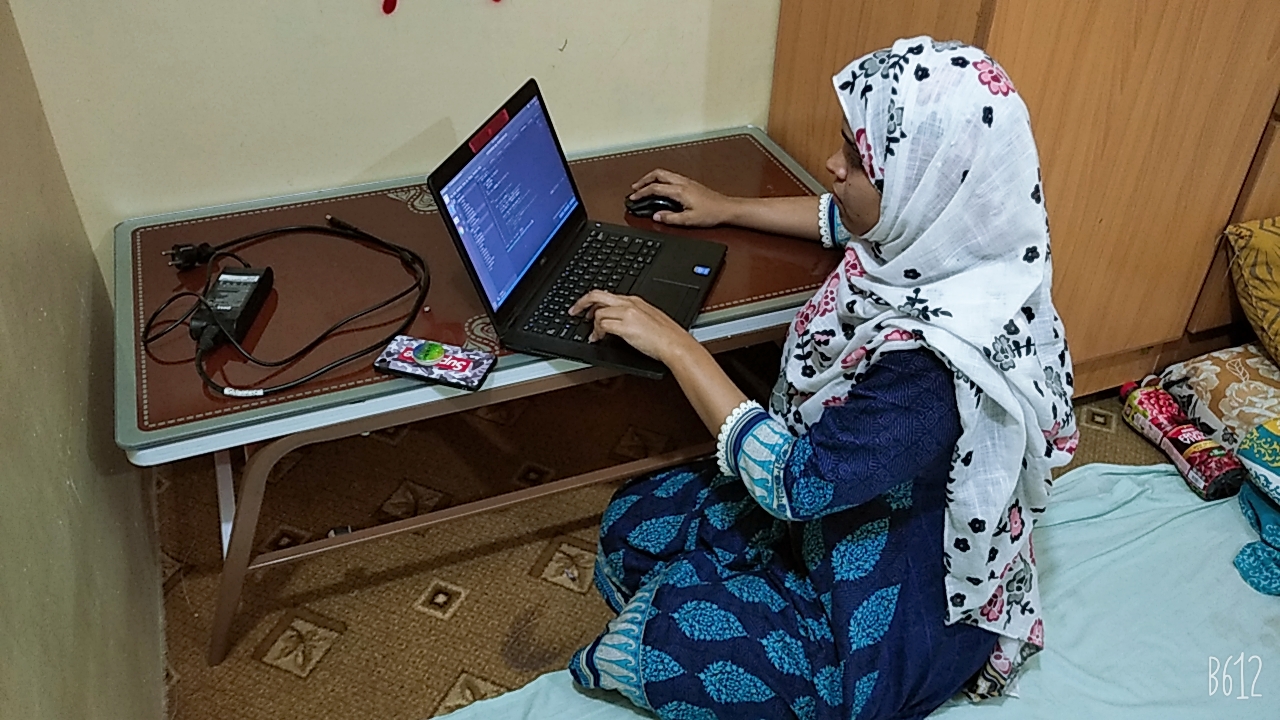
KARACHI (Thomson Reuters Foundation) – When Kainat Naz joined a women-friendly technology boot camp a year ago, she had no idea it would completely change her life and her views on how women can work in conservative Pakistan.
Naz, 22, had never ventured far from her home in Orangi Town in Karachi, one of the five largest slums of the world, but was feeling dissatisfied with her current teaching job.
So she signed up for tech programme called TechKaro, an initiative by Circle, a social enterprise that aims to improve women’s economic rights in Pakistan, and is now working fulltime for a software company.
Naz said the course was challenging in many ways but she soon found that the women on the training were just as good as the men at tech skills like coding, web development and digital marketing, and also at presenting themselves at interviews.
“From developing our CVs, to giving us tips on dressing for work, to conducting ourselves during an interview and how to battle some sticky questions … we were groomed for everything,” said Naz.
Women make up about 25% of Pakistan’s labour force, one of the lowest in the region, according to the World Bank.
It has set a target to increase this to 45%, calling for more childcare and a crackdown on sexual harassment to encourage more women out to work and boost economic growth.
In Pakistan, women represent only 14% of the IT workforce, according to a 2012 study by P@SHA, the Pakistan Software Houses Association for IT and IT-enabled services (ITeS).
GAP IN THE MARKET
Sadaffe Abid, chief executive of Circle, set up TechKaro with the help of a few private foundations in 2018 seeing this gender gap, and took on 50 trainees in the first year of which 62% were women and 75 in 2019 including 66% women.
Abid, who previously worked for a micro-finance institution, said she was delighted that women like Naz were proving that women could succeed in the tech world.
“I am a firm believer that one of the most powerful uses of technology is to bring it to young women, especially from under-served communities, to unlock their talents, resourcefulness and creativity,” said Abid.
“People told me I won’t find women, or women will drop out in high numbers, or after completing the course, women won’t find employment as the industry will not be open to hiring this unique diverse group with no degree in computer science.
“But I would say 50% of the graduates, a majority of whom are women, have found work in software companies,” said Abid, who also brought She Loves Tech to Pakistan, one of the world’s largest women and startup competitions globally.
TechKaro is one of the latest programmes in the country aimed at helping women crack the traditionally male domain.
CodeGirls Pakistan, a Karachi-based boot camp, trains girls from middle and low-income families in coding and business skills.
In 2017, a six-week camp SheSkills taught women everything from web development and digital design to social media marketing.
After attending the TechKaro course, Naz found work earlier this year at an IT company earning double the salary she was getting as a teacher but which meant leaving her neighbourhood, using public transport, and working side-by-side with men.
“I had never ventured out on my own and I was dead scared the first time I had to do it, but now it is just fine,” she told the Thomson Reuters Foundation said in an interview by telephone from Orangi Town.
“The rest of Karachi is not quite the big bad wolf I’d imagined it to be,” said Naz who navigated an app-based transit startup to reduce her travel time by two hours a day.
“It gave me a lot of confidence when I asked my employers if they would have a problem with my wearing the niqab (a veil that fully covers the face) and they said they were only interested in my work performance.”
WORK FROM HOME
Naz said women trying to break into new careers in Pakistan could face resistance not just in the workplace but at home.
The youngest of seven, she said she had the full support of her mother, who does not work, and her younger brother.
“But we had to hide this from my older brother, who is married and lives separately, as he was unhappy even with my working as a teacher,” she said.
She described the course of three hour sessions held three times a week for eight months as gruelling but worthwhile.
She paid 500 rupees ($3.13) a month for the course that involved 75 men and women and another 2,400 rupees on bus fares to attend workshops after mornings of teaching, and often spent three to four hours on homework at night.
“I had thought men would be better at this, but when I was in the thick of things, I realised that was not the case. Anyone can learn, if they put their mind to it,” she said.
A month since the lockdown was announced due the COVID-19 pandemic, Naz is working remotely.
“We use Zoom and Google Hangout for meetings and our tasks are put on Trello,” she said, at ease with the technology.
With no travel time or transport costs, she is enjoying working from home.
“For those women whose families do not allow them to step out of their homes, this kind of work would be ideal … All you need is a computer and the internet,” she said.
Abid said TechKaro has continued its work during the coronavirus lockdown by going “fully digital” so women can continue to learn tech skills from home.
“We have received applications from all across Pakistan,” she said. “Our aim is to scale this up to thousands of young women for in their success is Pakistan’s prosperity.”
($1 = 159.5500 Pakistani rupees)
(Reporting by Zofeen T. Ebrahim, Editing by Belinda Goldsmith @BeeGoldsmith and Annie Banerji; Please credit the Thomson Reuters Foundation, the charitable arm of Thomson Reuters, that covers the lives of people around the world who struggle to live freely or fairly. Visit http://news.trust.org)