Friday, May 29, 2026
Village Voice News
ADVERTISEMENT
  • Home
  • News
  • Sports
  • Editorial
  • Letters
  • Global
  • Columns
    • Eye On Guyana
    • Hindsight
    • Lincoln Lewis Speaks
    • Future Notes
    • Blackout
    • From The Desk of Roysdale Forde SC
    • Diplomatic Speak
    • Mark’s Take
    • In the village
    • Mind Your Business
    • Bad & Bold
    • The Voice of Labour
    • The Herbal Section
    • Politics 101 with Dr. David Hinds
    • Talking Dollars & Making Sense
    • Book Review 
  • Education & Technology
  • E-Paper
  • Contact Us
No Result
View All Result
  • Home
  • News
  • Sports
  • Editorial
  • Letters
  • Global
  • Columns
    • Eye On Guyana
    • Hindsight
    • Lincoln Lewis Speaks
    • Future Notes
    • Blackout
    • From The Desk of Roysdale Forde SC
    • Diplomatic Speak
    • Mark’s Take
    • In the village
    • Mind Your Business
    • Bad & Bold
    • The Voice of Labour
    • The Herbal Section
    • Politics 101 with Dr. David Hinds
    • Talking Dollars & Making Sense
    • Book Review 
  • Education & Technology
  • E-Paper
  • Contact Us
No Result
View All Result
Village Voice News
No Result
View All Result
Home News

Why Do We Eat Black-Eyed Peas on New Year’s?

Admin by Admin
December 31, 2022
in News
0
SHARES
0
VIEWS
Share on FacebookShare on Twitter

Enslaved West Africans brought cowpeas to the West Indies by 1674, according to the Library of Congress. The peas then made their way to the United States, where they were initially used to feed livestock. Several texts claim that during the Civil War, General William Tecumseh Sherman’s Union Army plundered crops throughout the South but ignored the black-eyed peas, ostensibly due to their lowly reputation as livestock food. With crops dwindling, enslaved people ate the peas left behind, eventually cementing their place in the soul food tradition.

On  Old Year’s Day (New Year’s Eve), many African-Americans make a point to cook black-eyed peas to usher in the new year, and as author John Egerton wrote in his book Southern Food, it is believed they have a “mystical and mythical power to bring good luck.”

READ ALSO

France reaffirms support for Guyana as Venezuela border tensions persist

Advancing Greenhouse Technologies and Digital Sensors in Guyana

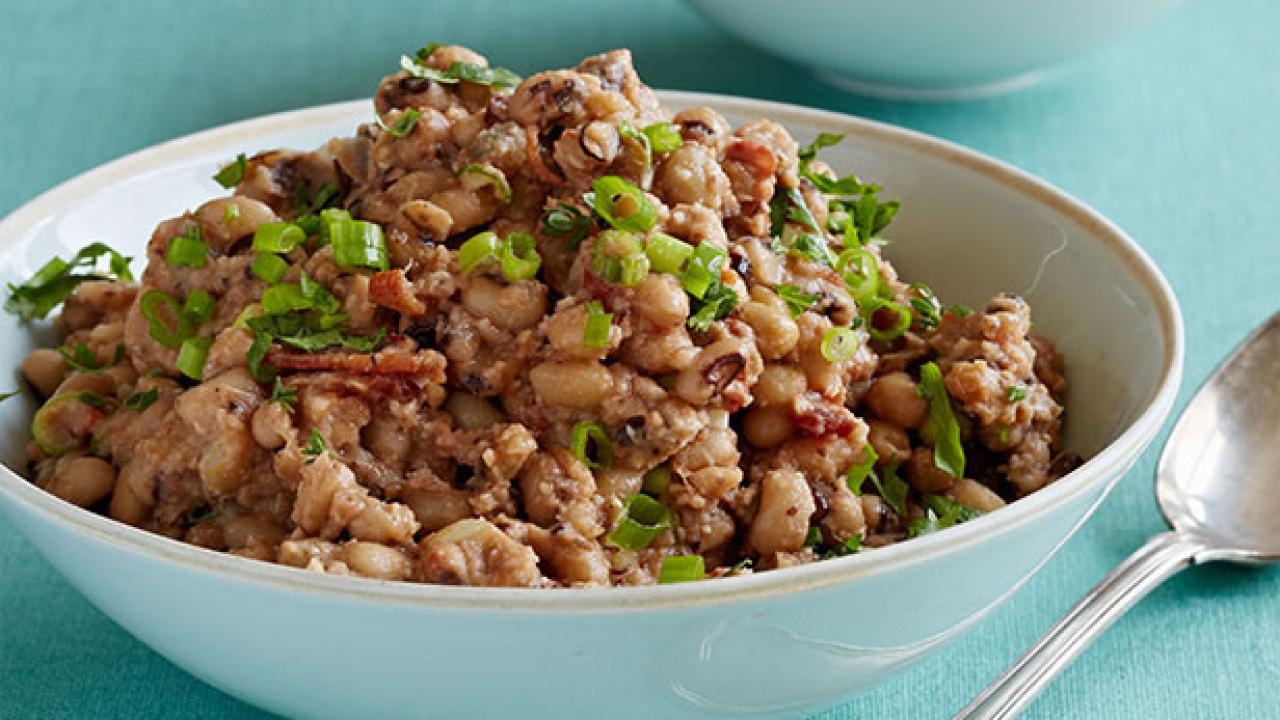
The black-eyed pea isn’t a pea at all. In actuality, it’s a bean that is in the cowpea family. Black-eyed peas made the journey to the Americas on slave ships, as the bean was brought on slave ships from West Africa to feed the ensalved people who made the long and tortuous journey across the Middle Passage. In Africa, black-eyed peas would have been either boiled and eaten with rice, or fried and eaten with rice and fried plantains. Once in America, black-eyed peas were able to be planted by enslaved people in their gardens because they were viewed as a food for poor people, and were also used to feed animals. They were often used in soups, stews and fritters.

After the Civil War, eating black-eyed peas became more common throughout the South and was not limited to being food for the enslaved people or the poor. The Union Army raided the Confederate Army’s food supplies during the Civil War and took everything that they considered edible, with the exception of black-eyed peas. At this point, the Confederate Army had to eat whatever they could find and ate the beans out of necessity.

The most common way to eat black-eyed peas is in the Hoppin’ John dish. The earliest recipe can be found in an 1847 cookbook, A Carolina Housewife, written by Sarah Rutledge. Most recipes for Hoppin’ John call for cooking the black-eyed peas with rice, pork (usually fatback or bacon) and seasonings. Some variations include chopped onions and hot sauce.

However, no one knows exactly where the tradition of eating black-eyed peas for good luck and prosperity in the new year came from; there are a couple of theories. One theory is that the enslaved ate black-eyed peas when the Emancipation Proclamation became effective on January 1, 1863. Another theory is based on the Southern phrase, “eat poor on New Year’s and eat fat the rest of the year”—grounded in the historically held belief that black-eyed peas were for poor people.

Southerners and African-Americans alike carry on the tradition of making sure a pot of black-eyed peas is on the stove to welcome in the new year, no matter where they live. As far back as 1904, there was a mention in the Broad Ax, a Black weekly newspaper in Utah. “Mrs. Marshall Drish, 4613 Dearborn Street, received a small bag of black eyed peas from one of her lady friends who came from behind the sun down in Tennessee; with the request she should cook and eat them all on New Year’s Day; If she did so she would have plenty of money all the year round. We are not in a position to state whether Mrs. Drish followed her friend’s advice or not.”

The jury is still out on if black-eyed peas really are the key to good luck for the year, but that is perhaps irrelevant. It could be said that it is more important to carry on the traditions of those who have come before, and in a small way, while we eat, we are continuing a ritual which binds us to our loved ones. What’s more valuable than that?


Extracted from the Grio and Modern Farmer


ShareTweetSendShareSend

Related Posts

News

France reaffirms support for Guyana as Venezuela border tensions persist

by Admin
May 29, 2026

As Guyana celebrates its 60th anniversary of Independence, French President Emmanuel Macron has reaffirmed his country’s support for Guyana’s sovereignty...

Read moreDetails
Farmers, extension officers and academia of regions 3, 4, 5, 6 and 10
News

Advancing Greenhouse Technologies and Digital Sensors in Guyana

by Admin
May 29, 2026

The Food and Agriculture Organization of the United Nations (FAO), in partnership with the Ministry of Agriculture (MoA) and the...

Read moreDetails
News

Congresswoman Yvette Clarke & Guyana’s Top CSEC Student Jayden Adrian To Be Grand Marshals Of Guyana’s Diamond Jubilee Independence Parade In Brooklyn On June 7

by Admin
May 29, 2026

The Guyana Independence Celebration Committee New York has announced that Chairman of the Congressional Black Caucus, Brooklyn Congresswoman Yvette Clarke,...

Read moreDetails
Next Post

Guyanese can enjoy one of the world’s highest living standards if PPP pays heed-Opposition


EDITOR'S PICK

Chinese President Xi Jinping (left, four) and leaders of the GCC countries pose for a photo at the China-GCC Summit in Riyadh, Saudi Arabia, December 9, 2022. /Xinhua

China, GCC states agree to strengthen strategic partnership

December 11, 2022
An aerial drone photo taken in April, 2025 shows the Deep Sea No. 1 energy station, in south China's island province of Hainan. China National Offshore Oil Corporation (CNOOC) announced Wednesday the full operation of the second phase of its flagship gas field in the South China Sea, marking the completion of the country's largest offshore natural gas development to date. The progress brings the gas field, named Shenhai Yihao or Deep Sea No. 1, to its designed production capacity of 4.5 billion cubic meters annually, according to CNOOC, the largest offshore oil and gas producer in China. (CNOOC/Handout via Xinhua)

Second phase of China’s largest offshore gas field goes operational

June 25, 2025

Open season on the Judiciary PPP style

May 21, 2023

GECOM extends Claims and Objection periods

September 15, 2022

© 2024 Village Voice

No Result
View All Result
  • Home
  • News
  • Sports
  • Editorial
  • Letters
  • Global
  • Columns
    • Eye On Guyana
    • Hindsight
    • Lincoln Lewis Speaks
    • Future Notes
    • Blackout
    • From The Desk of Roysdale Forde SC
    • Diplomatic Speak
    • Mark’s Take
    • In the village
    • Mind Your Business
    • Bad & Bold
    • The Voice of Labour
    • The Herbal Section
    • Politics 101 with Dr. David Hinds
    • Talking Dollars & Making Sense
    • Book Review 
  • Education & Technology
  • E-Paper
  • Contact Us

© 2024 Village Voice