For many Guyanese living with disabilities, completing a training programme is only the beginning of a much longer struggle to secure employment, earn an independent income and gain acceptance in workplaces that are not always equipped to accommodate them.
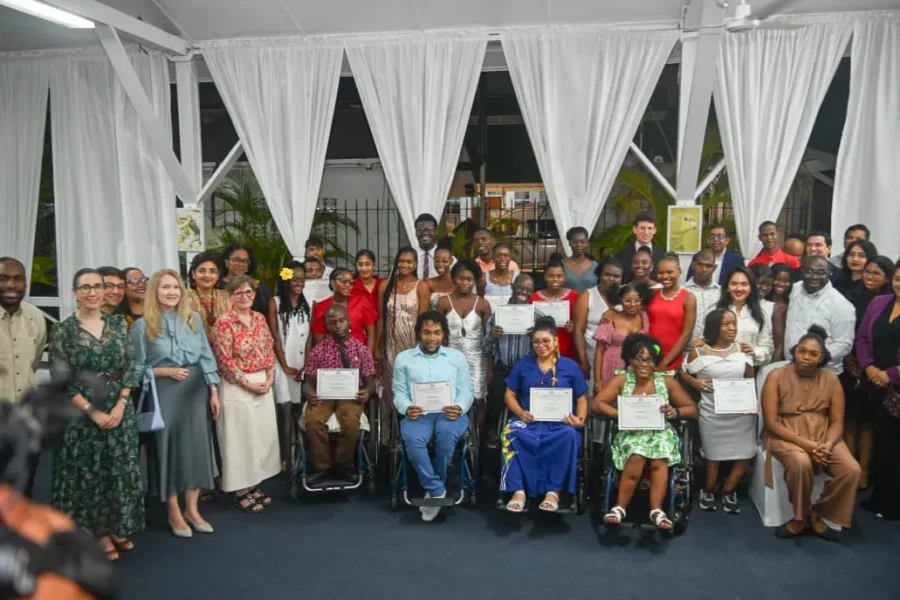
More than 30 persons with disabilities recently completed a five-day job-readiness and soft-skills programme organised by the Ministry of Labour and Manpower Planning. Their graduation on November 28 came with a significant development: at least eight private-sector companies have committed to hiring participants from the programme.
The Guyana Bank for Trade and Industry (GBTI) and John Fernandes Limited are among the employers that have made commitments, according to reports by the Department of Public Information. However, the companies have not publicly specified the number of positions available, the types of jobs being offered or when recruitment will take place. The commitments offer a potential pathway into employment for people who have historically faced considerable barriers in the labour market. Whether they translate into actual jobs, fair wages and sustained employment will be an important test of the initiative.
A significant gap in employment and education
The challenges are reflected in disability data published by the World Bank in its March 2023 report, Disability Inclusion in Latin America and the Caribbean: The Situation in Guyana.
Drawing on ECLAC analysis of Guyana’s 2012 Census, the report found that only 31 per cent of persons with disabilities aged 15 to 59 were economically active, compared with 57 per cent of people without disabilities.
The educational gap was also substantial. Among children aged three to 18, school attendance stood at 59 per cent for those with disabilities, compared with 81 per cent for children without disabilities. Among adults aged 18 to 59, 53 per cent of persons with disabilities had completed secondary education, compared with 76 per cent of those without disabilities. These figures are historical, not current 2026 employment measurements, but they illustrate the longstanding inequalities affecting access to education and economic participation.
The World Bank also cautioned that Guyana’s 2012 Census estimate of approximately three per cent of the population living with a limiting disability likely underestimated the actual prevalence because of weaknesses in data collection and reluctance among some respondents to disclose disabilities. A 2018 publication estimated that 48,519 people, or approximately 6.4 per cent of the population, lived with some form of disability.
570 people trained since 2020
The latest graduates join hundreds of Guyanese who have received vocational training through the Board of Industrial Training (BIT).
According to figures released by the Department of Public Information on November 25, BIT trained 570 persons with disabilities across 23 occupational areas between 2020 and 2026. Of that number, 347 were women and 223 were men.
Between January and September 2026, another 168 people enrolled in training across nine disciplines. Of these, 108 had graduated, while 60 remained in training.
Earlier this year, 84 persons with disabilities also graduated from a skills-training programme at the Centre for Equity, Opportunity and Innovation in Region Six, according to the First Lady’s Office.
The figures demonstrate that training opportunities are reaching more people. However, the critical question is how many graduates have secured jobs, how many remain employed and whether their qualifications are translating into improved financial independence.
Workplaces must be accessible
The challenge does not rest solely with jobseekers. Employers must also address physical, organisational and attitudinal barriers that prevent qualified people with disabilities from participating fully in the workforce.
First Lady Arya Ali, speaking at the November 28 graduation, emphasised that people with disabilities should be judged by their abilities and given equal opportunities.
“Persons with disabilities do not need sympathy. They need equitable opportunities to demonstrate their abilities and realize their ambitions,” she stated.
She also stressed:
“But preparing persons with disabilities for the workforce is only one part of the equation. We must also prepare our workplaces to actually receive them.”
This includes accessible buildings, suitable workstations, reasonable accommodations, fair recruitment procedures and protection against discrimination.
The World Health Organization estimates that approximately 1.3 billion people worldwide, or 16 per cent of the global population, experience significant disability. It identifies stigma, discrimination and barriers to participation as major factors affecting their access to opportunities.
Beyond employment to economic independence
For some participants, traditional employment may not be the only route to financial independence. Entrepreneurship and self-employment can provide alternatives, provided individuals have access to financing, business training, equipment and appropriate support.
Labour Minister Keoma Griffith has encouraged persons with disabilities to explore financing opportunities through the Guyana Development Bank to establish businesses and compete in the private sector.
The national target is to create 5,000 employment opportunities for persons with disabilities over five years. Budget 2026 also provides for vocational training for more than 1,200 persons with disabilities and entrepreneurial financing opportunities for more than 70 individuals.
The latest training graduates now face the decisive stage: moving from certificates to employment. The eight companies’ commitments are encouraging, but the public deserves to know how many people are actually hired and whether those jobs are sustainable.
Ultimately, progress should be measured not by the number of training programmes launched or certificates awarded, but by the number of persons with disabilities who secure decent work, earn independent incomes and participate in the economy with dignity and equal opportunity.