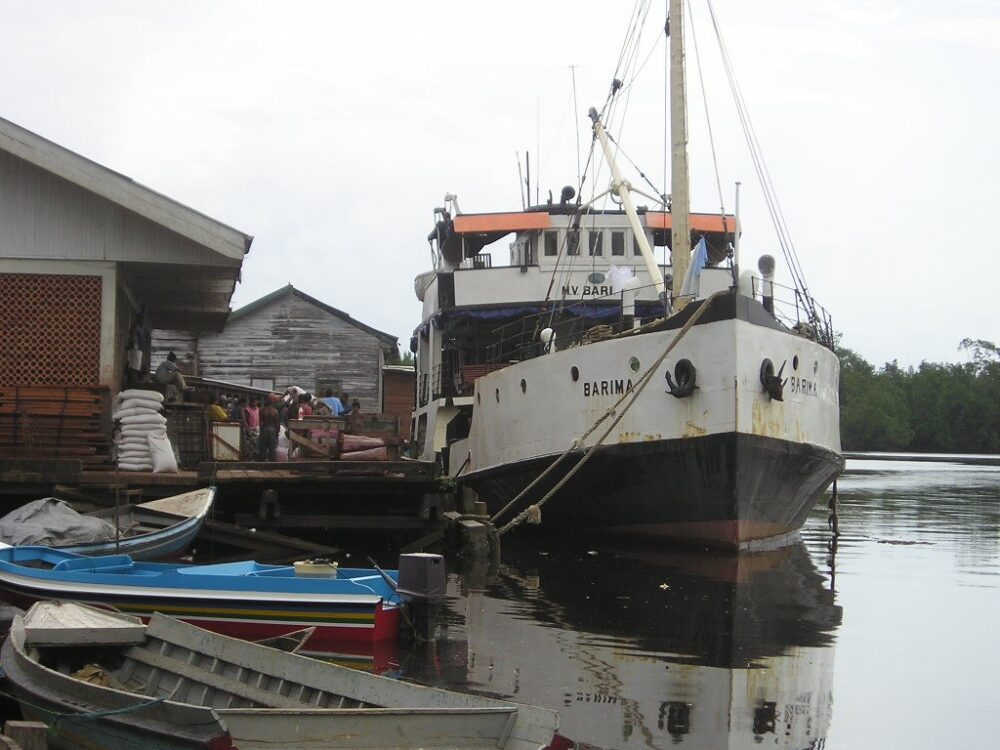
By Mark DaCosta- A forklift operator at the Transport and Harbour Department (T&HD) told the Commission of Inquiry into the sinking of the MV Barima on Friday 27 November that nobody he worked alongside checked, weighed or recorded what he lifted onto the vessel. Tromain Duncan said his job was simply to move pallets. His evidence points to a loading routine at the Kingston Goods Wharf where capacity was judged by eye and the weight of cargo was unknown to the people handling it. The inquiry is probing precisely that question, in the wake of a tragedy that has shaken our nation.
Duncan, who has driven a 10-ton forklift for seven years, walked the commissioners through the process. Customers deliver goods to the bond, where staff check them in. Labourers stack items on pallets, and he ferries these to the wharf. With a supervisor’s approval, heavy items such as steel rods can skip the bond and travel directly from a truck to the wharf. There is no marked loading area. The vessel’s own crane lifts each pallet on four hooks.
Asked about weight, Duncan said he never knew what any load weighed and, as far as he was aware, nothing was weighed when goods entered the bond. He could not say when a vessel was full. When space ran out, he said, goods were sometimes sent back to the bond, which he put at about half of all loadings. The practice suggests loading stopped when the crew ran out of room, not when a weight limit was reached.
He described how particular items were stowed: 20-pound gas cylinders strapped to pallets, 100-pound cylinders standing upright in braced rows, cement last and in the middle of the hatch. He did not see the hatch’s condition. All-terrain vehicles, he said, normally go on top of it. He could not give the weight of the generator or of seven ice boxes that commissioners asked about.
For the final loading day, 18 July, Duncan said work was behind after setbacks the previous day. He arrived around 6:30 a.m., waited about 20 minutes while the vessel was repositioned, and loaded gas cylinders first, then pallets of clay and tiles. He stopped about 2 p.m., an hour later than usual, and returned no goods to the bond. Commissioners put it to him that loading began on Monday, 13 July. He recalled starting on the Wednesday, but said he kept no record of the days. Rain, he added, can damage cargo during the long haul from bond to wharf, and weather or mechanical faults can halt loading. He said he had never had an accident in seven years.
Duncan’s account does not stand alone. A cashier told the inquiry last week that cargo tonnage figures are calculated from cash revenue rather than actual weight. Taken together, the two accounts suggest a chain in which no one is responsible for knowing how much a vessel carries. Neither witness is accused of wrongdoing, and the Commission has made no findings.
The stakes are heavy. The MV Barima capsised on its way to Region One, with 73 dead and at least 30 missing a week afterwards. Survivors rescued after hours in the water said the vessel was overcrowded with passengers and overloaded with cargo including vehicles and large pallets. Others cited heavy engines, fuel containers and all-terrain vehicles. The Commission’s remit includes the loading of the vessel and passenger boarding procedures. Earlier hearings were told the ferry’s emergency beacon was not registered.
Public confidence in the process remains fragile. At an October consultation, speakers voiced deep distrust of presidential inquiries. Evidence from workers at the bottom of the chain, who describe routines without the benefit of scales or records, may help reassure families that the questions are being asked. The commissioners will want to know who set the loading limits, who enforced them, and why a worker with seven years’ experience could not tell when a vessel was full. The inquiry continues.