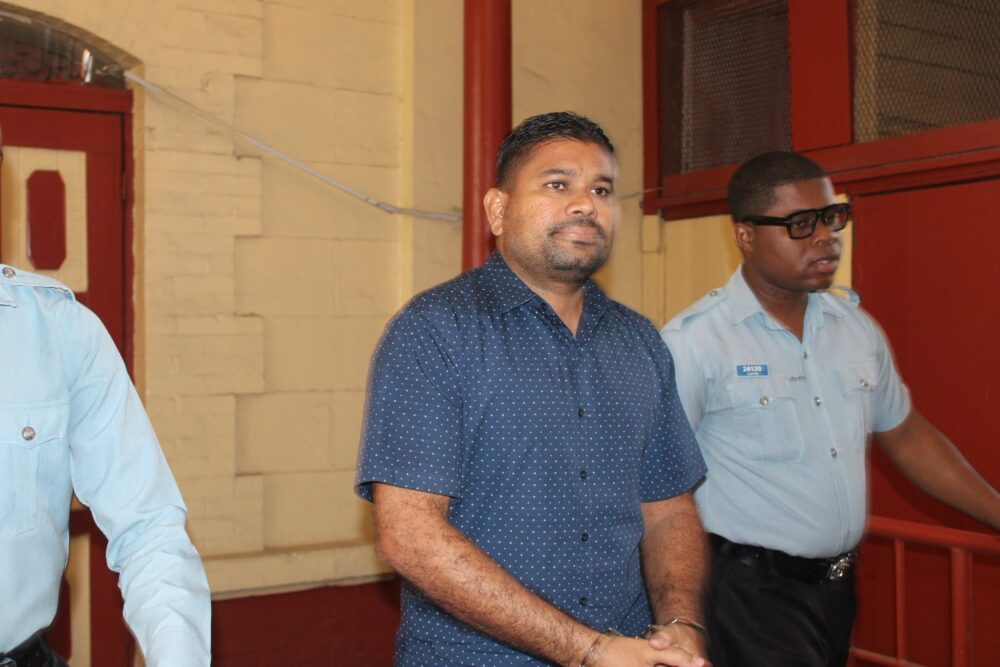
Opposition Leader Azruddin Mohamed will know today whether the High Court will overturn the decision to deny him bail on a cybercrime charge, following an extended hearing on Tuesday in which defence attorneys and State lawyers presented competing arguments over the legality of his continued detention.
Justice Priscilla Chandra-Hanif reserved her ruling until 11:00 a.m. on Wednesday, November 18, after hearing more than five hours of submissions from the respective legal teams.
Mohamed remains at Lusignan Prison pending the court’s decision.
The proceedings centre on a judicial review application filed by Mohamed’s mother, Bonita Mohamed, challenging Magistrate Abigail Gibbs’ October 30 decision to refuse bail to her son.
The defence is seeking to have that decision overturned, arguing that the circumstances surrounding the refusal raise questions about the proper application of the law and the evidential basis for keeping Mohamed behind bars.
Senior Counsel Roysdale Forde, who is representing Mohamed, argued that the legal threshold for refusing bail requires substantial grounds supported by credible information. He maintained that allegations and pending criminal charges should not automatically be treated as evidence of future wrongdoing or sufficient justification for continued detention.
Forde also challenged the reliance on information presented by prosecutors without adequate opportunity for that information to be scrutinised. The defence’s position is that evidence used to establish a risk of further offending must be capable of being tested.
Attorney Siand Dhurjon also appeared for the defence.
Attorney General Anil Nandlall, SC, however, urged the court to reject the challenge, maintaining that judicial review is not an appeal and should not become an opportunity for the High Court to conduct an entirely new bail hearing.
Nandlall argued that the court’s responsibility was to determine whether Magistrate Gibbs acted lawfully and within her authority, rather than substitute its own assessment for the magistrate’s decision.
He further maintained that the magistrate was entitled to consider Mohamed’s other pending criminal matters and the ongoing United States extradition proceedings when assessing whether bail should be granted.
King’s Counsel Darshan Ramdhani, representing the Director of Public Prosecutions, also defended the consideration of information supplied by prosecutors in determining bail applications. His position was that magistrates should be permitted to consider credible information relevant to the risk of future offending without necessarily requiring every allegation to be established through a full evidential hearing.
During the proceedings, Justice Chandra-Hanif questioned both sides about the extent to which pending charges and previous allegations could legitimately inform a magistrate’s assessment of whether an accused person might commit further offences.
The competing submissions have placed the interpretation and application of bail principles at the centre of the proceedings, particularly the distinction between considering relevant information and treating unproven allegations as established facts.
Mohamed was remanded on October 30 after he and Police Constable Ryan Greene were charged under the Cybercrime Act in connection with the alleged unauthorised acquisition and transfer of footage from the Guyana Police Force’s Safe Country surveillance system.
Prosecutors allege that footage connected to an October 12 incident outside the residence of Special Branch Head, Senior Superintendent Prem Narine, was transferred to Mohamed. He has denied the allegations.
The Opposition Leader is also facing separate proceedings involving allegations of unlawful possession of firearms and ammunition and attempting to obstruct the course of justice. He has pleaded not guilty to the firearm-related charges.
Wednesday’s ruling will determine the outcome of the immediate challenge to the refusal of bail on the cybercrime charge, but it will not necessarily settle Mohamed’s wider legal circumstances.
A separate development is expected on November 23, when Chief Justice Navindra Singh is scheduled to hear an application by the DPP seeking to revoke the GY$150,000 bail previously granted to Mohamed in the United States extradition proceedings.
Mohamed is also expected to return to the Magistrates’ Court on November 24 in connection with the substantive cybercrime matter.
The High Court’s decision today is therefore significant not only for Mohamed’s immediate prospects of securing his release, but also for the broader legal questions surrounding the evidential considerations that should inform decisions to grant or refuse bail.