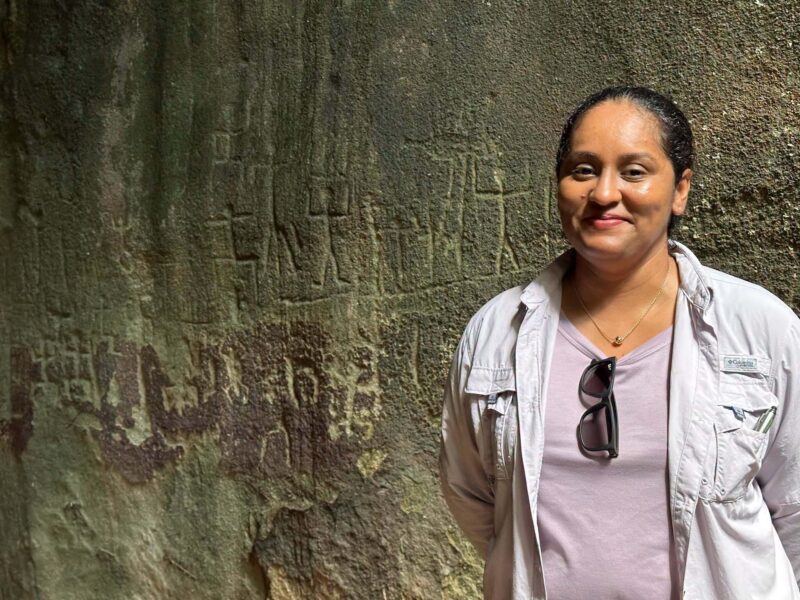
Two highly respected members of the University of Guyana’s (UG) academic community – Louisa B. Daggers, Director and Senior Researcher at the International Centre of Excellence for Indigenous and Anthropological Studies and Research – Amerindian Research Unit (ICEIASR-ARU), and Susy Lewis, Lecturer II in the Department of Forestry – are set to graduate with doctorates in Biodiversity when the University hosts its 60th Convocation this week.
Although their research has taken them along different paths, both women have pursued questions that reach beyond academic achievement: how natural environments respond to change, how knowledge can be preserved, and how research can contribute to Guyana’s future.
Daggers’ research explores the relationship between biodiversity conservation, archaeology and the human past. A longstanding curiosity about people and history, together with mentorship from Professor Emeritus Mark G. Plew, shaped her decision to pursue doctoral studies.
As head of ICEIASR-ARU, her work is closely connected to Guyana’s archaeological and Indigenous heritage. Pursuing a doctorate while continuing to serve at UG, however, meant balancing responsibilities that rarely paused. “It was a heavy mental load. Alongside being a mother of two boys, I was teaching, carrying out administrative duties, writing and publishing papers, and spending extended periods in the field,” Daggers said.
Daggers explained that she found support in her family, friends and fellow doctoral students, who helped one another through difficult periods, while her supervisors, Professor Plew and Professor Judith Rosales, provided guidance and critical feedback.
The experience also changed how she approaches research. Archaeology, she explained, requires patience, because findings such as shells, bone fragments and chemical measurements only become meaningful when understood in their proper context. “A PhD is both an education and an experience. It shapes how you think about research, its application and your own capacity to undertake demanding work,” she said.
Daggers began her journey at UG as a student before joining its staff. “The University of Guyana has been central to my development, first as a student and later as a member of staff,” she said. “Completing my doctorate here therefore carries particular meaning. It reflects the possibilities within our own institution and the value of research rooted in Guyanese questions and experiences,” the young scholar added.
Among her contributions is The Archaeology of Guyana, which she co-published with Professor Plew through the University of Guyana Press. She now hopes to strengthen archaeology in Guyana through collaborations, capacity building and greater participation by students and Indigenous communities, making the field more inclusive and responsive to the people whose histories it studies. “Personally, this degree represents the completion of a commitment that I carried through many different stages of my life. It brings a sense of fulfilment and relief. I know how much work, uncertainty and persistence sit behind this milestone,” she said.
Daggers’ advice to those considering doctoral studies is to choose a research question that matters to them, build a reliable support network and be prepared to adjust their plans. “You do not have to arrive knowing how to do everything; learning how to undertake the work is part of the degree,” she said.

Susy Lewis’ doctoral journey, on the other hand, began on a student field trip. After joining UG 21 years ago as a forester, she often accompanied undergraduate forestry students on field practicals through forests and degraded landscapes across the country.
One place stayed with her: the former bauxite-mining landscapes of Linden. Amid the disturbed terrain, she noticed vegetation returning, including Chrysobalanus icaco and native woody seedlings, and began asking how plants establish themselves in damaged environments, which species survive and what conditions support natural regeneration. “What started as a simple observation during a student field trip became one of the most meaningful journeys of my life,” she said.
Those questions became the focus of her doctoral research, but the work was far from straightforward. Her fieldwork took her across hazardous terrain, abandoned mine pits, spoil dumps and eroded slopes, often in areas that were difficult to reach.
Lewis’ research was supported by her savings, her colleagues and the Faculty of Agriculture and Forestry’s research and innovation funds. A small grant from the University of Guyana Institute of Research, Innovation and Entrepreneurship (UGIRIE) helped her complete her remaining transects, while the Guyana Forestry Commission provided accommodation in Kwakwani and a field camp at Ituni.
There were moments when the demands of the journey left Lewis questioning whether she could continue, but her family carried her through. Her late elder brother had told her his heart was swollen with pride whenever she published a paper. Her mother, now 94, called her a “warrior”. Her husband accompanied her into challenging landscapes, her three daughters became her research assistants, and her brother and sister-in-law helped care for the children.
She also leaned on her faith. “When I felt overwhelmed, when the resources seemed insufficient and when I could no longer see the way forward, I turned to God,” she said. “Prayer, fasting, reading the Bible and sometimes tears became my sources of strength.”
The landscapes she studied became a reflection of her own journey. Watching plants take root in the dusty, nutrient-poor soil of abandoned mining sites strengthened her resolve. “If they could survive, grow and flower under such conditions, I too could find the strength to continue,” she said.
Lewis now hopes to bring her findings into the classroom to help develop future forestry professionals, and to continue exploring forest ecology, environmental disturbance and natural regeneration. She encourages emerging researchers to be patient, believe in their abilities and avoid comparing themselves with others. “A doctoral journey is not a race, and everyone’s path is different,” she said.
As she prepares to graduate, she thinks of the many people who walked the journey with her. “Today, I do not see this doctoral degree as an achievement that belongs to me alone. It belongs to everyone who prayed for me, believed in me, travelled with me, cared for my family and encouraged me when I was tired,” Lewis said. “Yes, we made it together,” she added with much pride.