Guyana’s oil discoveries have transformed its economic landscape, placing the country among the world’s fastest-growing petroleum producers. However, behind the production figures and revenue announcements lies an important issue that remains insufficiently understood by the public: ring-fencing of petroleum projects.
Although the term sounds like technical accounting language, its implications are significant. It concerns how oil companies recover their investments and whether expenses associated with developing one oil project can reduce the revenue generated by another.
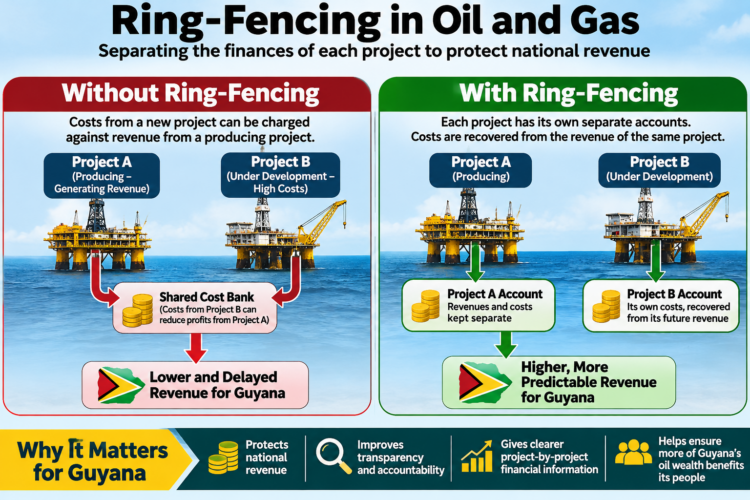
At its simplest, ring-fencing means keeping the financial accounts of individual petroleum projects separate. Costs incurred developing one project cannot automatically be charged against revenues earned from another.
Consider two offshore developments. Project A is producing oil and generating revenue, while Project B is still under construction and requires billions of dollars in investment. Without project-level ring-fencing, eligible expenses associated with Project B may be recovered against revenue from Project A, depending on the applicable petroleum agreement.
With ring-fencing, each project would have its own cost and revenue accounts. Project B’s development expenses would be recovered against its own production revenues.
The distinction is particularly important for Guyana, where several offshore developments are operating or being pursued within the Stabroek Block.
Understanding Guyana’s oil agreement
Under the 2016 Production Sharing Agreement (PSA), the contractor can recover up to 75 per cent of monthly production revenue as cost oil to cover eligible petroleum expenses. The remaining 25 per cent is profit oil, shared equally between the government and the contractor. Guyana also receives a 2 per cent royalty.
When the full 75 per cent cost-recovery allowance is utilised, Guyana receives 12.5 per cent of total production value as its share of profit oil, in addition to the royalty.
Consequently, the amount of oil produced does not necessarily translate into a proportionate increase in immediately available government revenue.
The Inter-American Development Bank (IDB), in its 2020 study, Traversing a Slippery Slope: Guyana’s Oil Opportunity, examined the implications of the agreement’s cost-recovery arrangements. Its analysis highlighted how costs across different fields within the contract area could affect the timing and amount of government revenue.
This is the central concern surrounding ring-fencing: whether established producing projects should bear eligible expenses associated with developments that have yet to generate revenue.
Dr. Vincent Adams raises concerns
One of the most persistent advocates for ring-fencing in Guyana is Dr. Vincent Adams, a Guyanese petroleum and environmental engineer and former Executive Director of the Environmental Protection Agency (EPA).
Dr. Adams brings considerable technical experience to the discussion. His qualifications include a PhD in Environmental Engineering, master’s degrees in Petroleum and Geological Engineering and Geohydrology, and a bachelor’s degree in Civil/Public Health Engineering. He also holds an Executive Leadership and Management diploma from MIT Sloan School of Business.

His professional experience includes approximately 30 years with the United States Department of Energy, including ten years in its Senior Executive Service, as well as work as a senior petroleum engineer with AMOCO Oil Company. He served as Guyana’s EPA Executive Director from 2018.
In September 2026, Adams renewed his concerns about the absence of ring-fencing, arguing that Guyana could be financing future petroleum developments through revenues generated by existing producing projects.
In a Kaieteur News article on September 9, he questioned the accumulation of costs associated with additional developments, including proposed projects eight and nine.
He also challenged the public explanation surrounding President Irfaan Ali’s August 18 announcement that approximately US$55 billion in costs had been recovered by ExxonMobil.
Adams argued that Guyanese needed a clearer breakdown of how much expenditure related to approved projects and how much was associated with future developments.
His concern is that exploration, appraisal and development expenses can accumulate years before a project begins producing oil. If eligible costs are recovered against existing production, Guyana’s immediate share of petroleum revenue can be reduced.
He questioned the government’s failure to provide sufficient public detail about the cost bank, including expenditure associated with projects that have yet to commence production.
Adams has previously maintained that ring-fencing should be a requirement in negotiations with ExxonMobil.
In May 2025, Adams, told Kaieteur News: “Regardless of oil price, because oil prices will go up and down…ring-fencing should be a requirement on the table to start the discussion with Exxon.”
His position is that Guyana should use discussions surrounding additional petroleum developments to pursue stronger financial protections.
Independent research reinforces the concern
The Institute for Energy Economics and Financial Analysis (IEEFA) also examined the implications of Guyana’s contractual arrangements.

A 2021 report authored by Tom Sanzillo, titled Lack of Ring-Fencing Provision Means Guyana Won’t Realize Oil Gains Before 2030s, If at All, explained how exploration expenses from other areas of the contract could be charged against revenues from producing fields.
The report illustrated the potential consequences of exploration expenditure being recovered against production from the Liza developments.
Although its projections should not be treated as established current outcomes, the report reinforces the importance of examining how petroleum costs are allocated.
Why Guyana must pay attention
Ring-fencing is important for several reasons.
First, it could protect revenue generated by existing producing projects from being reduced by eligible expenses associated with other developments.
Second, it would improve transparency by requiring clearer project-level accounting, making it easier for the government and public to understand where money is being spent and recovered.
Third, it could strengthen Guyana’s negotiating position as additional offshore developments are considered.
Importantly, ring-fencing does not mean oil companies cannot recover legitimate expenses. Rather, it concerns which project’s revenues should be used to recover those expenses.
Guyana also needs effective cost audits. The Ministry of Natural Resources has reported that previous audits identified expenditure disputed by the government. However, auditing costs and ring-fencing projects are different safeguards. The former examines whether expenses are legitimate; the latter determines how those expenses are allocated.
Both matter.
Who is protecting Guyana’s interests?
The government must explain how much of the existing cost bank relates to individual projects, whether expenditure associated with future developments is being recovered against existing production, and what options are being considered to introduce stronger project-level financial protections.
There are legitimate considerations surrounding investment, contractual obligations and the recovery of petroleum development costs. However, these should not prevent a serious examination of whether the existing arrangements adequately protect Guyana’s revenue.
The success of the oil industry cannot be measured solely by discoveries, production volumes or billions of dollars invested. It must also be measured by how much wealth remains available to Guyana and its people.
Dr. Adams’ warnings, together with the findings of the IDB and IEEFA, demonstrate why this issue deserves sustained public scrutiny.
Guyana’s oil belongs to its people. Protecting the value of that resource requires more than celebrating production figures; it demands transparency, accountability and financial arrangements that safeguard the national interest.