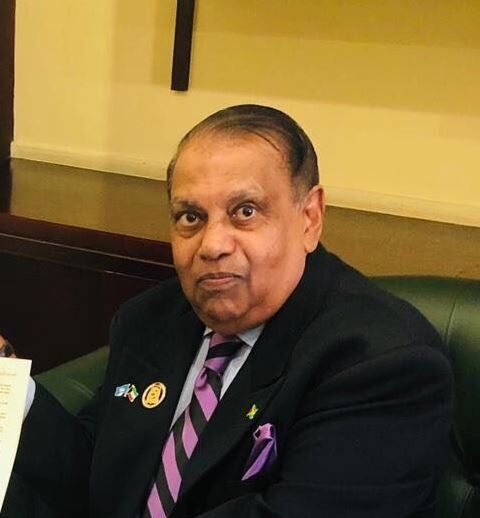
Former Guyanese Ambassador Professor Dr Shamir Ally has delivered a sobering assessment of the Alliance For Change (AFC), declaring that the party which once helped topple the People’s Progressive Party/Civic (PPP/C) has squandered its political influence, lost touch with voters and now faces an uphill battle to reclaim relevance after its crushing defeat in the 2025 elections.
In a hard-hitting opinion piece published on October 31, 2026, to mark the AFC’s 21st anniversary, Ally argued that the party’s spectacular decline from a parliamentary powerbroker to an organisation without a single seat was largely self-inflicted, driven by political miscalculations, organisational weaknesses and its failure to demonstrate tangible benefits to ordinary Guyanese.
The AFC was founded on October 29, 2005, by Khemraj Ramjattan, Raphael Trotman and the late Sheila Holder, who broke ranks with their respective political organisations to establish a third force challenging Guyana’s entrenched ethnic and winner-takes-all politics.
The party won five parliamentary seats in 2006 and seven in 2011, positioning itself as an influential political force. Its subsequent alliance with A Partnership for National Unity (APNU) helped end the PPP/C’s 23-year hold on government in 2015.
Twenty-one years after its formation, however, that political promise appears to have collapsed.
In the September 2025 elections, the AFC secured just 3,610 votes, approximately 0.82 per cent of valid ballots, and failed to win a single seat in the 65-member National Assembly.
“From KINGMAKER to FOOTNOTE,” Ally declared, capturing the magnitude of the party’s political humiliation.
He identified three principal reasons for the AFC’s collapse: organisational failure, an ineffective political message and its inability to reconnect with communities that once formed its electoral base.
Ally was particularly critical of the AFC’s decision to contest the elections independently after coalition negotiations with APNU collapsed.
He argued that disagreements over the presidential candidacy, distribution of political positions and ministerial appointments contributed to the breakdown, leaving opposition voters fragmented.
APNU subsequently secured 77,998 votes and 12 parliamentary seats, while the newly formed We Invest in Nationhood (WIN), led by Azruddin Mohamed, captured 109,066 votes and 16 seats.
Ally noted that even the AFC and APNU’s combined votes would have fallen short of WIN’s electoral performance, exposing a deeper crisis of voter confidence.
“VOTERS wanted a VEHICLE.”
The former ambassador argued that WIN successfully tapped into public anger over corruption, marginalisation and political exclusion, while the AFC offered little beyond its history and repeated declarations of principle.
He questioned why the party failed to capitalise on the record of the APNU+AFC administration, which governed between 2015 and 2020.
Among the achievements Ally attributed to that coalition were 15,000 jobs generated through GO-Invest programmes, 220 investment agreements valued at $250 billion, expanded educational facilities, improved healthcare services, infrastructure development and increased access to water and electricity.
These figures reflect achievements claimed by the former coalition administration rather than independently verified outcomes.
Ally nevertheless argued that the AFC failed to establish transparent systems for measuring project delivery and demonstrating results to citizens.
“APNU/AFC did not deliver a system to track delivery.”
He contended that political announcements and budgetary allocations mean little without measurable outcomes, project completion and accountability.
A Roadmap From Zero To Five Seats
Ally proposed a sweeping restructuring of the AFC, including a new leadership model, stronger grassroots organisation and a sharper focus on practical solutions rather than political rhetoric.
Central to his recommendations is the establishment of a Ministry of Planning and Project Management and a Ministry of Diaspora Affairs, with the AFC developing corresponding shadow structures to demonstrate its capacity to govern.
He urged the party to use technical expertise to monitor government expenditure, assess infrastructure projects and publish regular performance reports.
Ally also advocated renewed opposition cooperation, particularly with WIN, proposing a shared electoral ticket concentrated in Regions Four, Six, Seven and Ten.
He suggested that rebuilding the AFC to five parliamentary seats by 2030 would require approximately 35,000 votes, nearly ten times its 2025 performance.
The former ambassador also addressed concerns surrounding AFC leader Nigel Hughes’s law firm’s representation of ExxonMobil, recommending publicly disclosed safeguards to address potential conflicts of interest.
“VOTERS/Citizens WILL FORGIVE a Lawyer-Client Relationship. They do NOT forgive SECRECY.”
Ally maintained that the AFC’s survival depends on abandoning political complacency and demonstrating its usefulness through measurable commitments, competent leadership and credible accountability.
“I am NOT calling for AFC to DIE. I am calling for it to CHANGE ENOUGH TO MATTER.”
His intervention presents a stark warning to a party that once held the balance of political power: its founding ideals and past achievements will not automatically restore public confidence.
The AFC’s greatest challenge is no longer breaking Guyana’s two-party dominance. It is convincing voters that the party which once promised to transform Guyanese politics has not itself become another casualty of the political system it set out to change.