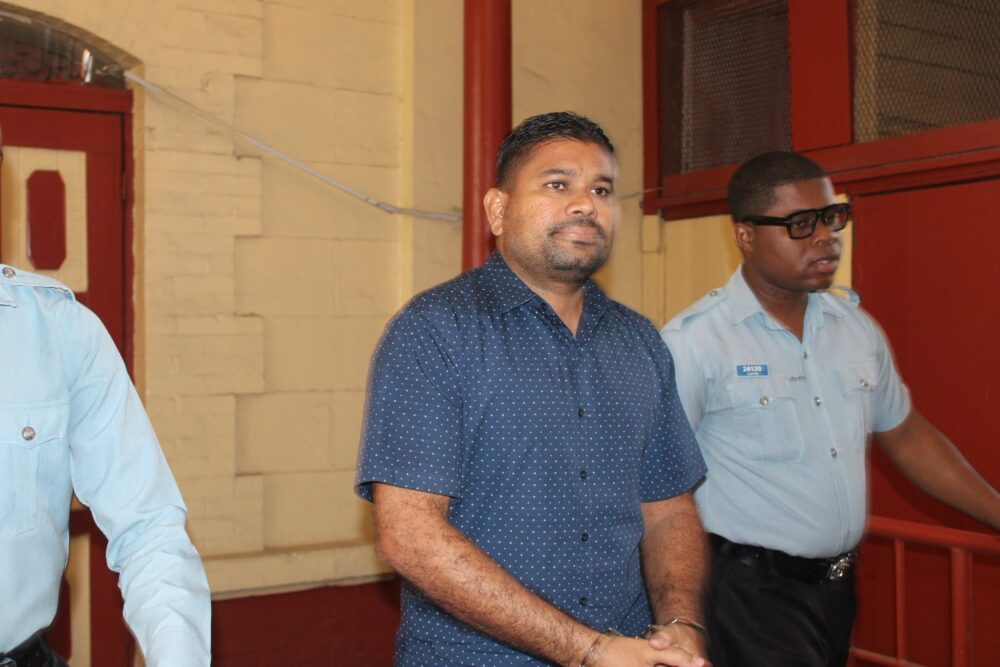
High Court Judge Justice Priscilla Chandra-Hanif has warned that Opposition Leader Azruddin Mohamed must not be subjected to psychologically oppressive conditions while on remand at Lusignan Prison, following a heated courtroom exchange between his defence attorneys and Attorney General Anil Nandlall over his treatment in custody.
The judge’s intervention came after Senior Counsel Roysdale Forde raised concerns about what he described as solitary confinement, prolonged isolation and constant exposure to bright artificial lighting that allegedly prevents Mohamed from sleeping properly.
Justice Chandra-Hanif, while cautioning that she could not prejudge the allegations without evidence, said she expected the Guyana Prison Service to ensure that Mohamed was not being held under oppressive conditions.
She emphasised that the conditions complained of should not exist and, if they did, should not continue.
Defence alleges isolation and sleep deprivation
Forde told the court that Mohamed was being held in solitary confinement, spending approximately 23 hours and 50 minutes each day inside his cell, with only about 10 minutes outside.
He further alleged that a bright white light remained shining in the cell, making it difficult for the Opposition Leader to sleep.
In describing the conditions, Forde told the court that Mohamed had resorted to propping his mattress against the wall and crawling underneath it to shield himself from the light in order to get some rest.
The senior counsel characterised the arrangements as psychologically oppressive and unlawful, urging the court to intervene.
Following the hearing, Forde welcomed the judge’s attention to the complaints.
“We’re grateful for the fact that the court has taken it as a matter of concern, the circumstances under which Mr. Mohamed would have been held.”
He maintained that the Opposition Leader was being detained in circumstances that were inhumane and oppressive.
International standards on solitary confinement
The allegations have particular significance under the United Nations Standard Minimum Rules for the Treatment of Prisoners, commonly known as the Nelson Mandela Rules, adopted by the UN General Assembly in 2015.
These internationally recognised standards establish that prisoners must be treated with dignity and protected against cruel, inhuman or degrading treatment.
Rule 43 expressly prohibits indefinite solitary confinement, prolonged solitary confinement and the placement of prisoners in cells that are dark or constantly illuminated.
Rule 44 defines solitary confinement as confinement for 22 hours or more a day without meaningful human contact. It defines prolonged solitary confinement as isolation exceeding 15 consecutive days.
Rule 45 stipulates that solitary confinement should only be used in exceptional circumstances, as a last resort, for the shortest possible period and subject to independent review.
These provisions are relevant to the defence’s allegation that Mohamed spends almost the entire day inside his cell.
The rules also address prison lighting. Rule 13 requires accommodation to meet basic health requirements, while Rule 14 requires sufficient natural and artificial lighting for prisoners to read and work without injury to their eyesight. The prohibition against constantly illuminated cells under Rule 43 is particularly relevant to the allegation that the lighting interferes with Mohamed’s sleep.
Although the Nelson Mandela Rules are international minimum standards and do not automatically establish a breach of Guyanese law, they provide an important benchmark for assessing the treatment of detainees.
Nandlall rejects allegations and produces photograph
Attorney General Anil Nandlall strongly disputed the defence’s account, accusing Forde of misleading the court about Mohamed’s treatment.
Nandlall rose during the proceedings and produced a photograph of the cell in which the Opposition Leader is being held, arguing that the conditions described by the defence did not accurately reflect the arrangements at Lusignan Prison.
He said Mohamed was classified as a high-profile prisoner and was being accommodated in a designated cell under established security protocols.
The Attorney General argued that the Opposition Leader should not expect luxury accommodation simply because of his political position.
“At the end of the day, we may, some people may not want to accept it or not, but the prison in Lusignan is not a five-star hotel. At the end of the day, it is a prison.”
Nandlall also invoked the Nelson Mandela Rules, arguing that prison authorities operate under established international standards and that additional security arrangements are necessary for high-profile detainees.
He rejected suggestions that Mohamed was being deprived of basic provisions or access to visitors.
According to Nandlall, Mohamed had submitted the names of three persons he wished to visit him, and all three had been permitted access. He also said the Opposition Leader received his meals on time and was given an opportunity to sit and eat.
Nandlall added that Mohamed’s attorneys had visited him on Sunday and spent approximately two hours with him.
“Prisons have been repeatedly sending out statements to debunk the allegations that are being made.”
The Attorney General said he had spoken directly with a prison officer in the presence of the court, who confirmed the visitation arrangements and other provisions being made for Mohamed.
Security measures cannot override humane treatment
The courtroom confrontation has brought renewed attention to the distinction between security measures for high-profile detainees and conditions that could amount to excessive isolation or psychological mistreatment.
A prisoner’s classification may justify additional security precautions, but it does not remove the obligation to ensure humane treatment and respect for human dignity.
The photograph presented by Nandlall and his account of visitors, meals and access to legal counsel form part of the government’s response. However, they do not, by themselves, resolve the specific allegations concerning constant lighting, sleeping arrangements and prolonged confinement.
Justice Chandra-Hanif has not determined that the defence’s allegations are established or that the Prison Service has breached the law. Her warning nevertheless places responsibility on the authorities to ensure that Mohamed is not held under psychologically oppressive conditions.
Mohamed remains on remand in connection with allegations involving an $800,000 payment to a police officer in relation to the unauthorised acquisition and dissemination of police surveillance footage. He has not been convicted of the offences.
The proceedings underscore a fundamental principle of justice: imprisonment restricts liberty, but it does not extinguish a detainee’s right to humane treatment, dignity and protection against conditions that could cause psychological harm.