
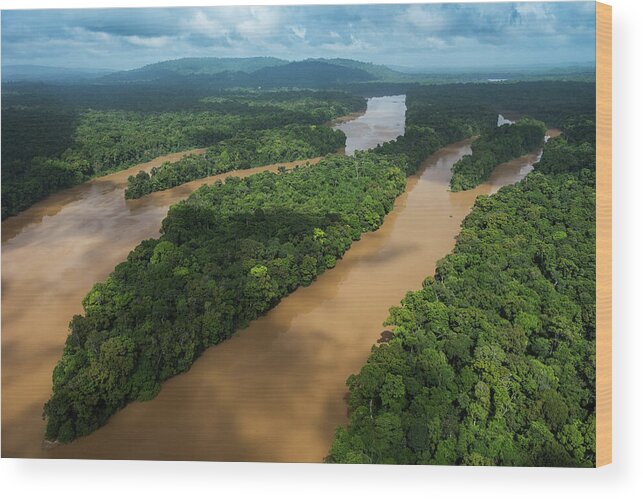
By Mark DaCosta- For the miners, boatmen and shopkeepers of Eteringbang, the Cuyuni has never been just a river. It carries the diesel, food and equipment that keep the camps upstream alive. Armed Venezuelan groups, known locally as “sindicatos”, are reportedly turning this lifeline into a toll road, shaking down traders, skimming gold and fuel, and exploiting a border that is barely policed. The danger has moved beyond commerce: our soldiers are reportedly being shot at on routine patrol. Guyana is adding troops and lodging protests, yet the persistence of the attacks suggests that our country needs a more durable strategy.
The Cuyuni rises in the Guiana / Guyana Highlands of Venezuela and turns eastward through the rainforests of Guyana’s Cuyuni-Mazaruni Region before joining the Mazaruni and the Essequibo near Bartica. Region Seven covers some 47,000 square kilometres but had only about 20,000 residents at the 2012 census. Eteringbang, a border settlement with an airstrip, hosts a Guyana Defence Force base and faces the Venezuelan community of San Martin across the water. Patrols run downstream towards Makapa along a stretch where the opposite bank is Venezuelan.
Sovereignty over this waterway is itself contested by Venezuela. An arbitral tribunal in Paris fixed the boundary in 1899, and Venezuela honoured it for about half a century before declaring it void in 1962. The International Court of Justice found in December 2020 that it has jurisdiction to hear Guyana’s application on the Award’s validity, and hearings were reported to be ongoing at The Hague in May 2026. Guyana maintains that the river is ours up to its junction with the Wenamu.
The criminal threat has a separate and more recent origin. In February 2016, Venezuela’s government decreed the Orinoco Mining Arc, a vast zone of southern Bolívar state of roughly 111,800 square kilometres opened to gold and other minerals. The International Crisis Group argued that it became little more than a legal veneer for plunder by armed groups. Mines there came to be run by local gangs or fighters of the Colombian ELN guerrilla group, and InSight Crime describes the sindicatos as brutal gangs that guarded the gold fields. Petty gold thefts and occasional killings blamed on Venezuelan criminals have been reported in Essequibo since 2016.
By 2018 the problem had reached the Cuyuni. Miners complained that gangsters camped on the Venezuelan bank were stopping boats of both nationalities and demanding gold and cash. One account put the price at a gram of gold for every five drums of fuel. Avalon Jagnandan of the Guyana Gold and Diamond Miners Association called it a national security matter requiring swift government action.
Crisis Group’s 2019 report described a gauntlet of three checkpoints, run by a guerrilla group, the sindicatos and Venezuelan security forces, with payments extracted at each. InSight Crime found such shakedowns typically involve eight to fifteen men, usually armed with rifles, and that fuel, mercury and firearms flow through these corridors. Some observers allege that Guyana is also used to launder illicit Venezuelan gold. That claim is hard to verify, but it deserves scrutiny from our regulators.
What has changed is the gangs’ willingness to confront the state. In February 2025, six GDF soldiers were wounded when a resupply patrol was fired upon from the Venezuelan bank. Three further attacks on patrols followed in May 2025. Brigadier Omar Khan, the Chief of Defence Staff, stressed that the entire river is Guyanese territory and that soldiers and police may stop and search vessels on it. He noted that the army is stationed in almost all of the river’s 13 villages.
The violence has continued. Georgetown formally protested to Caracas over attacks on patrols near Black Water on 20 and 21 April 2026, and a soldier was reportedly wounded in another exchange of fire on 5 May. Kaieteur News has reported that such shootings have become more frequent, and that a Guyanese boat captain abducted from the river was later found in a Venezuelan jail.
The response so far has been reinforcement, firm statements and diplomatic complaint. The Alliance For Change has called for better training and modern equipment for the army. Reinforcement matters, but history shows its limits. In 2018, reporting noted that gang members moved upriver or downriver whenever pressure rose, and returned afterwards.
According to analysts, lasting answer needs several elements. Armed escorts and reliable emergency response would reassure river users. Drones and radar would reduce the advantage of ambushes from the opposite bank. Force alone will not solve it: miners rely on cheap Venezuelan diesel because supply from the coast is costly, so a dependable domestic fuel chain would weaken the smugglers’ hold. Tighter oversight of gold sales would make laundering harder. And persistent diplomacy, backed by regional and international partners, must press Caracas to rein in the groups operating from its bank.
Our country has long insisted that the Cuyuni belongs to Guyana. That claim will mean little to the people who live there until they can travel the river without paying a toll to armed men.