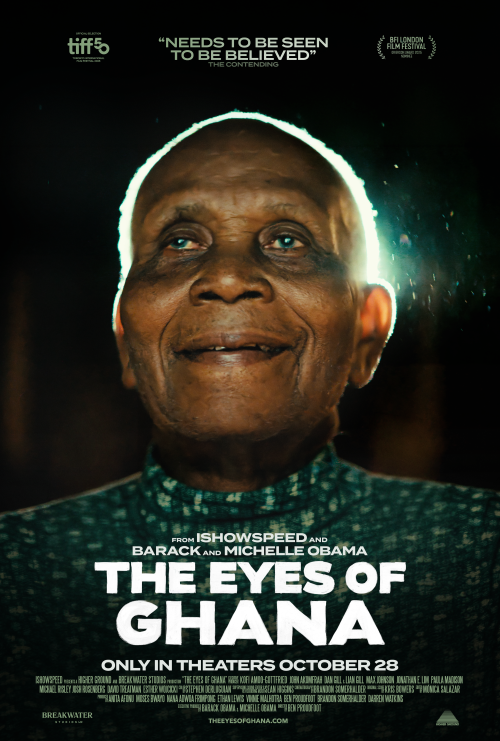
Former United States President Barack Obama and former First Lady Michelle Obama are executive producers of The Eyes of Ghana, a 90-minute documentary tracing Ghana’s independence struggle through the work of veteran filmmaker Chris Hesse and his efforts to preserve more than 1,300 reels of historical footage documenting the birth of African independence.
The film, directed by two-time Academy Award-winning filmmaker Ben Proudfoot, is produced through Higher Ground Productions, the company established by the Obamas to support stories of cultural and social significance. It is scheduled for a North American theatrical release on October 28, 2026.
At the centre of the documentary is Hesse, now in his nineties, who served as personal cameraman to Ghana’s first president, Kwame Nkrumah. Through his camera, Hesse documented Ghana’s emergence from British colonial rule, Nkrumah’s leadership and the wider Pan-African movement seeking political liberation and unity across the continent.
Much of the footage was believed to have been destroyed or lost following the 1966 military coup that overthrew Nkrumah. Hesse, however, preserved more than 1,300 reels, safeguarding a visual record of a defining period in Ghanaian and African history.
The documentary follows his effort to recover, restore and return the archive to public view, while passing responsibility for its preservation to a younger generation of Ghanaian filmmakers.
Among them is filmmaker and producer Anita Afonu, who works with Hesse to bring the footage to new audiences. Her ambition to organise a public screening at Accra’s historic Rex Cinema reflects the film’s central question: who preserves a nation’s history, and who gets to tell it?
Ghana’s historical significance extends beyond its independence in 1957. Before becoming an independent state, the territory known as the Gold Coast was a major centre of the transatlantic slave trade. European powers established coastal forts and trading posts, including Elmina Castle and Cape Coast Castle, through which captive Africans were held before being transported across the Atlantic.
Millions of Africans were forcibly taken from the continent during the transatlantic slave trade, with enslaved people subjected to brutal conditions in the Americas, including the Caribbean. The trade shaped societies throughout the New World and contributed to the development of African diaspora communities whose cultural, political and historical connections to Africa endure today.
Ghana’s independence under Nkrumah became a landmark in the struggle against colonialism. Nkrumah championed Pan-Africanism, advocating solidarity among African nations and people of African descent worldwide. Hesse’s footage captures that ambition and the political developments surrounding the emergence of newly independent African states.
The documentary also highlights the importance of preserving African accounts of these events, rather than allowing the continent’s history to be defined solely through outside perspectives.
The film has already been screened at international festivals and received recognition at several events. A public screening is also scheduled for October 31, 2026, at the Kwame Nkrumah Memorial Park in Accra, according to the Dikan Centre.
Beyond its historical record, The Eyes of Ghana documents the relationship between an ageing filmmaker seeking to protect his life’s work and a younger generation determined to ensure that the images survive.
Through the Obamas’ executive production role and Proudfoot’s direction, the film is bringing Hesse’s archive to a wider audience, renewing attention to Ghana’s independence struggle and the continuing importance of preserving Africa’s historical memory.