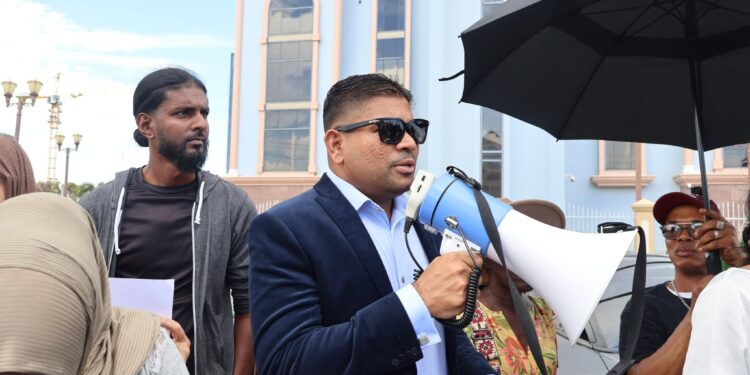
As Guyana observes Agriculture Month 2026, A Partnership for National Unity (APNU) salutes our farmers, fisherfolk, sugar workers, livestock producers, agricultural entrepreneurs and the thousands of Guyanese whose labour sustains our nation.
Guyana possesses the land, freshwater resources, fertile soils, geographical advantages and growing financial capacity to become a leading Caribbean agricultural producer and exporter. With a comprehensive, professionally managed national agricultural transformation plan, our country can achieve greater food security, reduce food imports, expand regional exports, generate sustainable employment and make nutritious food more affordable for every Guyanese family.
Yet this enormous potential is being undermined by inadequate planning, inconsistent execution, weak accountability and the PPP/C Government’s preference for measuring agricultural progress by billions spent rather than results delivered.
The Government’s own 2026 Mid-Year Report exposes the gap between promises and performance.
While the overall economy expanded by 33.3% during the first half of 2026, agriculture, forestry and fishing contracted by 0.5%. Other crops declined by 6.4%, including vegetables by 4.2%, spices by 17.7%, cole crops by 19.1%, and beans and cereals by 5.7%. These declines occurred despite growth in rice, sugar, livestock, forestry and fishing.
Even more troubling, the Government reduced its projected annual growth for agriculture, forestry and fishing from 7.6% to just 2.9%, while its sugar-growing growth forecast was slashed from 67.9% to 18.1%.
Meanwhile, Government reports that food prices increased by 6.7% between December 2025 and June 2026. At the same time, rice export earnings declined by 20.6% compared with the corresponding period in 2025. These developments demonstrate that expanding expenditure and announcing ambitious production targets are no substitutes for improved productivity, competitiveness and affordable food.
The PPP/C Government allocated G$113.2 billion to agriculture in Budget 2026, including substantial investments in drainage and irrigation. Yet farmers continue to report flooding, inadequate irrigation, poor access roads and insufficient maintenance of agricultural infrastructure.
The Government has announced additional drainage pumps, rehabilitated sluices, mechanisation, shade houses and digital agricultural services. APNU does not oppose these investments. We insist, however, that their effectiveness be measured by operational infrastructure, protected acreage, improved yields, farmers’ incomes and lower consumer prices—not the size of announcements.
The unusually heavy rainfall experienced earlier this year was a genuine challenge. However, climate change and extreme weather are no longer unforeseen emergencies. They are realities for which a responsible government must plan. Investments in drainage, irrigation, flood protection and water storage must protect farmers against both excessive rainfall and drought.
The international evidence confirms that Guyana can do better.
In its October 2026 assessment, the International Monetary Fund emphasised the importance of economic diversification, stronger public enterprise performance, effective expenditure oversight, food security and climate-resilient agriculture. The IMF specifically identified investments in drainage, sea defences, human capital and climate resilience as essential to sustainable national development.
The Food and Agriculture Organization (FAO), through its Guyana Country Programming Framework, similarly prioritises sustainable food systems, resilient agricultural communities, stronger value chains, digital agriculture and climate-risk management. The Inter-American Development Bank has also supported programmes emphasising agricultural productivity, reliable data, farmer training, improved standards and sustainable land use.
These recommendations must inform a coherent national strategy, supported by measurable targets and transparent implementation.
GuySuCo: End the cycle of losses, political interference and failed management.
The continuing difficulties at the Guyana Sugar Corporation represent one of the clearest examples of the PPP/C’s failure to match expenditure with outcomes.
At the beginning of 2026, the Government projected production of 100,000 tonnes of sugar. By the Mid-Year Report, that target had been revised downward to 70,401 tonnes, following first-crop production of only 19,031 tonnes. Although sugar output increased over the corresponding period of 2025, this does not erase the corporation’s continuing production weaknesses, labour shortages, poor cane quality and operational difficulties.
Reports of sugar wastage at Uitvlugt, concerns over estate management, deteriorating workplace conditions and allegations of conflicts of interest require independent investigation. Workers’ safety, public resources and the livelihoods of sugar-dependent communities must never be sacrificed to protect politically connected individuals.
APNU’s 2025 Manifesto offers a fundamentally different approach: restructuring and diversifying GuySuCo into commercially viable operations, with sugar cultivation remaining a foundation while expanding into agro-processing, aquaculture, food crops, manufacturing and appropriate housing development. Opportunities involving ethanol, livestock feed, bagasse-based products and electricity cogeneration must be evaluated for commercial viability.
This approach recognises that GuySuCo’s future cannot depend indefinitely on public transfers of billions of dollars without corresponding improvements in productivity, profitability and worker welfare.
APNU therefore calls for an independent, expert-led operational and financial review of GuySuCo, transparent appointment of qualified professional managers, enforceable performance targets and a phased diversification strategy that protects workers and sugar communities.
The Government must engage proven agricultural economists, agronomists, engineers, industrial specialists and experienced sugar-industry professionals—not politically favoured PPP/C cronies rewarded with appointments or contracts regardless of competence.
APNU calls for a comprehensive agricultural transformation programme built on six priorities:
1. Food security and affordability: Expand reliable production of essential foods, reduce post-harvest losses, strengthen domestic distribution, improve market competition and reduce unnecessary costs between farm and consumer.
2. Climate resilience and sustainability: Modernise drainage and irrigation, improve water storage, introduce climate-resilient crop varieties, strengthen soil management and reduce environmentally harmful farming practices.
3. Research and local capacity: Establish dedicated, sustained funding for agricultural research, seed development, pest and disease management, soil science and climate adaptation. Strengthen the National Agricultural Research and Extension Institute, the Guyana Rice Development Board, the University of Guyana and the Guyana School of Agriculture, while expanding practical extension services and technical training.
4. Export development and value addition: Develop commercially viable regional and international markets through agro-processing, cold storage, quality certification, traceability, food safety systems and reliable shipping logistics, consistent with CARICOM’s regional food-security objectives.
5. Farmer financing and inclusion: Expand affordable agricultural credit, crop insurance, secure access to land, and targeted technical support for small farmers, women, young entrepreneurs and hinterland communities.
6. Transparent governance: Publish programme expenditure, production outcomes, infrastructure performance and independent evaluations, with qualified professionals held accountable for implementation.
A properly planned agricultural sector is also a powerful instrument against Guyana’s high cost of living. More reliable local production, lower transportation and storage losses, efficient distribution and greater competition can help stabilise food supplies and reduce avoidable price pressures. Guyanese consumers must benefit directly from our nation’s agricultural development.
APNU believes that the revenues from oil must be strategically invested to build a resilient, competitive and diversified non-oil economy. Agriculture must be central to that transformation.
We, therefore, call on the PPP/C Government to replace political favouritism, fragmented projects and publicity-driven announcements with a comprehensive, independently evaluated national agricultural development plan, developed in genuine consultation with farmers, scientific institutions, industry professionals and agricultural workers.
Agriculture Month must be about more than celebrating potential. It must be about delivering results. Guyana must become a country that feeds its people affordably, rewards its farmers fairly and competes successfully in regional and international markets.
That is the agricultural future APNU believes Guyana can achieve.
COASTAL WATER TREATMENT MUST DELIVER RESULTS FOR COMMUNITIES
APNU has serious concerns about the condition and performance of coastal inline water-treatment facilities. Perseverance and Calcutta are examples of the wider programme we have been examining. The public deserves a clear account of what has been built, what is functioning and whether these investments are delivering the improved water service promised to communities. Announcements and expenditure cannot substitute for functioning infrastructure and reliable service.
At Perseverance, APNU Members of Parliament Sherod Duncan and I examined the treatment equipment and questioned whether the filtration system was functioning as intended. We also raised concerns about maintenance and the quality of service being delivered. Those concerns require a documented technical response from Guyana Water Incorporated. GWI should disclose the facility’s operational status, maintenance history and recent water-quality results, including testing before and after treatment. Residents should not have to rely on competing assurances when the evidence can be made public.
At Calcutta, we examined the treatment installation opposite the well station. We pointed to what appeared to be unfinished connections, damaged fittings and missing equipment. We also raised allegations that the system had been tested, failed and subsequently abandoned, and that equipment had been transferred to other locations. GWI must address these matters through its commissioning records, equipment inventory and project documentation. Questions about the treatment installation must be answered separately from those concerning the well station; the existence of a functioning well would not, by itself, account for the investment in treatment.
APNU, therefore, calls on GWI and the ministry responsible to publish a site-by-site account of the coastal inline water-treatment programme, identifying the contractors, contract values, payments, completion dates, testing results and present operational status. Where defects or incomplete works are identified, the public must be told who is responsible, what corrective work is required, whether contractual remedies will be pursued and when the facility will deliver the intended service. Public expenditure must be traceable through to functioning infrastructure and measurable benefits for the people it is meant to serve.
These visits also raise a fundamental question of priorities. As government considers selling treated bottled water, its first obligation must remain ensuring that investments in community water-treatment systems deliver reliable service to households. Completing outstanding work, maintaining equipment and demonstrating water quality should command urgent attention. The people of Perseverance, Calcutta and other coastal communities deserve clear answers, effective corrective action and value for the public money spent in their name.