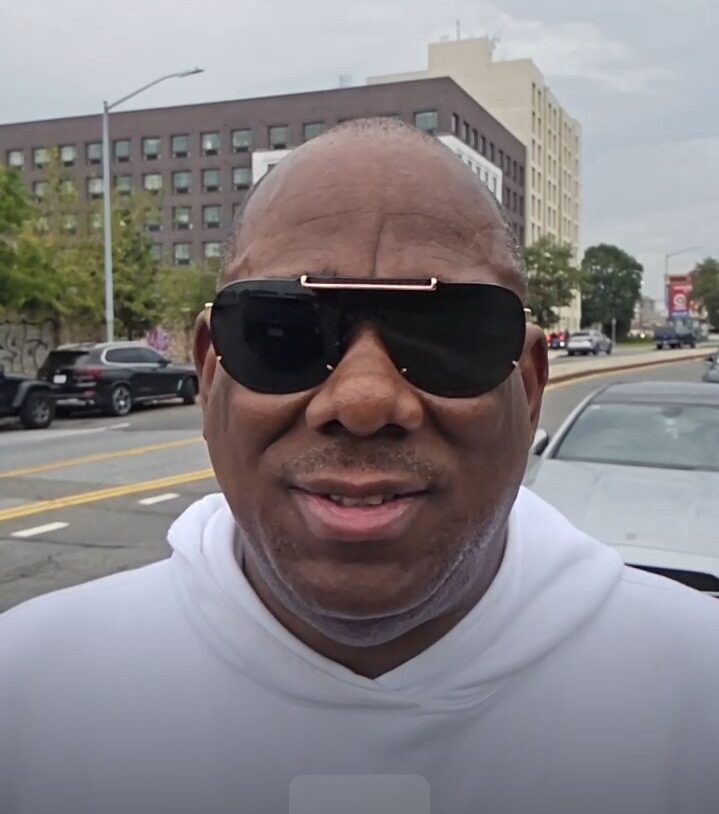
Guyanese-American activist Rickford Burke, President of the Caribbean Guyanese Institute for Democracy (CGID), has questioned the credibility of the Guyana Police Force’s account of a reported shooting incident involving Opposition Leader Azruddin Mohamed outside the home of Special Branch head Prem Narine, urging United States officials to treat information supplied by Guyanese authorities with caution.
Burke stressed that he is neither a political supporter of Mohamed nor of his party, We Invest in Nationhood (WIN), and said his concerns stem from his allegations of police misconduct rather than any political allegiance to the Opposition Leader.
He made the remarks today during a Facebook livestream following the incident in Kitty, Georgetown, which resulted in Mohamed and two other men being arrested.
Burke alleged that the Guyana Police Force had a history of planting and fabricating evidence and providing misleading information to US authorities. He did not present supporting evidence for those broad allegations during the portion of the livestream provided.
“I know for sure that the Guyana Police Force plants evidence, fabricates evidence, and passes on misleading, mendacious, deliberately falsified information to the United States government,” Burke said.
He urged United States officials not to accept police or government accounts without scrutiny, particularly where information could influence proceedings involving Mohamed and his family.
The incident occurred on October 12 near Narine’s residence on Barr Street. According to the police account, Narine saw a black Toyota Allion travelling slowly along the street and returning to the area. He reportedly heard what appeared to be a gunshot and fired several rounds from his service weapon towards the vehicle.
Police subsequently intercepted the car and arrested Mohamed, Mario Mohamed and Eugene Thorne. Investigators said a .32 Taurus pistol without a serial number, three live rounds and spent shells were recovered. The firearm and ammunition were lodged for ballistic testing, while CCTV footage was expected to be reviewed.
Mohamed and his attorney, Siand Dhurjon, have disputed the police account. They allege that no firearm was found during an initial search of the vehicle and question how a gun was subsequently discovered beneath the accelerator at the Kitty Police Station. Those claims have not been independently established.
Burke challenges Narine’s credibility
During the livestream, Burke questioned where Narine was positioned when he allegedly observed the vehicle and whether other cars were in the vicinity.
“Where was he? Where in the house was he? Was he on the road? Was he in the yard? Was he upstairs, downstairs, back window, side window?” Burke asked, challenging the details of the officer’s account.
Burke also attacked Narine’s professional record, alleging that the senior officer had previously engaged in misconduct and had been involved in incidents in which individuals were wrongly accused. Those allegations were not independently verified in the material provided.
He further questioned Narine’s credibility by referring to his testimony in the extradition proceedings involving Mohamed and his father, businessman Nazar Mohamed. During those hearings, Narine faced defence questions over discrepancies between his sworn statement and courtroom testimony about how extradition documents were received, the destruction of three notebooks containing potentially relevant information, and omissions from his written account of an alleged statement by Nazar Mohamed.
Narine attributed some discrepancies to errors or omissions and defended the destruction of the notebooks. The defence challenged his credibility, but the reported proceedings did not establish a judicial finding that he committed perjury.
The Government has described the latest incident as serious, highlighting Narine’s role as a witness in the extradition case and saying the US Department of Justice had been informed.
Burke’s comments add to competing public accounts of the incident. The circumstances surrounding the reported gunfire, the discovery of the firearm and the conduct of those involved remain matters for investigators to establish through evidence and due process.