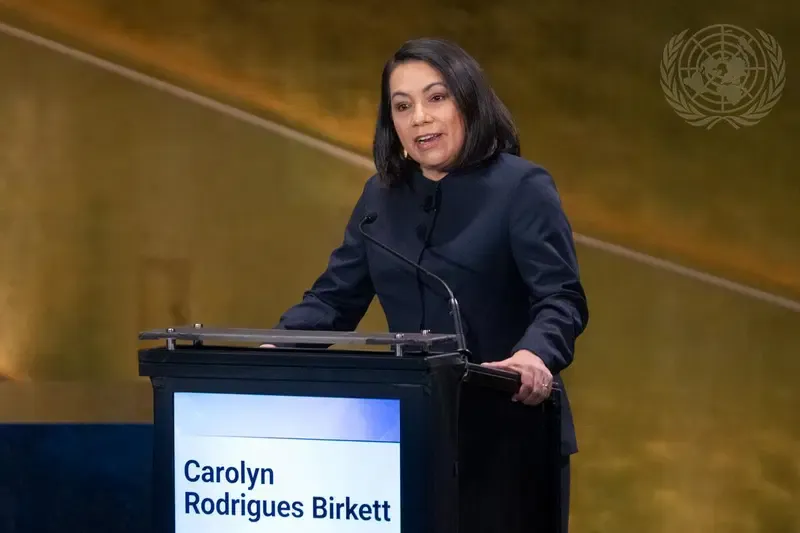
Guyana’s bid to secure the United Nations’ top diplomatic post has suffered its sharpest setback yet, with Ambassador Carolyn Rodrigues-Birkett recording her weakest result in five Security Council straw polls and seeing opposition to her candidacy rise sharply.
In the latest informal poll conducted on October 7, Rodrigues-Birkett received five “encourage” votes, nine “discourage” votes and one “no opinion”, placing her third among the seven candidates still seeking to succeed António Guterres as UN Secretary-General.
The result represents a significant reversal for Guyana’s nominee, who had remained among the leading candidates through the first four rounds.
Rodrigues-Birkett received nine “encourage” votes in the first poll on July 30, followed by eight in each of the next three rounds. Her “discourage” votes, however, have steadily increased—from two in the first poll to three in the second, six in the third and fourth, and now nine in the fifth.
The latest result means that, for the first time, more Security Council members discouraged Rodrigues-Birkett’s candidacy than encouraged it.
Her decline has also changed the positioning of the leading contenders.
Costa Rica’s Rebeca Grynspan, the former vice-president of Costa Rica and current Secretary-General of the UN Conference on Trade and Development, remains in first place with nine encourage, six discourage and no “no opinion” votes. Although she retained the lead, her support also weakened from 10 encourage votes in the previous poll, while her discourage votes doubled from three to six. Reuters
Argentina’s Rafael Grossi, Director General of the International Atomic Energy Agency, moved into second place with six encourage, seven discourage and two no-opinion votes.
Grossi had received eight encourage votes in the fourth poll but lost two in the latest round. His rise to second therefore reflects Rodrigues-Birkett’s sharper decline rather than a broad surge in his own support.
Senegal’s former president Macky Sall remains behind the leading trio with five encourage and 10 discourage votes. Ecuador’s María Fernanda Espinosa received three encourage votes, Uganda’s Olara Otunnu three, while Ecuador’s Ivonne A-Baki received none.
Race remains unresolved
Despite Rodrigues-Birkett’s setback, the race is far from settled.
A candidate must secure at least nine votes in the 15-member Security Council and avoid a veto from any of its five permanent members—the United States, United Kingdom, France, Russia or China. The eventual appointment is made by the 193-member General Assembly following a Security Council recommendation.
The identities of members casting the “discourage” votes remain unknown because the early straw polls do not distinguish between permanent and elected Council members. This means the latest result cannot establish whether any of the five veto-wielding powers is actively opposing Rodrigues-Birkett.
The latest poll nevertheless raises fresh questions about the prospects of Guyana’s nominee, who was formally nominated by Guyana on June 15. Her campaign has emphasised UN reform, stronger representation for developing countries and a more effective response to global conflicts and crises.
The race has become increasingly fluid, with no candidate yet commanding a clear consensus. Grynspan remains the front-runner, but her own decline in support underscores the divisions within the Council.
The next stage could prove decisive as the Council moves toward identifying a candidate capable of securing the required nine votes while avoiding a permanent-member veto. The new Secretary-General is expected to take office on January 1, 2027, when Guterres’ second term ends.