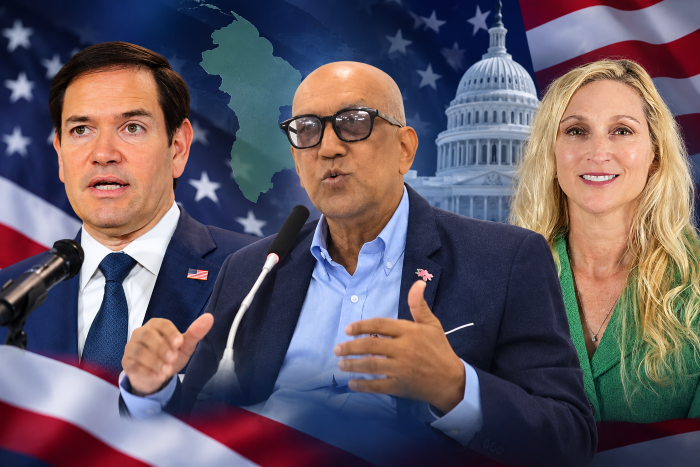
Financial analyst and commentator GHK Lall is calling on the United States to extend its recent use of visa revocations against individuals accused of corruption, money laundering and drug-trafficking activities to Guyana, arguing that Washington should apply its anti-corruption measures consistently regardless of political or commercial relationships.
In an October 2 op-ed published by Village Voice News, titled “Visa Revocations In Latin America, Guyana’s Turn Overdue,” Lall pointed to U.S. visa actions involving officials and other individuals in Bolivia, Colombia, Ecuador and Peru.
“The U.S. must not be squeamish in its efforts to right wrongs. No selective seeing, no cherry-picking, please. Remember! True justice is blind.”
Lall specifically appealed to U.S. Ambassador to Guyana Nicole D. Theriot to take his concerns to Washington, questioning when the U.S. campaign against corruption and illicit financial activity would extend to Guyana.
“When is the U.S. sweep through Latin America for money launderers, drug trade colluders, and corrupters going to reach South America? There is Guyana.”
Lall alleged that Guyana’s drug-trafficking environment could not operate at a significant level without official involvement and called on U.S. authorities to examine the conduct of public officials. He did not, however, identify specific officials in the op-ed or provide evidence establishing criminal wrongdoing by particular government officials.
His concerns come against a broader backdrop of international and domestic scrutiny of Guyana’s governance and financial controls.
Transparency International concerns
Transparency International’s 2025 Corruption Perceptions Index gave Guyana a score of 40 out of 100, placing the country 84th among 182 countries. The index measures perceived public-sector corruption, with zero representing “highly corrupt” and 100 “very clean.” Guyana’s score improved by one point from the previous year.
While acknowledging the improvement, Transparency International’s 2025 Americas assessment identified “harassment and intimidation of independent media and civil society” in Guyana as factors that curtail oversight and accountability.
Transparency International has also highlighted concerns in Guyana involving the influence of elites, resource misappropriation, illicit enrichment and environmental crime. Those assessments concern the broader corruption environment and do not establish criminal liability against specific individuals.
Auditor General flags financial controls
Lall’s call also comes as the Auditor General has repeatedly identified weaknesses in public financial management.
The 2024 Auditor General’s Report found that 829 government contracts valued at G$48.19 billion were examined, with G$1.011 billion in overpayments across 86 contracts. The report said all identified overpayments had been recovered either through repayments or contractors returning to complete outstanding works.
The audit findings do not automatically constitute evidence of corruption. Overpayments and other irregularities can result from administrative failures, inadequate controls or errors. They nevertheless highlight vulnerabilities that can create opportunities for waste, fraud or misuse of public funds.
The scale of the oversight challenge has increased alongside government expenditure. Auditor General Deodat Sharma has noted that Guyana’s National Budget increased from G$383.1 billion in 2021 to G$1.558 trillion in 2026, bringing greater value and complexity to public expenditure requiring scrutiny.
The 2025 Auditor General’s Report was handed to Speaker of the National Assembly Manzoor Nadir on September 25, 2026, but had not yet been formally laid before Parliament and therefore was not yet a public document. The Auditor General said the Audit Office has had to strengthen its capacity in response to the expanding scale and complexity of public expenditure.
Lall also questioned the effectiveness of Guyana’s Public Accounts Committee and the delay in appointing what he described as an anti-corruption czar.
“If the promised anticorruption czar cannot be appointed over a year later, then there is that stable of corruption that will not be cleaned up.”
He argued that any anti-corruption official must be independent and capable of investigating powerful individuals without fear or favour.
Lall then turned his attention to the relationship between Guyana and the United States, particularly Washington’s commercial interests in Guyana’s expanding oil sector and ExxonMobil.
“I want to know why the U.S. State Department, with Secretary Marco Rubio in charge, is so slow, so skittish, to get to Guyana.”
He questioned whether U.S. commercial interests could influence Washington’s approach to alleged corruption in Guyana and raised the possibility of a relationship involving ExxonMobil. However, those claims were presented as questions and allegations by Lall, without evidence in the article establishing a quid pro quo between the U.S. Government, ExxonMobil and Guyanese officials.
His central argument is that U.S. anti-corruption measures should be applied consistently, including in countries where Washington has significant diplomatic and commercial interests.
As Guyana’s oil revenues and public spending continue to grow, the effectiveness of independent oversight, financial controls and anti-corruption institutions is likely to remain under increasing scrutiny.