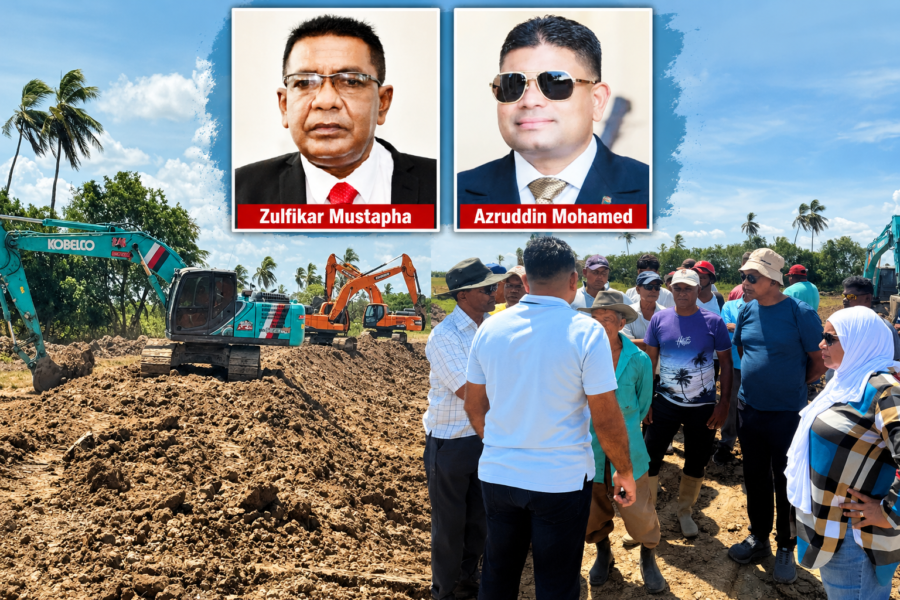
Opposition Leader Azruddin Mohamed says his decision to visit Abary Creek and publicly expose farmers’ concerns has forced the government to respond to a dispute over excavation works on lands farmers say they have occupied and depended on for decades.
In a September 28 statement, Mohamed said representatives of the Ministry of Agriculture visited the farmers after his September 27 intervention and announced that digging on private lands would stop, while assuring residents that government would not continue excavating on privately owned lands.
“Following Opposition Leader Azruddin Mohamed’s visit to Abary Creek yesterday [September 27], where he exposed the government’s decision to carry out excavation on private lands, the government has been forced to respond.”
Mohamed said the farmers welcomed the intervention but warned that the government would be held accountable.
“This reactionary government has shown repeatedly that it often takes public pressure and exposure before meaningful action is taken.”
The confrontation exposes a widening dispute over a major government drainage and irrigation project, with the administration promoting the works as an agricultural transformation programme while affected farmers say they are being asked to bear the immediate costs.
Several Abary rice and cattle farmers recounted to Mohamed in video recordings that excavators moved onto the lands about a week ago and that they were concerned about access, drainage and the ability to continue farming. One farmer said he held a 50-year lease, while others said they had cultivated the area for 15 years or more.
One farmer questioned why machinery had arrived before affected residents had been properly engaged.
“We are being bullied and victimised. This is not right. We are here for decades. You should have come and let us know what is going on.”
Another warned that the proposed canal could obstruct drainage and make it difficult to transport harvested rice.
“This what they are doing here, we gon’ can’t plant. All the lands will be abandoned…”
The government, however, has rejected Mohamed’s account as “misleading.”
Agriculture Minister Zulfikar Mustapha’s ministry said the Abary Creek Drainage and Irrigation Project is intended to improve water management, strengthen flood resilience and expand agricultural production. The project includes embankments, drainage and collector canals, a high-level canal, bridges, culverts and sluices.
The ministry says the project is expected to improve drainage and irrigation across 55,281.97 acres between Mahaica and Abary, with approximately 300 Abary farmers expected to benefit directly. Its feasibility assessment projects annual economic benefits exceeding G$1.595 billion in Region Five and G$3.85 billion across Regions Three and Six.
But those projected benefits do not answer the immediate concerns raised by farmers whose lands are being affected.
The ministry says consultations and negotiations with landowners and occupiers have been ongoing since April 2022, with the latest engagement held on September 21. Farmers, however, described difficulties obtaining clear information and said decisions appeared to have been made before they were given a meaningful opportunity to influence the project. That contradiction is now at the heart of the dispute.
The government says it is consulting farmers. Some farmers say they were confronted with machinery first and explanations afterward.
Mohamed has also alleged that the government is using major infrastructure spending to benefit politically connected contractor.
“Public money must work for the people, not just a select few. Farmers deserve answers, accountability, and respect, not bulldozers destroying their livelihoods.”
The Agriculture Ministry insists the project is lawful public infrastructure and says it will continue stakeholder engagement.
Yet the government’s decision to send representatives to the farmers immediately after Mohamed’s public intervention has added another dimension to the controversy.
Whether the excavation actually stops on privately occupied lands, whether alternative alignments are considered, and whether affected farmers receive meaningful input now become tests of the government’s promise that the project is being implemented in their interest.
The Abary dispute therefore goes beyond a canal. It raises a basic question about development: can government claim to be putting farmers first while farmers standing in the path of its projects say they were not adequately heard?