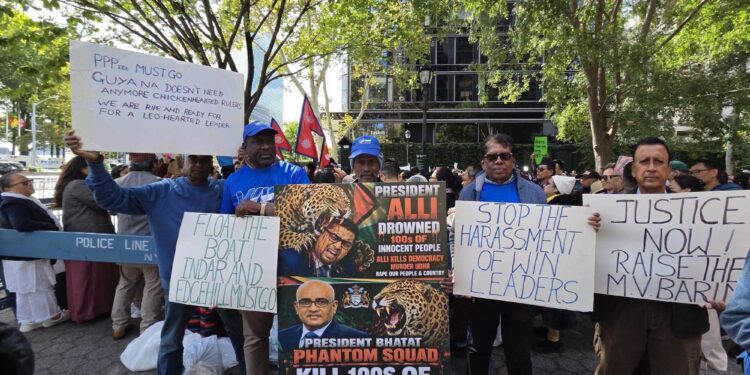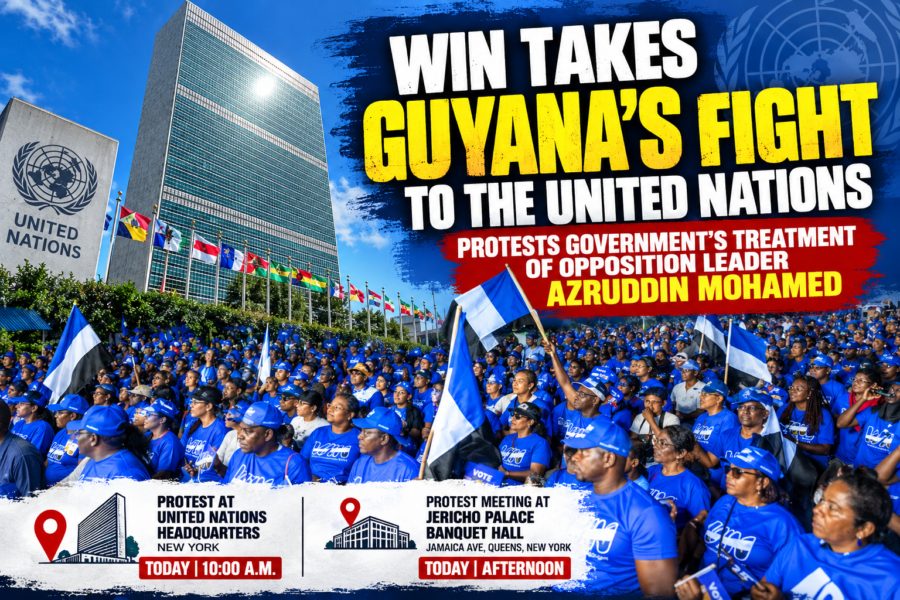
The dispute over the treatment of Opposition Leader Azruddin Mohamed is no longer confined to Guyana’s courts and political institutions. Today, supporters of the We Invest In Nationhood (WIN) movement are taking their concerns to the streets of New York, arguing that the handling of Mohamed at home has raised questions about the use of state power, police conduct and the ability of the Opposition Leader to carry out his constitutional role.
The newly established WIN chapter in New York is organising a demonstration outside United Nations Headquarters in Manhattan at 10:00 a.m., followed by a second gathering this afternoon at Jericho Palace Banquet Hall on Jamaica Avenue in Queens.
According to a WIN organiser, the demonstrations are principally about what organisers regard as the abuse of executive and state power inside Guyana, including Mohamed’s two recent arrests, police actions against members of his political team and what they describe as official efforts to obstruct his ability to conduct the work of the Opposition.
The organisers contend that the issue is not simply Mohamed’s personal legal circumstances but whether state institutions are being deployed in ways that interfere with the constitutional role of the country’s Opposition Leader.
Two arrests in days
The concern follows two separate episodes in which Mohamed was detained by police within a matter of days.
On August 26, Mohamed was arrested following a Joint Services operation involving a fast boat on the Demerara River. Police alleged that the vessel failed to respond to signals to stop during a pursuit. Mohamed was subsequently released on $100,000 station bail. Opposition parliamentarians disputed aspects of the police account.
A second episode occurred in early September.
Police intercepted vehicles near President Irfaan Ali’s Leonora residence on September 2 amid concerns about security and allegedly unauthorised drones. Mohamed was detained and later released. Hours afterward, he was arrested again after returning to the area and broadcasting on Facebook Live. Police cited an alleged breach of security protocol. He was subsequently released.
The incidents prompted Mohamed and WIN to seek international attention, with the Opposition Leader later presenting a political brief to international organisations alleging harassment, arrests, vehicle impoundments, seizure of electronic devices and other actions against him and members of his political organisation.
The government and police have maintained that the actions were connected to legitimate security and law-enforcement concerns.
Captain’s licence becomes another flashpoint
The dispute has also expanded into the maritime regulatory arena.
Mohamed has complained publicly about the refusal or delay in issuing a captain’s licence for his fast craft, arguing that he submitted the required documents and that applications by other individuals were processed more quickly.
The Maritime Administration Department (MARAD) has rejected any suggestion that the matter is politically motivated, maintaining that its decision is based on regulatory and compliance considerations. In a statement, the agency said
“Any responsible public authority dealing with a sanctioned person must, therefore, carefully consider the legal, financial, banking, contractual and compliance consequences of any proposed transaction. MARAD would, therefore, be extraordinarily reckless as the national regulatory maritime agency to issue a licence to anyone of such sanctioned character.”
The licence controversy has consequently become another point of contention between Mohamed and government institutions, with each side presenting a different account of whether the issue is ordinary regulatory enforcement or part of a broader pattern of state pressure.
Opposition role under scrutiny
The protests come as Mohamed’s political position itself is being tested by a series of developments involving the police and other government agencies.
Most recently, Special Branch head Senior Superintendent Prem Narine told a court that he considers Mohamed the “greatest threat” to Guyana’s national security, while citing intelligence involving serious allegations. Narine subsequently acknowledged that Mohamed had not been arrested or charged in Guyana over six alleged execution-style killings referred to during his testimony.
That testimony has added another layer to the controversy because Mohamed is not merely a private citizen facing legal proceedings. He is Guyana’s constitutionally recognised Leader of the Opposition, whose role is to scrutinise the executive and provide parliamentary opposition to the government.
Questions have also arisen over police record-keeping after Narine testified that he destroyed notebooks containing information connected to the Mohamed matter. The defence has challenged the circumstances surrounding those records, while the Guyana Police Force has rejected suggestions that relevant evidentiary documents were deliberately destroyed.
The dispute now extends beyond Mohamed’s personal legal troubles and into wider questions about how state institutions are treating a sitting Opposition Leader. WIN maintains that the arrests, police actions and refusal to grant Mohamed a captain’s licence reflect an escalating pattern of official pressure. The Government and relevant agencies have maintained that their actions are grounded in law, security requirements and regulatory procedures.
Against that backdrop, WIN is taking its concerns beyond Guyana, using the New York protest to draw international attention to what it describes as the treatment of the Opposition Leader and the broader political implications for democratic governance.