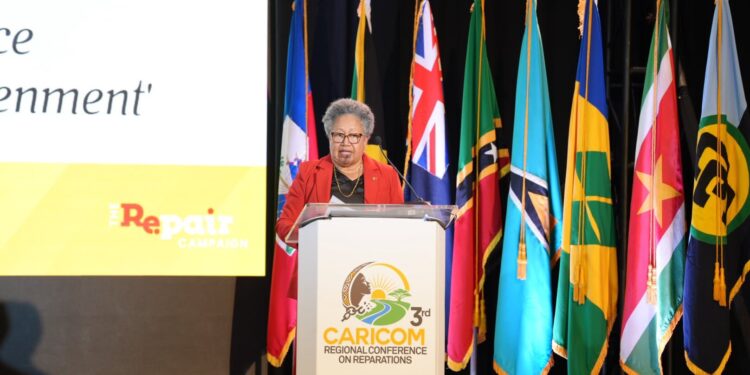
The Third CARICOM Regional Conference on Reparations, held in Barbados from September 17–19, has moved the Caribbean’s reparations campaign toward a more explicitly action-oriented phase, with regional leaders unveiling a revised Ten-Point Plan for Reparatory Justice, discussing legal and diplomatic strategies toward former colonial powers and calling for stronger coordination with Africa and the global African diaspora.
The conference, held at the Wyndham Grand Sam Lord’s Castle in St. Philip, Barbados, was organised by the CARICOM Reparations Commission, the Government of Barbados and the CARICOM Secretariat under the theme “Reparatory Justice as the Coming Enlightenment.” It was the first major CARICOM reparations forum following the UN General Assembly’s March 25, 2026 resolution describing the trafficking and racialised chattel enslavement of Africans as “the gravest crime against humanity.”
Revised Ten-Point Manifesto relaunched
A central development was the formal relaunch of the revised CARICOM Ten-Point Plan for Reparatory Justice: A Manifesto for the Coming Enlightenment.
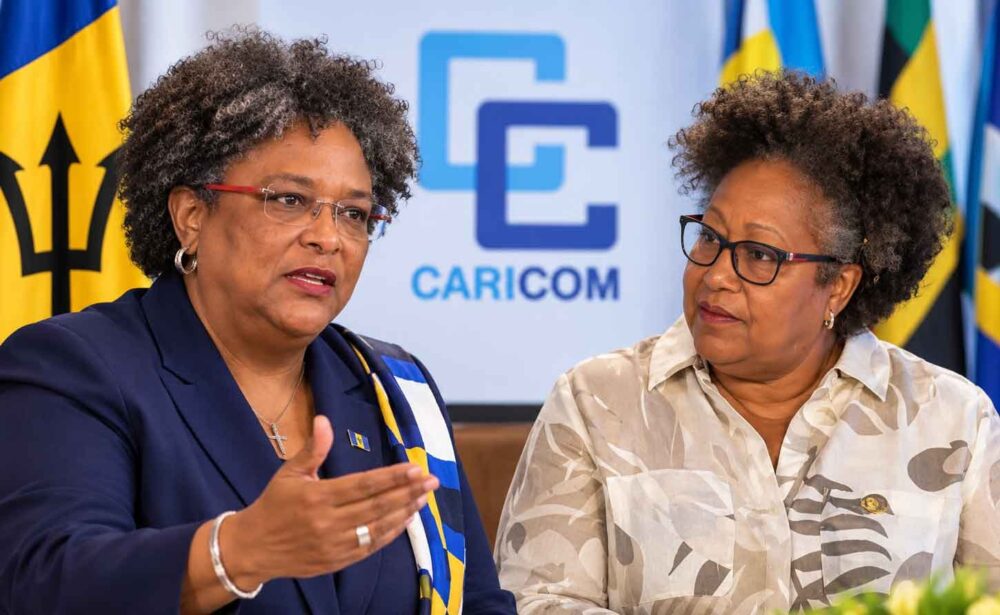
CARICOM Secretary-General Dr Carla Barnett said the framework is intended to address historical wrongs and their continuing effects, with areas including public health, education, psychological rehabilitation, cultural development, support for Indigenous communities, gender justice, debt cancellation and monetary compensation. The revised plan was adopted by CARICOM Heads of Government in July 2026.
Barbados’ Ambassador to CARICOM David Comissiong described the revised document as a more developed version of the original plan and said it would also serve as an educational tool for Caribbean populations.
Push for negotiations with Britain
The conference also produced a stronger focus on strategies for engaging former colonial powers, particularly the United Kingdom.
According to The Guardian, Caribbean representatives were working on a multi-pronged action plan aimed at encouraging Britain to enter negotiations on reparatory justice. Possible legal avenues under discussion include Jamaica’s engagement with the UK Privy Council and seeking an advisory opinion from the International Court of Justice, should diplomatic approaches fail.
The British government has maintained that it will not pay reparations, according to the same report.
Former St Vincent and the Grenadines Prime Minister Ralph Gonsalves argued that any reparations framework should be structured as a long-term, multigenerational programme, rather than treated simply as a single financial payment.
Barbados to quantify its historical claim
Barbados Prime Minister Mia Mottley announced that her government will appoint a technical committee of historians and economists to research and quantify Barbados’ specific reparations claim arising from more than two centuries of slavery. Mottley said a strong evidentiary foundation would be necessary to support the country’s case.
She also said the Caribbean was seeking justice rather than the financial destruction of former colonial powers.
Indigenous peoples demand greater inclusion
The conference also brought attention to the reparations claims of Indigenous peoples, not only those arising from African enslavement.
Taíno Chief Damon Gerard Corrie argued that Indigenous communities must have a substantive role in the regional reparations process rather than being included symbolically. He said reparations should address both the genocide and dispossession of Indigenous peoples and the enslavement of Africans.
CARICOM Secretary-General Barnett similarly identified Indigenous peoples and youth among the groups whose involvement is important to sustaining the movement across generations.
Beckles says movement entering “final phase”
Chairman of the CARICOM Reparations Commission, Professor Sir Hilary Beckles, described the regional movement as having entered what he called its “final phase.” He argued that the present moment should be used to convert decades of advocacy into coordinated action.
The conference comes after CARICOM Heads of Government approved the revised reparations manifesto in July and agreed to maintain reparations prominently on the regional agenda, including at the Commonwealth Heads of Government Meeting in Antigua and Barbuda in November 2026.
The latest developments therefore point to a shift from establishing the historical case for reparations toward questions of evidence, negotiation, legal strategy, regional coordination and implementation. The extent to which those strategies produce formal negotiations or concrete reparatory measures remains to be determined.