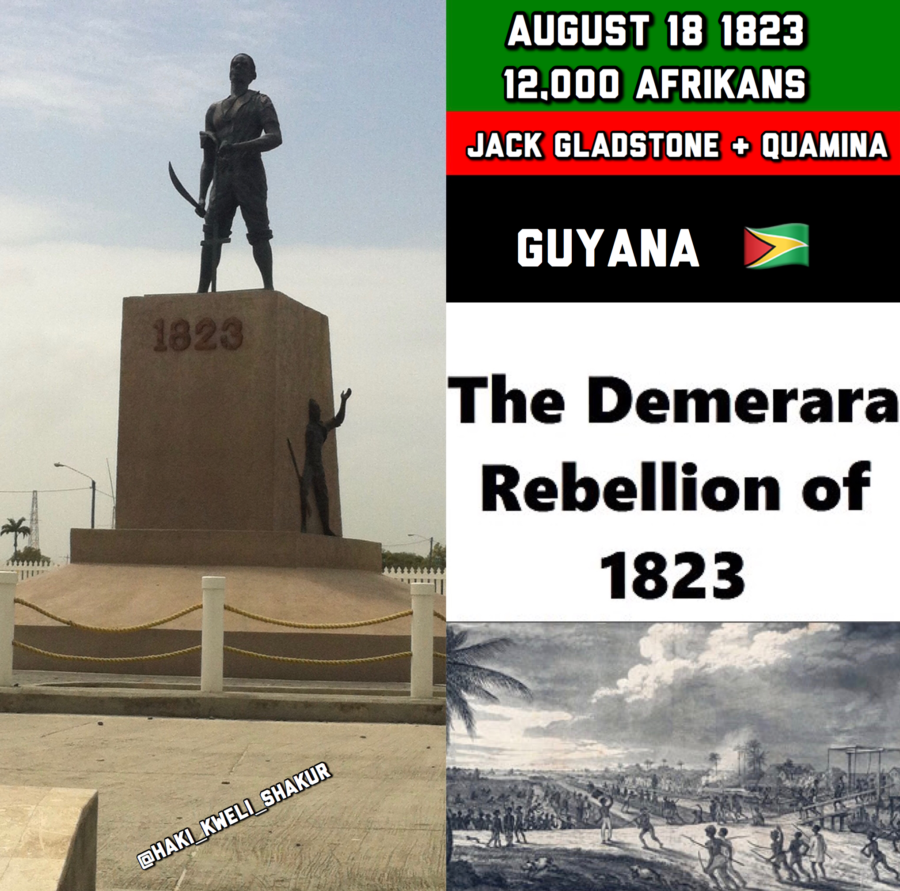
By Christian Høgsbjerg- August 2023 marks the bicentenary of one of the most important revolts by enslaved people in the history of the British Empire, taking place in what was then Demerara (later part of British Guiana, now Guyana) on the Caribbean coast of mainland South America in 1823.
The uprising came in the aftermath of the victorious Haitian Revolution of 1791-1804, which represented a massive blow against slavery, colonialism and racism, establishing the first independent black republic outside of Africa. This was followed, in 1816, by some 4,000 enslaved people in one of the oldest British colonies in the West Indies, Barbados, rising up in what became known as Bussa’s Rebellion. This was brutally crushed.
Yet, just seven years later, revolt erupted again, this time in one of the newest colonial territories in the British Caribbean, and on an even greater scale, involving at least 9,000 rebels. The Demerara Rebellion—one of the greatest historic movements demanding that “Black Lives Matter!”—took place in a colony with much greater revolutionary potentialities than those on the tiny island of Barbados.
The form the revolt of the enslaved took was also surprisingly modern in its “strike-like” character, though this should perhaps be expected since many of the plantations at the very centre of the revolt were essentially huge “sugar factories”.
Indeed, according to the leading historian of the revolt, Emilia Viotta da Costa, in her 1994 book Crowns of Glory, Tears of Blood: The Demerara Slave Rebellion of 1823, the exploitative slavery-based society of Demerara itself “functioned almost like a factory”. In the colony, as da Costa noted, “A tiny minority of whites (soldiers, merchants, clerks, doctors, attorneys, managers and other plantation employees), amounting at the time of the rebellion to only about 4 percent of the total population, as well as an equally small number of free blacks, lived surrounded by an overwhelming slave majority”.
This essay will outline and examine the heroic and inspirational rebellion itself, but also explore its “proto-proletarian” character. It will ask whether the dynamic of the revolt can be illuminated by viewing it as an instance of “collective bargaining by slave revolt” (to borrow from the phrase “collective bargaining by riot” coined by Marxist historian Eric Hobsbawm in his description of the machine breaking carried out by the Luddites of the early British working-class movement).
Demerara: the development of a slave society
In 1823, Demerara and its neighbouring colony, Essequibo, had a total population of 80,000 people, with a small white colonial elite of some 2,500 or so massively outnumbered by an enslaved population of 75,000. About 46 percent of these enslaved people had been born in Africa and survived the dreaded “Middle Passage” route to the Americas. The 25-mile coast east of the Demerara River (known as the “East Coast”), where the rebellion began had, according to da Costa, “perhaps the highest concentration of slaves in the West Indies”.
These were spread across 71 plantations. Half produced sugar, though only 11 did so exclusively, with cotton and coffee also key products. Though the three colonies of Demerara, Essequibo and Berbice first came under European control with the arrival of the Dutch West India Company in the mid-17th century, it was a century before the settlement of Demerara by Europeans was enabled given the flooding along its coastal lowlands. The Dutch made plantations possible in flooded Demerara, using their accumulated knowledge of how to deal with land below sea level back home, and now they put the enslaved to work building dams and canals.
The transformation of these colonies into slave societies by the Dutch and other European planters engendered a rich tradition of resistance among the enslaved almost immediately. The region’s physical geography and topography made marronage—enslaved people running away from the plantations and forming independent “Maroon” communities—much easier than, for example, on a tiny and relatively flat island such as Barbados. However, alongside flight as a form of resistance, open slave revolts also took place.
Such rebellions took place in Bernice in 1733, 1749 and 1752. Perhaps most remarkably, a rebel slave army led by Kofi, an Akan man abducted from West Africa by slavers, controlled the colony and kept European forces at bay for almost a year in 1762-3. In response, the Dutch developed a particularly cruel tradition of barbaric retribution. In 1790, for example, the following sentences were carried out on captured Maroons in another nearby Dutch colony, Suriname:
Continue reading here: http://isj.org.uk/demerara-rebellion-1823/