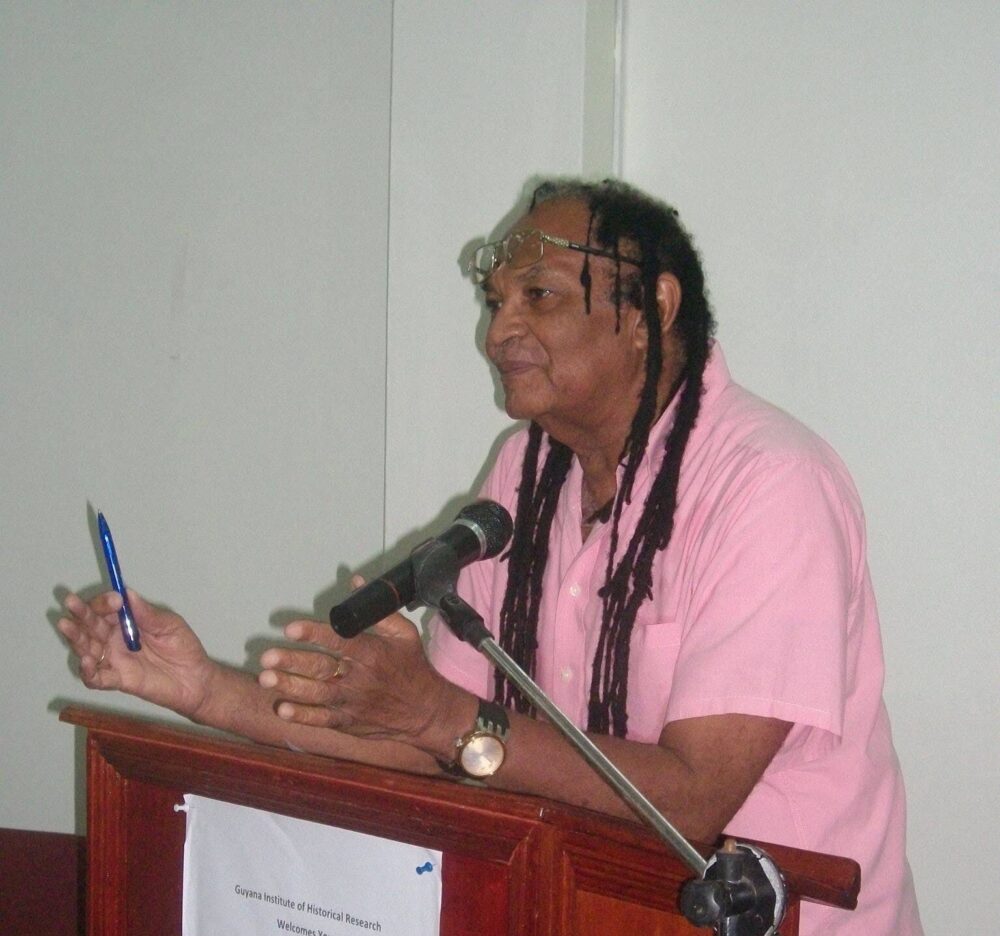
Guyana has lost one of its most distinctive voices on African history, identity and culture with the death of Tom Dalgetty, widely known as Ras Tom Dalgetty, who died on Saturday, August 22, 2026, at the age of 86.
Dalgetty, born November 24, 1939, leaves a legacy spanning broadcasting, Pan-African activism, historical research, Rastafari and cultural advocacy. For decades, he challenged Guyanese to examine the country’s history through the experiences and contributions of its African population.
He attended Queen’s College, where he served as athletics captain, before studying chemistry and geology at the University of Aberdeen in Scotland. While at Aberdeen, he held positions in both the West Indian Students Association and African Students Association. The Organisation of American States (OAS) has described him as a Pan-Africanist whose outlook was influenced by his parents and family background.
Dalgetty became particularly well known through broadcasting. From 1972 to 1980, he produced and presented “Music from Africa” on radio, introducing Guyanese audiences to African music and perspectives at a time when African culture had limited space in mainstream broadcasting.
He later presented “Dalgetty’s Africa” on television, beginning in 1999. His interest in Africa extended beyond broadcasting. He participated in conferences on appropriate technology in Africa and was involved in initiatives including the establishment of corn mills in Namibia.
Dalgetty embraced Rastafari in the 1980s, an important development in his continuing identification with African history, culture and consciousness.
A Voice for African-Guyanese
For decades, Dalgetty was an outspoken figure in Guyana’s Pan-African movement and a persistent advocate for the African-Guyanese community.
A central theme of his public commentary was the contribution of Africans to Guyana’s development and the questions of land, economic ownership, political power and the future of Afro-Guyanese people.
He argued that African labour, sacrifice and struggle had helped build the foundations of Guyana and used the metaphor of an “African-Guyanese House” to describe that historical inheritance.
His advocacy continued into contemporary debates over race and governance. In 2022, Dalgetty was among African-Guyanese leaders who signed correspondence to international organisations raising concerns about discrimination, governance and the distribution of Guyana’s resources.
Political Views and Historical Debate
Dalgetty’s political evolution also made him a controversial figure at times.
He was associated with the Working People’s Alliance (WPA) during the 1970s and 1980s. In later years, however, he questioned the movement’s opposition to Forbes Burnham, arguing that the WPA might have been better served by seeking compromise with Burnham.
He also argued that Walter Rodney was wrong to oppose and weaken Burnham’s government, a position that generated considerable debate among Guyanese commentators.
Dalgetty’s views appeared to reflect his retrospective assessment of Guyana’s political development and what followed Burnham’s period in office, rather than simply an unqualified defence of Burnham.
Historian and Cultural Activist
Dalgetty was also active as a historian and author. The Guyana Institute of Historical Research identified him as the author of Burnham and Beyond and included him among presenters at its research conferences.
His commitment to preserving Guyana’s cultural heritage was equally visible.
In 2012, during controversy surrounding the funeral arrangements for celebrated sculptor Philip Moore, Dalgetty worked with cultural groups to organise a public viewing of Moore’s body at the Square of the Revolution in Georgetown.
The initiative reflected his belief that Guyana’s cultural pioneers, particularly those who helped shape its African identity, deserved national recognition.
A Lasting Legacy
Dalgetty occupied an unusual place in Guyanese public life—broadcaster, Pan-Africanist, Rastafarian, historian, author, cultural activist and political commentator.
He introduced generations of Guyanese to African music and ideas, defended the historical contribution of Africans to Guyana and repeatedly challenged the country to confront questions of race, identity, land and power.
His views were not always comfortable or universally accepted, particularly his later assessments of Burnham, Rodney and the political history of Guyana. But his willingness to challenge prevailing interpretations made him a persistent participant in the national conversation.
With his death at 86, Guyana loses a distinctive voice whose public life stretched across more than five decades.
Ras Tom Dalgetty leaves behind a body of work and a challenge that remains relevant: that Guyana must understand its history, recognise the sacrifices that built the nation and determine what that history demands of the country today.