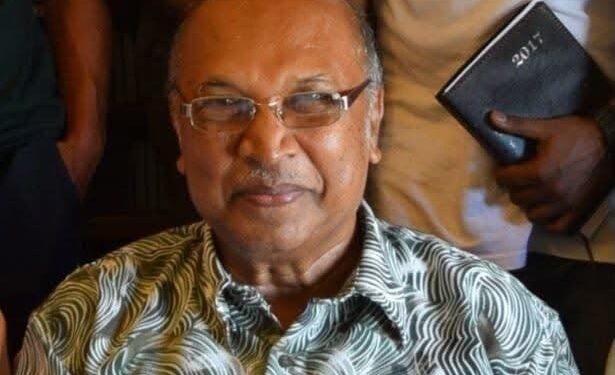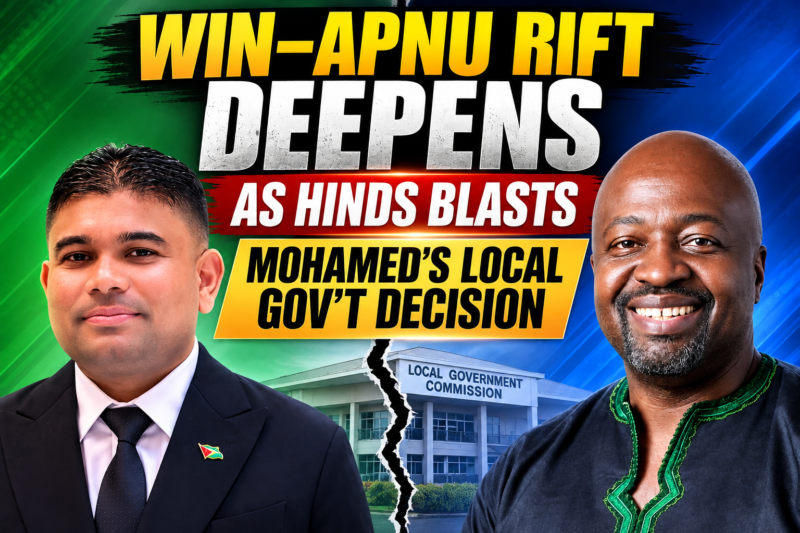
A Partnership for National Unity (APNU) Member of Parliament and Working People’s Alliance (WPA) co-leader Dr. David Hinds has sharply criticised Opposition Leader Azruddin Mohamed’s handling of nominations to the Local Government Commission (LGC), arguing that the decision exposes a widening political divide between We Invest in Nationhood (WIN) and APNU and raises questions about the sincerity of calls for opposition unity.
Hinds, speaking on his programme Politics 101, said Mohamed had an opportunity to demonstrate a genuine commitment to opposition cooperation when he invited APNU to submit two nominees for the Commission. APNU reportedly complied, but neither nominee was ultimately selected. Instead, WIN submitted two nominees, while the Forward Guyana Movement (FGM), led by Amanza Walton-Desir, secured the third position.
Hinds said the decision was revealing.
“If he were interested in opposition unity and he got three, he would take one, keep APNU one and give another one to Amanza,” he said.
His criticism comes against the backdrop of an increasingly fragmented opposition following the 2025 general elections. WIN emerged as the largest opposition bloc with 16 of the 29 opposition seats in the 65-member National Assembly, while APNU holds 12 and FGM one. Mohamed was subsequently elected Leader of the Opposition.
The competing political interests have intensified debate over whether the opposition can forge meaningful cooperation while WIN and APNU compete for influence and electoral territory.
Hinds, who has repeatedly expressed reservations about broad calls for opposition unity, stressed that his position should not be interpreted as opposition to opposition parties working together.
“I have been in politics too long to be driven by simple sentiments,” Dr. Hinds noted.
Instead, he argued that political calculations behind the unity debate cannot be ignored, particularly if WIN’s objective is to emerge as the dominant opposition force.
“If his objective is to eclipse APNU, why do you expect APNU to go begging Mr. Mohamed?” he questioned.
The LGC dispute has therefore become a test of whether opposition unity is based on genuine political cooperation or whether the parties are primarily seeking to strengthen their respective political positions.
The Commission is an important institution within Guyana’s local government system, with responsibilities relating to the administration of municipalities and Neighbourhood Democratic Councils. Its composition has historically been politically sensitive because of its role in local governance.
The latest dispute also comes as WIN has signalled an aggressive electoral strategy, including plans to contest local government elections across the country. That puts the party in direct competition with APNU for opposition votes and grassroots influence.
Hinds warned that Guyana’s electoral system makes such divisions potentially costly. Fragmentation among opposition parties can create conditions in which the governing party benefits from divided support.
He argued that parties cannot weaken one another politically and then expect unity to materialise when elections approach.
“You can’t want to strip your vote from APNU and then, when you lose, you lose everything,” Hinds said.
According to Hinds, Mohamed has every right to pursue WIN’s political strategy, but that strategy should not be confused with genuine opposition unity.
The LGC nominations, he suggested, offered Mohamed a practical opportunity to demonstrate whether he was prepared to make concessions to APNU in the interest of broader opposition cooperation.
Instead, Hinds said, the decision reinforced his belief that WIN is seeking to strengthen itself at APNU’s expense.
“I’m glad he did that because he’s proven me correct,” Hinds said.
The dispute leaves the opposition facing a fundamental political question: can WIN, APNU and FGM compete for influence while still finding enough common ground to prevent fragmentation from undermining their collective electoral strength?