Dear Editor,
Over the past two weeks, President Irfaan Ali has been crossing the country, sitting in schools and community centres, launching what the government calls its Model Village initiative. The pitch is an attractive one. Engineers and technical teams have spent months assessing each community’s roads, drainage, lighting and green spaces, and now the President himself is turning up to hear residents describe what they want their villages to become over the next ten to twenty years.
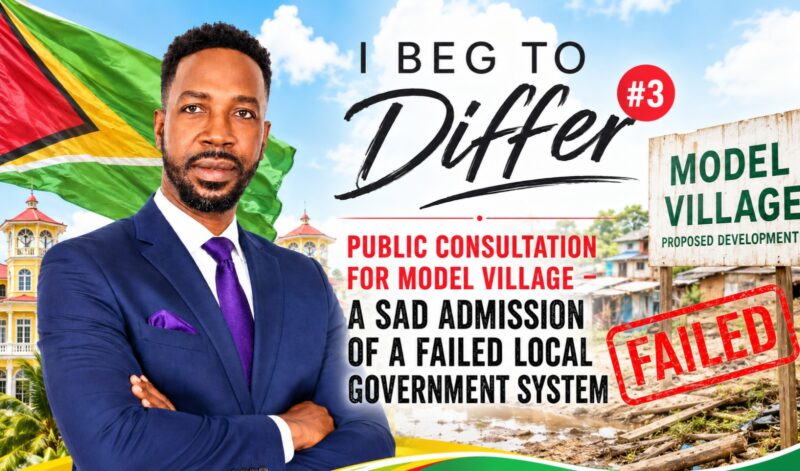
On the face of it, this sounds like democracy at work, a listening government, a President in shirtsleeves taking notes from ordinary people, and I have no doubt that many will receive it exactly that way. But I beg to differ.
What this roadshow actually reveals is not a government that listens. It is a government admitting, in the most public and flamboyant way possible, that the Local Government system built precisely to listen has stopped working.
Consider how the machinery is supposed to run. Guyana is not short of channels through which a community can be heard. We have seventy Neighbourhood Democratic Councils, ten municipalities and ten Regional Democratic Councils. Across them sit more than a thousand elected councillors, every single one of them attached to a community, every single one of them elected for the express purpose of knowing that community’s business, its broken bridge, its choked drain, its dark street corner, its idle young people.
Those councillors are not meant to wait for a presidential visit. They are meant to be in the community constantly, sitting with residents, collecting complaints, then carrying those concerns into the council chamber, where they are debated, costed and folded into a work programme and a budget. The NDC feeds the RDC. The RDC feeds the region. The region feeds the central government. That is the design. That is the entire point of having tiers of elected local government in the first place.
So here is the simple test of whether that system works. If it did, the President would not need to leave his desk. He would pick up the telephone, call the chairman of Region Four, for example, and say: send me everything your councils have gathered from the communities on the East Bank and the East Coast, their priorities, their costs, their timelines. Within a day it would be on his desk, because the councils would already have it: already collected, already organized, already ranked. He would know precisely what a community like Kaneville needs without ever setting foot in Kaneville, because the very people Kaneville elected would have told him long ago.
Ask yourself why the Head of State must physically walk into a village to learn what its people want. The answer is damning: because the councillors that village elected, and the councils this government funds, are not doing the job. The President is not leading a consultation. He is covering for a failure, his government’s failure.
It is not as though that system is starved of money. In this year’s budget the government raised the annual subvention to each NDC from five million to thirty million dollars, and to each municipality from eighteen million to fifty million. Councillors’ stipends were increased. Add it up across seventy NDCs, ten municipalities and ten regional councils, and the state is pouring billions of dollars every year into the machinery of local representation. We are paying, and paying handsomely, for a system whose core job is to know what communities want and to act on it. The Model Village tour is that same job being done a second time, from the top of the pyramid, by the President, because the bottom of the pyramid is not delivering.
The President himself has said that the people who live in a village know it better than anyone else. He is right. But that is an argument for empowering the councillors those villagers elected, not for stepping over them. When the Head of State has to become a kind of super-councillor, personally auditing the needs of individual streets, something has gone badly wrong in the tiers beneath him, and no amount of green space, CCTV and street lighting will paper over it.
So let me be clear about what I am not saying. I am not against better roads, safer communities or serious investment in our villages. I am against the theatre. When you strip it down, this travelling roadshow shows exactly what this government has a penchant for: the PR stunt over the hard, unglamorous work of building systems and making the ones we already have actually serve the people. It is easier to summon a crowd, a camera and a headline than it is to make an NDC consult, report and plan the way it is paid to. And some might say that the PR show is the better way to go, that the optics are the point. But I beg to differ.
A model village is a fine idea. A model local government system would have made this entire tour unnecessary.
Yours truly,
Randolph J. Critchlow