The Ethnic Relations Commission (ERC) continued to advance its constitutional mandate throughout July 2026 to promote harmony, mutual respect and good relations among Guyana’s diverse peoples through a range of public education, stakeholder engagement, media monitoring and investigative activities. The month was marked by the Commission’s response to the MV Barima Tragedy, a moment of profound national grief that called upon the Commission’s role as an institution that stands with all Guyanese, across every community, in times of shared loss.
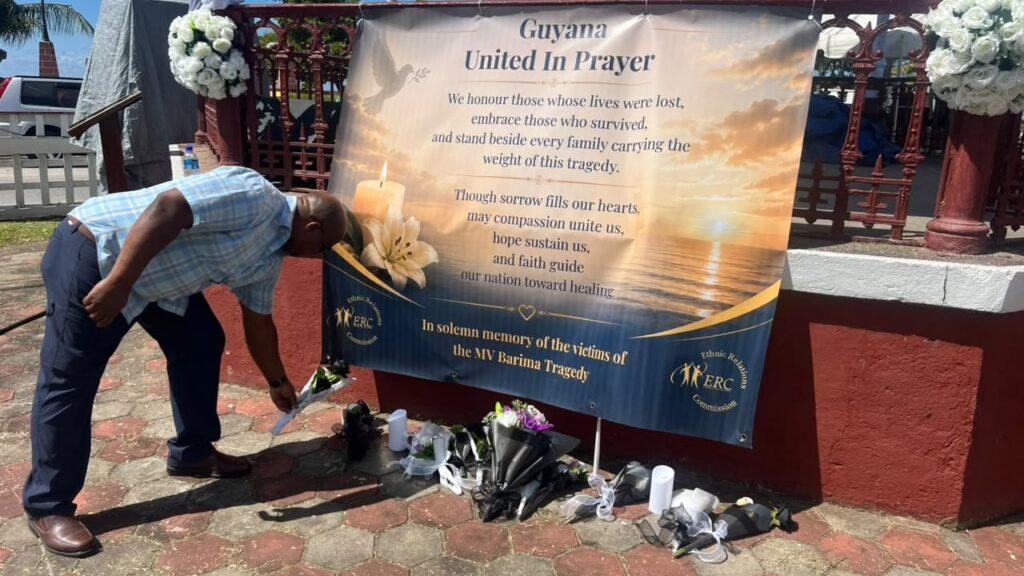
Following the tragic sinking of the MV Barima, the Commission issued a statement of solidarity on July 19, 2026, as search and rescue efforts were still underway, signaling its readiness to provide support to those affected.
On July 22, 2026, a team, of Commissioners and staff, led by Chairman Shaikh Moeenul Hack, was deployed to Region Two, to provide support to the grieving families that had gathered. The Commission’s presence stood in solidarity with the families and communities affected.
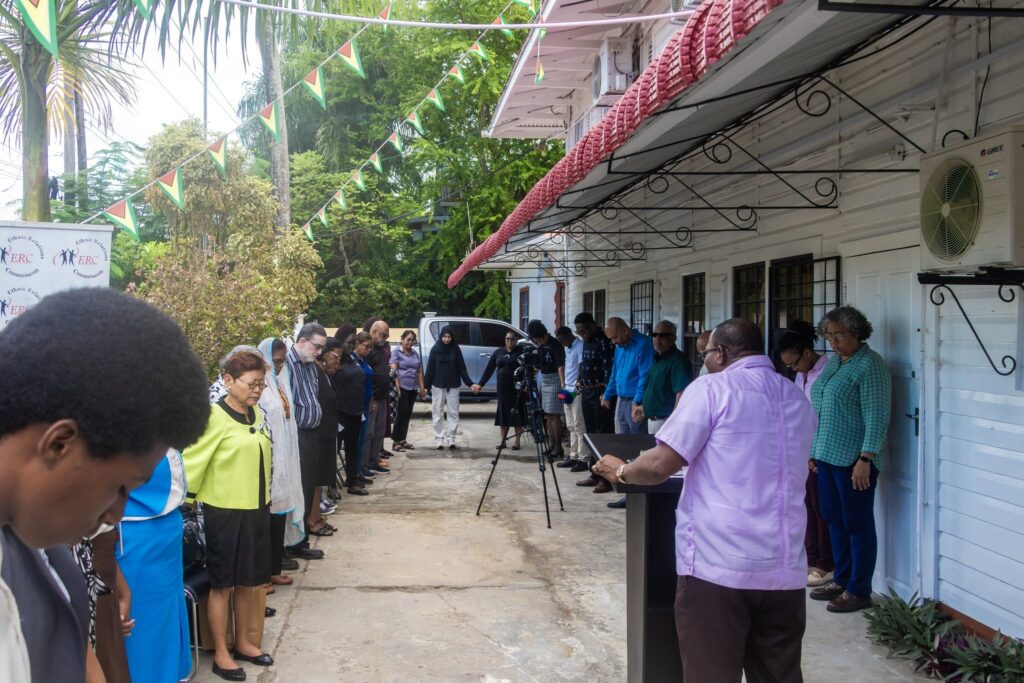
On July 23, 2026, the Commission convened a solemn National Service of Prayer and Reflection in memory of the victims, bringing together Commissioners, representatives of other constitutional commissions and the staff of the ERC Secretariat. The Commission again extends its deepest condolences to all families and communities affected by this national tragedy.
The Commission maintained a public outreach and awareness booth at the National Toshaos Council (NTC) Conference 2026, held from July 20 to 24 at the Arthur Chung Conference Centre under the theme “Empowering Leadership while Building Sustainable Village Economies through Inclusive Partnership.” The engagement afforded the Commission direct contact with Toshaos, village councillors and community members from Indigenous villages across Guyana.
On July 10, 2026, the Commission publicly denounced racially stereotypical and derogatory commentary circulating online. In keeping with its mandate under Article 212D of the Constitution to promote harmony and good relations and to discourage ethnic ill-will and hostility, the Commission reminds all citizens that the digital space is not exempt from the standards of respect and decency that govern public discourse, and that words which demean persons on the basis of their ethnicity cause real harm to individuals, families and communities.
Media Monitoring
During the review period of June 20 to July 28, 2026, the Commission’s Media Monitoring Unit recorded a marginal increase in the number of warnings issued to social media users for instances of ethnic hate speech, with 37 warnings issued compared with 34 during the corresponding period in 2025. All of the infractions identified during the period occurred on Facebook.
The warnings reflected a range of forms of ethnic and racial intolerance. Of the 37 cases, 10 involved racially derogatory statements, primarily directed at Indian and African Guyanese. A further eight cases involved racially stereotypical content, while another eight related to the use of standalone racial slurs. The Unit also recorded five instances of racially prejudiced or insensitive remarks and two instances of racially hateful remarks. In addition, two cases involved religiously intolerant statements, while one case each involved racially divisive content and xenophobic remarks directed at persons of Spanish origin.
Separately, the Unit identified a matter involving disparaging remarks concerning religion on TikTok, which was referred to the Commission’s Investigative Unit for further attention.
Complaints and Investigations
The Investigative Unit’s consolidated statistical register reflects a total caseload of eighty-six (86) matters spanning the period 2022 to 2026. This comprises three (3) matters brought forward from 2022–2023, fourteen (14) matters brought forward from 2024, forty-nine (49) matters received during 2025, and twenty (20) matters recorded for 2026 to date, of which three (3) were received during the reporting period.
In status terms, the consolidated docket demonstrates substantial progress in case finalization while maintaining an active investigative portfolio. Fifty-one (51) matters, representing approximately 59.3% of the total caseload, have been closed by the Commission. A further thirteen (13) matters (15.1%) remain under active investigation, while six (6) matters (7.0%) are pending legal advice and six (6) matters (7.0%) have been completed. Smaller proportions comprise four (4) matters in which the complaint was withdrawn (4.7%), three (3) matters (3.5%) pending Sub-Committee review, two (2) matters (2.3%) at the conciliation stage, and one (1) matter (1.2%) recorded as pending.
The Commission remains committed to its constitutional mandate of promoting harmony and good relations among all ethnic groups in Guyana, and thanks the citizens, communities, agencies and stakeholders who continue to partner with it in this work.