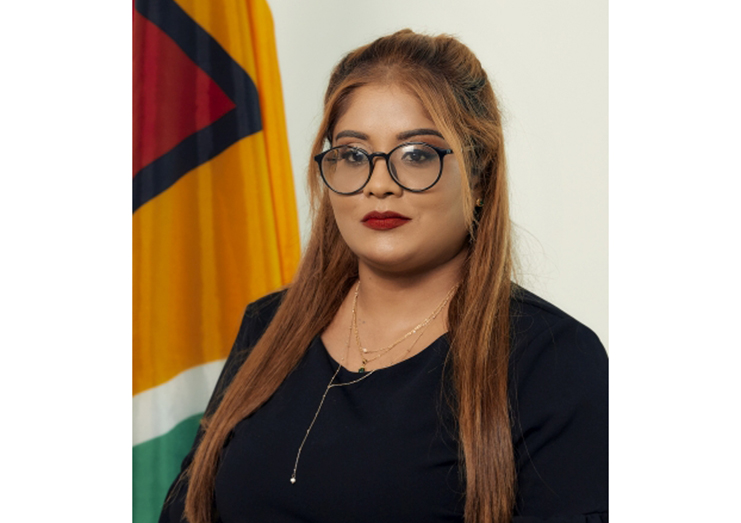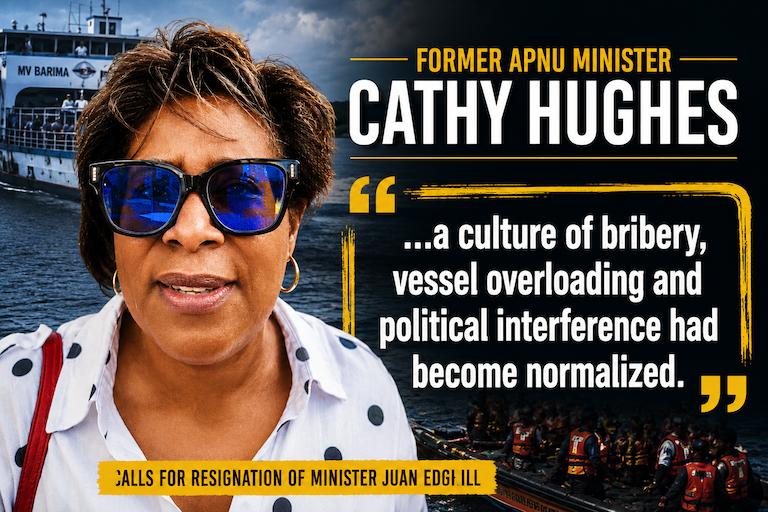
Former Minister of Public Telecommunications Cathy Hughes has joined growing calls for the resignation of Public Works Minister Juan Edghill, arguing that the sinking of the MV Barima exposed deep-rooted failures in Guyana’s maritime transportation system that can no longer be ignored.
Speaking from the protest line on Tuesday, Hughes said the tragedy was not simply the result of human error but reflected a culture of poor oversight, weak enforcement and unsafe operational practices that had been allowed to persist for years.
“Edghill needs to go because he is the head of this ministry,” Hughes declared, contending that the minister had ample opportunity to reform the system but failed to do so. She argued that those in charge have a responsibility to change practices that continue to endanger lives.
Hughes alleged that a culture had developed in which bribery, vessel overloading and political interference had become normalized. She claimed that business operators were able to secure last-minute cargo space through ministerial intervention while safety regulations were routinely disregarded.
The former minister also questioned the state of the vessel’s safety equipment, referring to reports that some life jackets may have been expired. She argued that beyond the number of life jackets carried, authorities should have required every passenger to wear one before departure.
“If a system forced everybody that when they walked onto the boat, they were handed a life jacket, and we ensured that they put it on, maybe we would have had more bodies floating in the water that could have been rescued,” Hughes said.
She further criticized the emergency response, questioning why helicopters equipped for search and rescue operations reportedly took hours to reach the disaster area despite being stationed nearby. According to Hughes, a faster aerial response using powerful searchlights could have improved rescue efforts during the critical early hours following the sinking.
Hughes also painted a troubling picture of conditions aboard the vessel, saying that many passengers, including children, were forced to lie on the floor among cargo. She argued that the manner in which cargo was loaded created additional hazards once the vessel began taking on water.
“The poorest of the poor in this country have to have their children lie on the floor of a boat, and then when it’s turning over, boxes are falling on top of them because we don’t even package the cargo in a place where people could be safe in the event of an emergency,” she said.
Throughout her remarks, Hughes maintained that the disaster highlighted the need for sweeping reforms rather than limited disciplinary action against individual workers. She said Guyana could no longer accept unsafe practices as normal and called for leadership capable of transforming the country’s maritime safety culture.
She ended with an appeal to President Irfaan Ali to address the nation directly and explain how his administration intends to restore public confidence and ensure that a tragedy of this magnitude is never repeated.