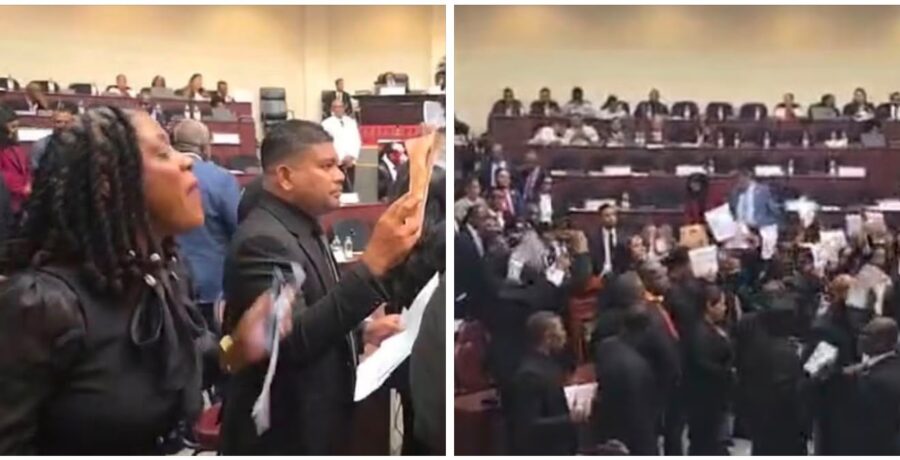
Parliament opened Monday under a cloud of grief, anger and open defiance as the Joint Opposition staged a dramatic protest inside and outside the National Assembly, declaring there could be ‘no business as usual’ while dozens of families continue to mourn the victims of the MV Barima disaster and demand accountability.
In one of the most forceful parliamentary protests in recent years, Opposition Members of Parliament (MPs) abandoned convention and transformed the opening of the sitting at the Arthur Chung Conference Centre into a public demonstration against the Government’s handling of the July 18 maritime catastrophe.
Dressed entirely in black—a colour of mourning in Guyana—the parliamentarians gathered outside the Centre carrying placards demanding the resignation of Public Works Minister Juan Edghill and Minister within the Ministry of Public Works Deodat Indar.
The protest did not end at the entrance.
The MPs marched into the chamber chanting in unison, carrying their placards into the hallowed House and effectively disrupting the opening of the sitting as they demanded answers, accountability and justice for the victims.
At the centre of the protest stood Opposition Leader Azruddin Mohamed, and other parliamentarians, who wore a placard around their necks bearing the photographs of several of those who perished aboard the 87-year-old state-owned ferry.
The haunting images served as a stark reminder that behind the official casualty figures are mothers, fathers, children and entire families whose lives were wiped out in a tragedy many Guyanese believe was entirely preventable.
The coordinated demonstration sent a clear political message: the opposition has no intention of allowing Parliament to proceed as though the country’s worst maritime disaster in decades was simply another item on the national agenda.
The protest comes as public outrage continues to intensify over the sinking of the MV Barima.
As of July 26, authorities reported that 73 bodies had been recovered, 76 people rescued and 30 people remained missing. Investigators now estimate that approximately 179 passengers and crew were aboard the vessel when it capsized—far exceeding the original official manifest, which listed only 116 passengers and 16 to 17 crew members. Authorities later determined that dozens of unlisted passengers had also boarded the ferry.
The growing disparity between the official manifest and the estimated number of people on board has fueled serious questions about passenger controls, regulatory oversight and whether safety protocols were ignored.
Those questions have been compounded by allegations from survivors and relatives that the ferry had been operating with mechanical problems and that repeated warnings about its condition had gone unheeded.
Families have also publicly condemned the Government’s handling of the aftermath, describing the process of identifying loved ones at the Charity and Suddie mortuaries as traumatic and undignified. Others have complained of inadequate counselling, poor communication and compensation they say falls far short of the magnitude of their loss.
Calls for ministerial accountability have steadily grown louder in recent days.
Opposition parties, trade unions, civil society organisations and relatives of victims have all questioned whether senior officials responsible for Guyana’s transport system can remain in office while a Commission of Inquiry investigates what has become one of the country’s darkest national tragedies.
Monday’s protest sent a blunt message to both the Government and the nation: the deaths of dozens of Guyanese cannot be buried beneath parliamentary procedure, official statements or promises of an inquiry.
Until those responsible are held accountable, they signaled, there will be no return to business as usual.
This is a developing story.