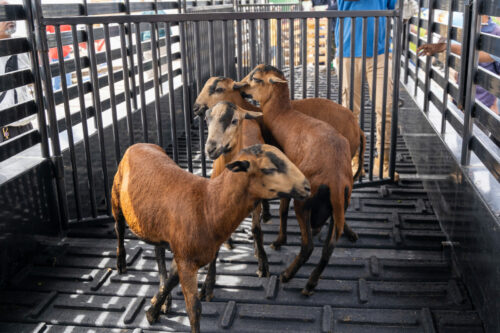
Barbados is rethinking its Black Belly sheep development strategy after the island’s national flock failed to grow, even as Guyana has expanded its own flock fivefold using breeding stock imported from the Caribbean neighbour.
Speaking with Barbados TODAY, Barbados’ Minister of Agriculture and Food and Nutritional Security, Dr. Shantal Munro-Knight, said the government is developing a new plan to revive the country’s indigenous Black Belly sheep industry after recent figures showed the national flock has remained largely unchanged.
“The ministry is developing a plan going forward in terms of how we scale for the Black Belly sheep in a more sustainable way,” Munro-Knight told Barbados TODAY.
“So, looking not only in terms of building out here in Barbados, but also things like feed, but also a plan for what is the value added that can be derived.“
Her comments come as Guyana continues to tout the success of its own Black Belly sheep programme, which began in 2022 after importing 1,003 purebred Barbados Black Belly sheep under the St. Barnabas Accord, a bilateral cooperation agreement between the two countries.
According to Guyana Livestock Development Authority (GLDA) Chief Executive Officer Dr. Dwight Walrond, the programme has grown from an initial flock of approximately 1,000 sheep to more than 5,000 animals, providing fresh genetics for local farmers and creating new income opportunities.
“It has allowed farmers to have access to fresh genetics, and for any production system to be successful, you need quality genetics supported by a robust production and animal health programme,” Dr. Walrond said.
The GLDA said more than 450 sheep farmers have benefited from the programme, with many now raising third-generation animals. The authority has also begun introducing Dorper sheep to crossbreed with the Barbados Black Belly in an effort to improve meat yields while retaining the breed’s hardiness, disease resistance and reproductive traits.
In contrast, Barbados is now examining why its own programme has stagnated.
“Based on the numbers shown to me, it’s stayed the same,” Munro-Knight told Barbados TODAY.
“Which itself is something that we’re looking at, right? Because if the intent was actually to grow, we have to be able to look at what are some of the kind of factors, but it’s remained fairly stable, to be honest.”
The minister said the review will focus on breeding practices, feed availability, production systems and opportunities to derive greater value from the iconic breed.
She also revealed that Barbadian officials have visited Guyana to study the country’s programme.
“When we went down to Guyana and we actually saw the Black Belly sheep there… we know that in Guyana… their programme is based on a little bit of [cross-breeding]… with other sheep in Guyana.”
She noted, however, that Guyana continues to maintain pure Barbados Black Belly sheep.
“So, of course, we have to look and see if that model kind of works, but they are still pure Black Belly sheep from Barbados in Guyana.”
Munro-Knight stressed that no decisions would be made until the ministry completes its review.
“I prefer always to be informed by the research and by the analysis before I come to the public to be able to give definitives,” she said.
The Barbados Black Belly, regarded as one of the island’s most prized indigenous livestock breeds, evolved from African hair sheep and European breeds introduced during the 17th century. Over the past century, Barbados has exported the breed to countries around the world because of its adaptability, disease resistance and meat quality.